
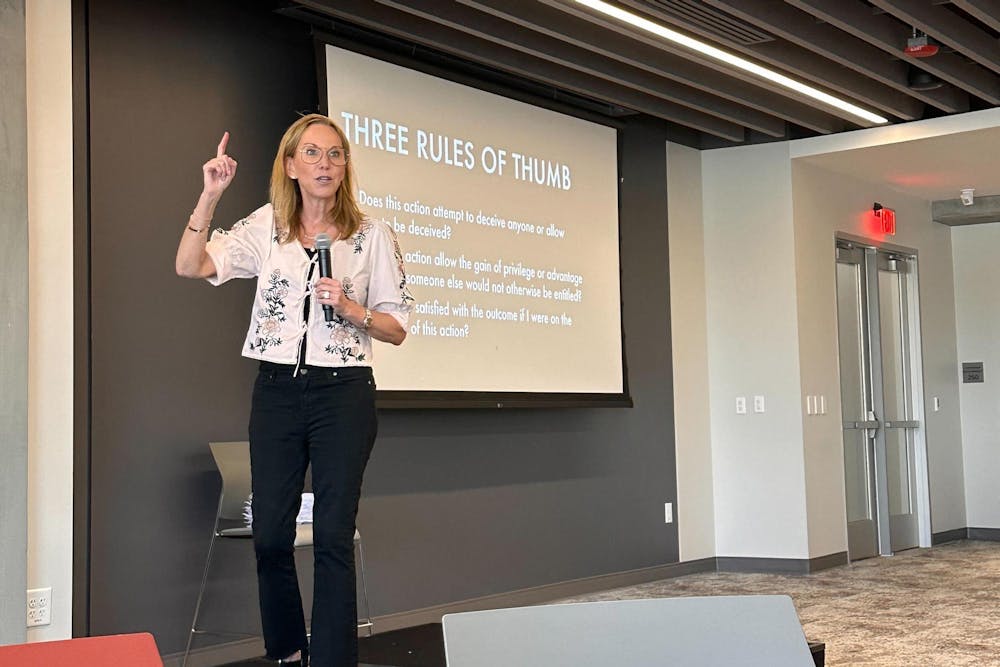
USC hosted a hazing prevention summit to address, prevent and educate students on hazing culture. Students, university officials, and fraternity and sorority life leaders gathered at Gateway 737 on Sunday for the summit.
The summit featured keynote speaker and educator Lori Hart, who holds a doctorate in educational policy studies and specializes in community building and organizational growth. She facilitated the curriculum of the event and other activities throughout the day, such as breakout group discussions and presentations from university officials.
The event was largely collaborative and encouraged participation and cooperation among the many Greek student organizations present, particularly during Hart’s presentations.
Hazing culture
Hart’s presentation targeted leaders of Greek organizations and utilized student participation to discuss tactics leaders could use to sway their organizations toward better, healthier behavior.

Focusing on the importance of community, she urged students to be inclusive with one another.
“The only time I’ve ever seen hazing actually fixed is when people connect from the heart and start caring differently and start believing people matter,” Hart said.
When discussing the patterns within organizations where hazing occurs, Hart expanded on the idea of power and compliance. She discussed how the quiet majority of students within an organization tend to drift to those with the most power and influence. Without strong leaders who hold others accountable and tell the truth, the chapter must be held accountable down the line, she said.
“If (student leaders) would actually start listening and partnering together and being truthful to each other, all this could stay out of conduct,” she said.
Hart also stressed the importance of a high level of self-esteem when entering college and big student organizations. She said students will find what they’re looking for when setting expectations and standards for their experiences.
“You have to know your soul,” she said. “If your line is, 'I’m going to join an organization where I’ll be treated with dignity and respect,' you naturally just go out and find that.”
Taking proactive measures
According to Bill Weisenhorn, the associate director of Chapter Services, the university has been organizing this event for over a year. It is a part of USC’s focus on shifting toward preventative measures regarding hazing incidents, as opposed to reactive ones.
“The real goal was to take the opportunity to use our resources as the flagship state institution to offer a resource to our community on preventative work on hazing and culture change,” Weisenhorn said.
Weisenhorn said he hopes that by planning ahead of time, the university will see less incidents down the line. He said it is a matter of “taking things that could go off the rails and shift them to be things that are productive, are healthy and are forging stronger relationships in a positive mindset.”
As Weisenhorn works toward a healthier campus culture, he hopes students walk away feeling more empowered to make a change.
“(Students) have all the tools capable in their wheelhouse already,” Weisenhorn said.
Recent hazing reports
The summit also included education of the Tucker Hipps Transparency Act, named after a 19-year-old Clemson student who is believed to have passed away during his pledging process in September 2014.
The law states that the university must publish reports of actual findings of violations of the school’s Student Organizational Conduct, specifically involving alcohol, drugs, sexual assault, physical assault and hazing.
The summit comes shortly after an influx of hazing incidents being reported in recent years. In the 2025-26 academic year, there have been two official reports of hazing among fraternities on campus.
Delta Kappa Epsilon was charged with hazing, failure to comply, misrepresenting the truth and undue influence in November, according to the Student Organizational Conduct page of USC’s website. The report specified that an incident of hazing was reported to university staff, and the organization had failed to cooperate fully with the investigation. It was sanctioned conduct probation until Feb. 4, 2027, and educational outcomes.
A similar report was made regarding Sigma Chi in October. It was charged with hazing, and the investigation by the university found instances of inappropriate activities in the new member process. Similarly, it was sanctioned conduct probation until May 11 and educational outcomes.
According to the university's Code of Conduct Outcomes, educational outcomes could mean alcohol education modules, essays and reflections, conflict styles assessments, therapy assisted modules, or the Students Taking Initiative & Responsibility in-person program. The report does not specify which ones the fraternities were required to partake in.
The same website also notes that the fraternity Theta Delta Chi is currently suspended until the fall following a hazing report in September of 2022.
The only other suspended organization is the Gamecock Pageant Club, which is suspended until Spring 2027 after the university found the organization had been mishandling its finances.
As the university continues addressing hazing through education and accountability, Weisenhorn is optimistic about USC’s progress. He said he and his team have seen positive trends in the last couple of years.
“I’ve been heartened to see the self-reporting and a lower tolerance for hazing behavior in the community,” Weisenhorn said.
As more students engage in preventative education and practice holding their peers accountable, Hart hopes college students can work toward a healthier community environment, especially regarding sorority and fraternity organizations.
“What makes for a good life is good relationships that keep you happier and healthier, period,” Hart said. “I believe that sororities and fraternities are that caveat to foster good relationships.”