
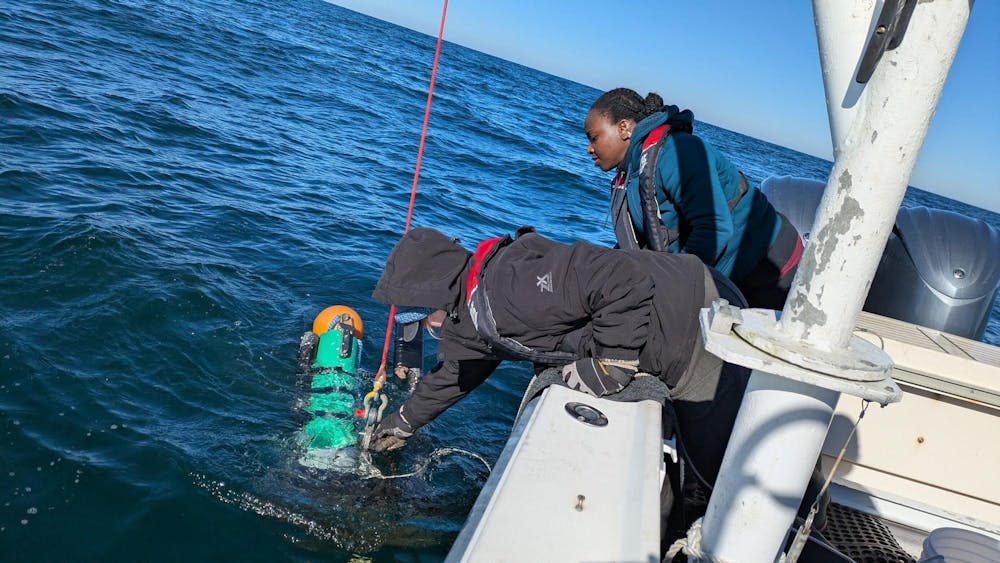
For the last five and a half years, Erin Meyer-Gutbrod has been researching the critically endangered North Atlantic right whales as an assistant professor at the School of the Earth, Ocean and Environment. With only 384 whales left and only 70 active females, the number of newborns is declining. Meyer-Gutbrod started her research to better understand the whales’ birthing trends.
She said these whales have been protected from hunting for over 100 years, but haven't bounced back despite that.
Access to food helps build up blubber to reproduce, and researching helps the team understand the problems the whales may be facing.
"It's not like we're going to take a big boat full of zooplankton and dump them in front of a feeding whale the way you would feed a dog. It's just not possible," Meyer-Gutbrod said. "But by understanding how much food they get and how their food is changing in the ocean, we can better understand why their population is growing or not growing each year."
Lydia Sims, a third-year marine science doctoral student, has been a part of Meyer-Gutbrod's lab for three years. In the lab, Sims is pushed to pursue her own research into the topic of North Atlantic right whales, she said.
Her research is focusing on the conditions that would lead North Atlantic right whales to have continued poor reproduction.
"I do really care about understanding how the ecosystem is working and how we can expect for them to have either a good or a bad year with foraging," Sims said.
She looks at temperature data and physical oceanography to connect it to the amount of prey the whales have for feeding.
Sims also said the research team deploys hydrophones in the water so that they can listen to whale calls because most people in the marina do not believe that the right whales are off the coast of Georgia during the winter.
Amadi Afua Sefah-Twerefour, a fifth-year marine science doctoral student, has been in Meyer-Gutbrod's lab for five years, and her research focuses on human and climate change impacts to the marine environment, she said.
Sefah-Twerefour said she wanted to look at the different human risks so that when management makes use of the resources, they can tailor them to that particular risk for that particular environment.
She also said that taking action for North Atlantic right whales is a collaborative effort.
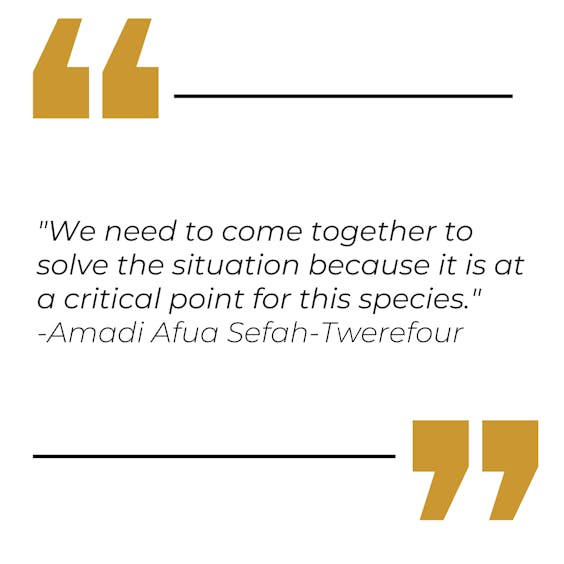
"We need to come together to solve the situation because it is at a critical point for this species," Sefah-Twerefour said. "Compromises have to be made, and everything is not the best scenario, but everybody needs to be there."
Meyer-Gutbrod has also been writing letters of concern to the federal government because the rule that protects whales could be deregulated.
According to the NOAA Fisheries, that rule is the North Atlantic Right Whale Vessel Strike Reduction Rule. This rule is intended to reduce the chance of deaths or serious injuries to North Atlantic right whales from getting hit by boats, according to the Federal Register.
Meyer-Gutbrod has been appointed to a few positions to support the federal government in managing the species and other marine mammal species.
She said there should be other protections so they do not get hit by boats or get tangled up in fishing gear. People can also use safer fishing gear and pull it out of the water in times and places where it's not safe for whales, Meyer-Gutbrod said .
”I think it’s really important — this type of work — in being able to understand where the whales are,” Meyer-Gutbrod said. “If we know where the whales are, then we can put in other protections.”