
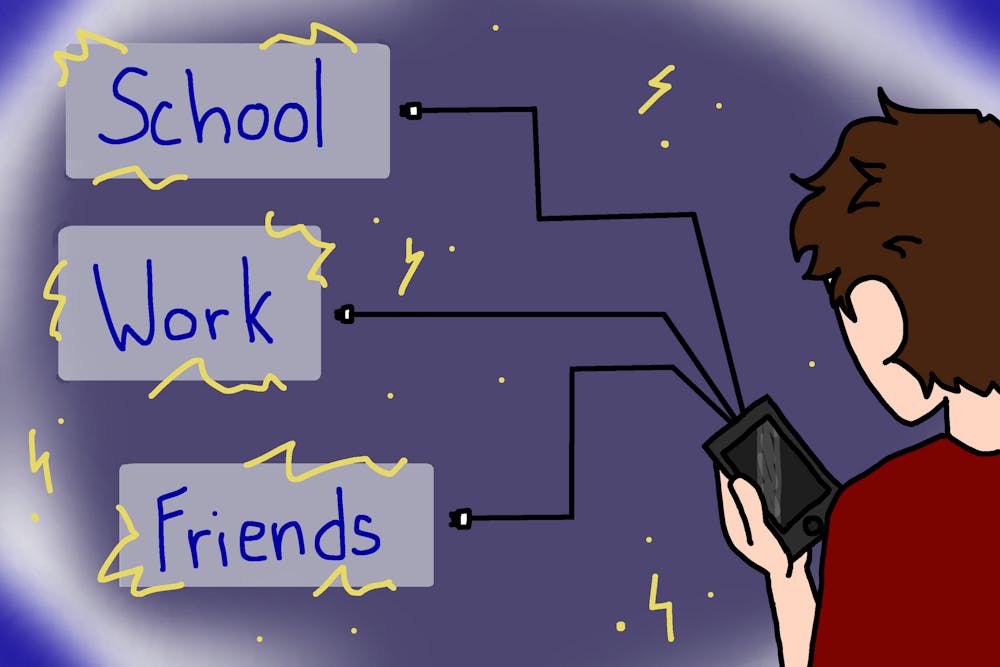
As you look around campus, you’ll see an overwhelming number of students using phones and computers. We all depend on electronics to some degree daily, whether it's to check emails, scroll social media, play games or message friends.
A survey from Mental Health America found that those aged 18-24 reported the largest feelings of reliance on technology (81.34%) and had nearly 75% of people using it for entertainment purposes.
The increasingly digital age is both a convenience and a crutch. Higher screen time is associated with anxiety, depression, low self-esteem, sleep disruption, attention and focus issues, emotional numbing and social isolation.
There is a growing movement of students and health care professionals recognizing a need to unplug by intentionally taking time away from screens. 63% of Gen Z were found to be unplugging, with many health guides promoting digital detox by setting screen time limits, designating device-free periods, and establishing device-free zones.
Licensed psychotherapist Christine Chae recognizes that younger adults' reliance on devices for school, work, and social interaction makes it harder to determine when technology is not a necessity. The pressures to stay connected, perform professionally, and maintain an online presence cause stress.
There is a reason students have become reliant on technology. They feel they have to.
Abby Still, a fourth-year English student, regularly uses TikTok, Instagram, YouTube, Outlook, Teams, and GroupMe on her phone. These apps are key to her connections with clubs, her job, emails, entertainment, news and campus events.
“Instagram is like one of the best ways that people stay connected socially and can keep up with what’s going on within their community," Still said
She deleted Instagram last year for a few months, spending more time on her hobbies and reading, but she felt "so out of the loop."
More students are trying to unplug, such as Austin Charkier, a second-year philosophy and English student. He connects with nature while unplugging through hikes with friends, bike rides, and the riverwalk.
“If it’s an activity that requires strain, whether it's mentally or physically, that can keep you locked in to where you are not constantly thinking about something else. You're too focused on the task at hand to even consider your phone,” Chariker said.
However, he noted the compulsions to use his phone. Chariker downloaded the StayFree app to block Instagram Reels and YouTube Shorts, in order to avoid short-form video content that is "especially bad."
Although he deleted Instagram and X, formerly Twitter, he still finds ways to be online. He uses Substack, which is an open-form platform similar to X, formerly Twitter, that's more essay-focused.
“Every time I get rid of one thing, there’s something else to fill its place,” Chariker said.
Chariker admitted his unplugging attempts can often prove futile.
“The temptation to play games or watch a YouTube video instead of doing homework is always there. It’s very hard to get rid of that, even with the blocks on, it's only a couple swipes away to take the blocks off,” Chariker said.
He said he agrees that device usage harms sleep, productivity and mental health. He particularly recognized that X, formerly Twitter, destroys his mental health.
Despite students on campus largely relying on technology, Chariker is optimistic.
“Everyone wants to get off — at least a little bit,” Chariker said.
Still explained larger trends in students moving to “dumb phones,” or flip phones. This helps decrease addiction to screens by adding barriers and making even texts and phone calls more difficult. Though the demands on students make this extreme unplugging unrealistic.
“I feel like it's so essential now to have a phone and stay up to date — especially in college,” Still said.
One of the ways that Still is trying to unplug is by having a rule that once her lamp is off before bed, her phone is off too. She desires to have more hobbies to avoid screens more.
After transferring from Midlands Technical College, the USC community has influenced Still's decreased device usage.
"I don’t spend nearly as much time on the phone because I have people to spend time with who I care about, and I have other things going on that take up my time,” Still said.
Phones are indeed one of the best ways to stay connected and have become required for daily life. A complete digital detox from Outlook, Blackboard and phone messaging services would make it almost impossible to meet academic and social needs.
Some students have additional responsibilities such as posting to a club Instagram, checking Slack or GroupMe for club and residence hall updates and using LinkedIn for job searches or networking.
Despite obligations necessitating technology, students should resist allowing technology’s addictive effects to become all-encompassing. Students should unplug when feasible to avoid the aids of technology becoming a detriment to their health and well-being.
Begin by setting time limits or deleting the apps that are unnecessary to your functioning. Not every student can feasibly unplug in the same ways and to the same degree, but everyone can take steps to unplug and improve their livelihood.
Students can fill the hole from lost online activity with new outlets. Whether that be enjoying time in nature as the weather warms up, staying inside to read a book, or spending time with friends.
The loneliness and detachment screen time fosters can be solved by exploring the opportunities the campus has to offer. Between clubs, local events, campus socials, and classes, students should find time to connect with the area and people around them. Technology is useful and important. But so is your personal development.
If you are interested in commenting on this article, please send a guest column to sagckopinion@mailbox.sc.edu.