
Correction note: A previous version of this article misconstrued computer science professor Biplav Srivastava's stance regarding funding for research. The phrasing has been changed to reflect his meaning.
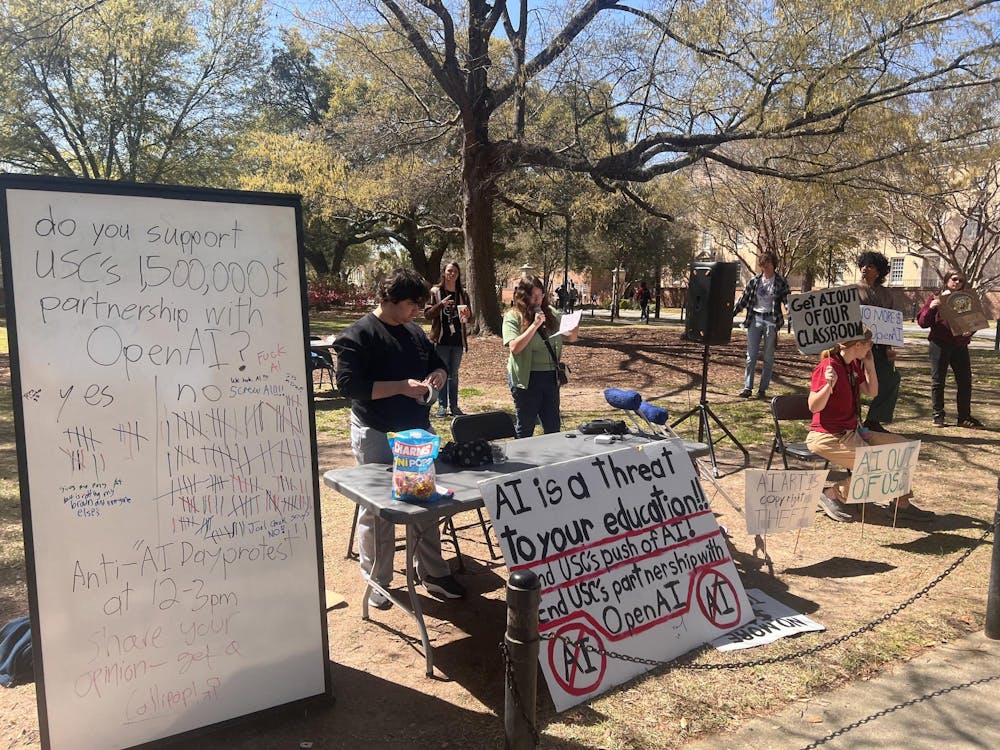
A whiteboard with the question “Do you support USC’s $1.5 MILLION partnership with OpenAI?” stood beside students on Davis Field as they protested USC’s AI Day March 19.
Student protest organizer and third-year statistics and economics student Brooklyn Tyner decided to organize the event after seeing the email announcement for AI Day. To gain student support, Tyner made flyers and asked students for their opinions on AI. She encouraged those who shared similar concerns to join the protest.
Tyner’s flyers called for USC to promote AI less, end its partnership with OpenAI, raise awareness about how AI is affecting education and ask legislators for more regulation of AI and data centers.
Even though the flyer called for action from federal and state legislators, Tyner wanted the focus to be on the impact that AI is having on USC.
“I’ve had TA's (and) professors come up to me and say, ‘I have my concerns of how it’s affecting my class, how it’s affecting how I work, how our students learn, how other people are using it,’” Tyner said.
For second-year fashion merchandising student and protester Wolfgang Perrett, Tyner’s protest provided a sense of reassurance.
“When I saw the flyer, that's when I was really just happy, just relieved kind of that there was a push back,” Perrett said.
Third-year studio art student Danielle Mejias was also a protester during AI Day. The effect she has seen AI have on human art led her to join the movement. Similar sentiments were shared by protester and first-year media arts student Bas Roquemore, who is also concerned about the loss of human touch in art.
Roquemore is also concerned about job security, especially since he is hoping to pursue a career in the arts, he said.
“I’ve been told by professionals and the adults in my life that I need to figure something else out because AI is going to take my job,” Roquemore said.
However, Roquemore remains somewhat hopeful for the future of the job market. He says educating people on AI while also supporting human work is the answer.
Going forward, Roquemore hopes the university can show more student work on the TVs across campus. Similar sentiments were shared by Perrett, who believes that USC needs to increase support for its student arts programs going forward by focusing on an "equal appreciation of the arts and of the artists."
To look further into how the general student population feels about AI, The Daily Gamecock interviewed 40 students to ask them for their opinions.
Out of the 40 people interviewed, six students expressed a positive view of AI, while 25 students said it depended on how the technology was used.
Several students said they use AI as a way to clarify course material or as a tool to create study guides or practice questions. However, many voiced their concerns about other students using AI as a way to cheat on assignments, a worry shared by Perrett.
“I’ve seen people open up an assignment as soon as they receive it, copy and paste it into ChatGPT and immediately turn in what pops out," Perrett said. "It is giving students a tool that they will, with no second thought, use to cheat."
Second-year environmental science student Chase Orvin said he's concerned about how professors choose to incorporate AI into their lectures. Orvin described his experience being in a class where a professor would ask students to consult with an AI to see what it said about course material.
"I'm not paying a college tuition to hear what AI thinks," Orvin said.
Computer science professor Biplav Srivastava said he actively encourages his students to use AI to find errors in written code and programming. Srivastava explained they would otherwise not be able to detect these errors since they do not have as much experience.
“The generative AI is acting as a coach in nudging them towards more advanced features of the languages,” Srivastava said.
Srivastava is also involved in research at USC that uses AI. However, with this research comes a need for funding, which Srivastava would like to see more of from the university. He said USC needs to invest more in what is to come instead of following the trends of the present.
“I don't think we have that mindset of being at the frontier because being at the frontier means that you need to accept risk and take challenges, and you need to reward risk," Srivastava said. "I think we are a very safe thinking university."
When asked if he would like to see an increase in funding for more research at the university, Srivastava said that he would be in support of that initiative. He said this is what sets universities apart from each other.
USC is currently investing in the future of research on campus, according to an email from Collyn Taylor, director of news and communications.
"The university is also putting a lot of money and resources into improving our research infrastructure with renovations going on now to the Jones Physical Science Center and a biobehavioral research suite in the Williams-Brice building," Taylor said in a written statement.
Editor's note: Georgia Fowler contributed to the reporting in this article.