
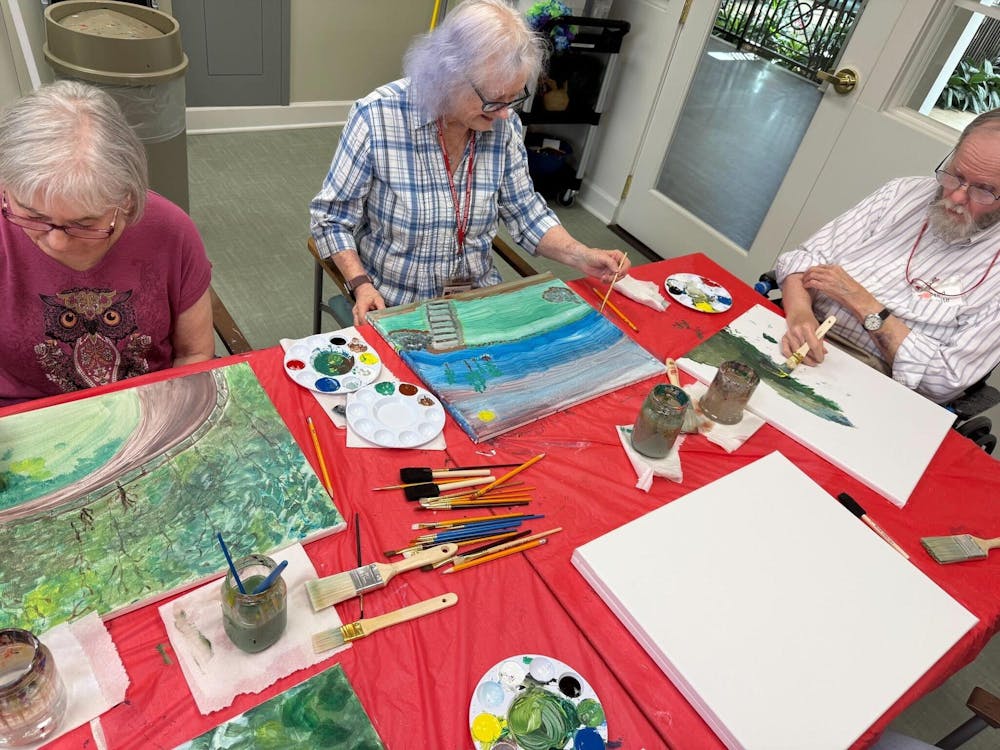
Art has always been a huge part of third-year neuroscience student Ansley Martin's identity. Inspired by her grandmother, a talented painter who had developed a tremor in her hand due to Alzheimer's medication, Martin came to a realization. The very thing her grandmother was afraid to do could be what helped her, thus beginning the research to the science behind it.
In November 2024, Martin and fourth-year art education student Stella Tew proposed Vibrant Minds — a student-led, peer-reviewed, research-backed art therapy program — to USC's Brain Health Center. Its goal was to create a program that hosts classes that teach therapeutic art techniques based on current science shown to help with improving motor skills.
“I think, in the science world, there has been a shift," Martin said. "People used to turn their nose up at the arts … The arts just aren’t as valued anymore in our society, but I think in the past five years, there’s been a shift in understanding the really important intersection between arts and science.”
Martin said art can improve both a patients quality of life and the careers of scientist and medical professionals.
“I think with research where people are actually looking at the impact of art, even on a technical scientific level, has really validated this type of approach to the value of integrating this into care,” Martin said.
USC Brain Health program manager Alyssa Paley said one of the center's goals is to prevent cognitive decline and supporting different beneficial lifestyle practices involved in brain health. The center had been discussing different ways to further explore that goal, but it wasn't entirely sure how to approach it.
When Martin and Tew presented their idea, the center saw this as an opportunity to achieve that goal.
"These two came to us, and they had everything so organized and laid out. They knew exactly what they wanted to do, and we were like, 'Okay, this is the chance. We need to fund it,'" Paley said.
In March 2025, the Vibrant Minds program hosted its first art program.
While the participants where hesitant at first, they slowly began warming up to the classes overtime. Now, the participants are eager to pick up a paint brush and engage with the visiting students.
Tew is incredibly grateful for the chance to be the teacher within the art program.
“If you have the opportunity, if something comes along where you think that you can make a program like this into reality, you should definitely go for it because we need as many people serving each other as we can," Tew said.
The program is frequently at Westminster Memory Care and Still Hopes Episcopal Retirement Community. Paley said she's had experience with individuals with Alzheimer's.
"In Westminster, it’s a little different because every time we go, the participants don’t remember we were there last month," she said. "But, we've still noticed positive improvement in their participation."
Paley said there is even a husband-and-wife duo that has been recently touched with this program. The wife in the facility expressed how doing art had been helping with her husbands PTSD.
The program has eight students involved, but as it expands, it hopes more students will become involved Paley said. The program's next step is the creation of art kits with structured lessons that it can distribute to various brain health facilities in South Carolina to allow its impact to slowly trickle down.
For Martin, the impact of this program means connecting with those participating.
"The depth of your impact is just as important, if not more, as how many people you reach," she said.
Tew, Martin and Paley all emphasized how much impact the program has had, not only on the participants but also themselves.
“That’s why we’re here," Tew said. "I think the barest human nature is to help each other, so, if you want to help somebody, make it happen.”