
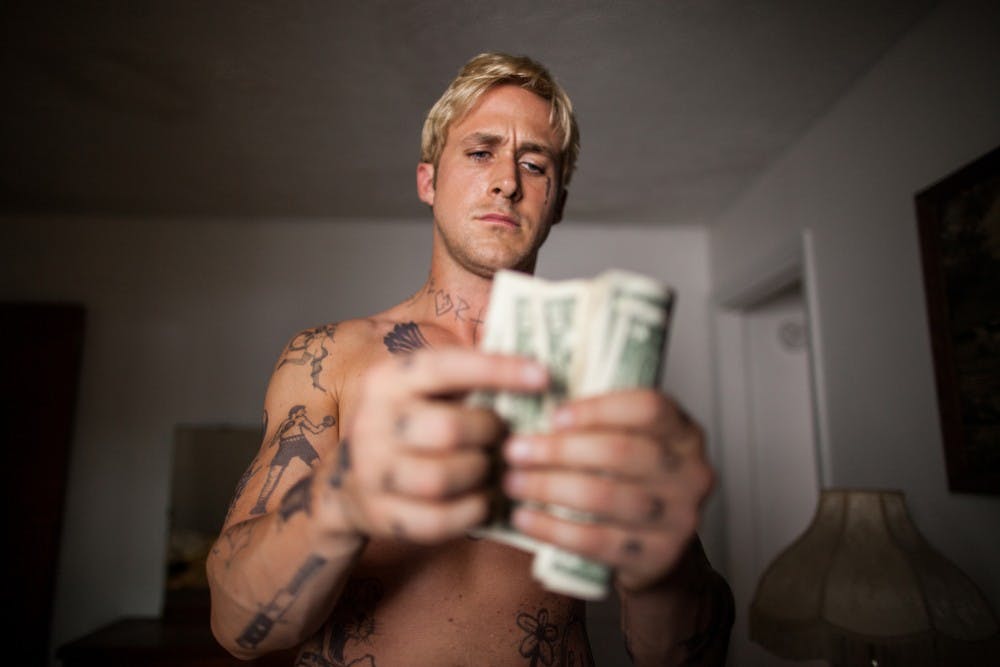
“The Place Beyond the Pines” contains some of the best scenes and performances so far this year, especially in the first hour. The second half goes off track somewhat, but, overall, the film is rich and extremely well directed.
That first hour or so follows Luke (Ryan Gosling, who starred in the director’s previous film, “Blue Valentine”), a stunt motorcycle rider who is part of a traveling carnival. There is a masterfully choreographed long shot that follows him walking from his trailer through the fairground and into a tent with a large steel circular cage, in which he joins two other riders and whirls around at fast speeds.
It is thrilling to watch a spontaneous shot that must have taken great planning to accomplish. This single shot exemplifies the film’s greatest strength. The director, Derek Cianfrance, captures life with a gritty, documentary aesthetic so effortlessly. He takes great care in crafting scenes and images that don’t seem preplanned. The film displays a real energy, even in scenes of everyday life.
After his death-defying performance, he notices Romina (Eva Mendes), an attractive woman that he obviously has seen before at the carnival. He finds out that he is the father of her baby. Even though Luke is a damaged loner, he sincerely wants to raise the child. Conflict arises because Romina is dating another man (Mahershala Ali), and he is raising the child as if it is his own.
Since Luke wants to stay near his child, he quits his job. He starts working for Robin (Ben Mendelsohn), a lowlife mechanic who offers him work for measly cash. In order to provide for his child, Luke starts robbing local banks, riding away on his motorcycle with the help of Robin. The realism of the robbery scenes adds to the excitement. When Luke hopped on his motorcycle and zoomed out onto the road with his engine roaring, swerving between cars, my heart raced.
As in “Drive,” Ryan Gosling exudes suppressed intensity and violence without talking or displaying facial expressions. His blank face, his eyes and his body movements build his character. He is a muscular hunk of a man with a real physical presence, but at the same time, he is a broken person with little meaning to his life. He can fly across the town after a heist on his motorcycle or zip around in an enclosed cage, but he is unsure about where he wants to go in life. Gosling captures all of these emotions with so little effort. He is a great actor because he doesn’t seem to be acting.
The second, more flawed, half of the film flashes forward in time and follows Avery Cross (Bradley Cooper), a cop who — well, it would be a major spoiler to say anymore. This section of the film also shows what happens to Luke and Romina’s son, Jason (Dane DeHaan), who is now a teenager.
The major flaw with the second half of the film is the clash between the film’s style and story. As previously noted, the director does an impeccable job capturing the lives of these characters in a way that seems natural and unforced. The problem lies in the plot of the film which stretches credibility at times and strives for Greek tragedy. As in the Best Picture Oscar winner, “Crash” (2005), there are too many instances of characters connecting and lives intersecting to be completely believable. The film strives for grand themes about family, especially father-son relationships and how the actions of past generations affect the present, but it wobbles and doesn’t hold up entirely. The documentary feel of the film does not mesh with the lofty, and even preachy, story.
The strongest aspect of the second half of the film is Cooper’s performance. Along with his Oscar-nominated performance in last year’s “Silver Linings Playbook,” this film proves he is an actor of worth.
Even with its problems, the film is unquestionably worth seeing. Cianfrance is a director to watch.