
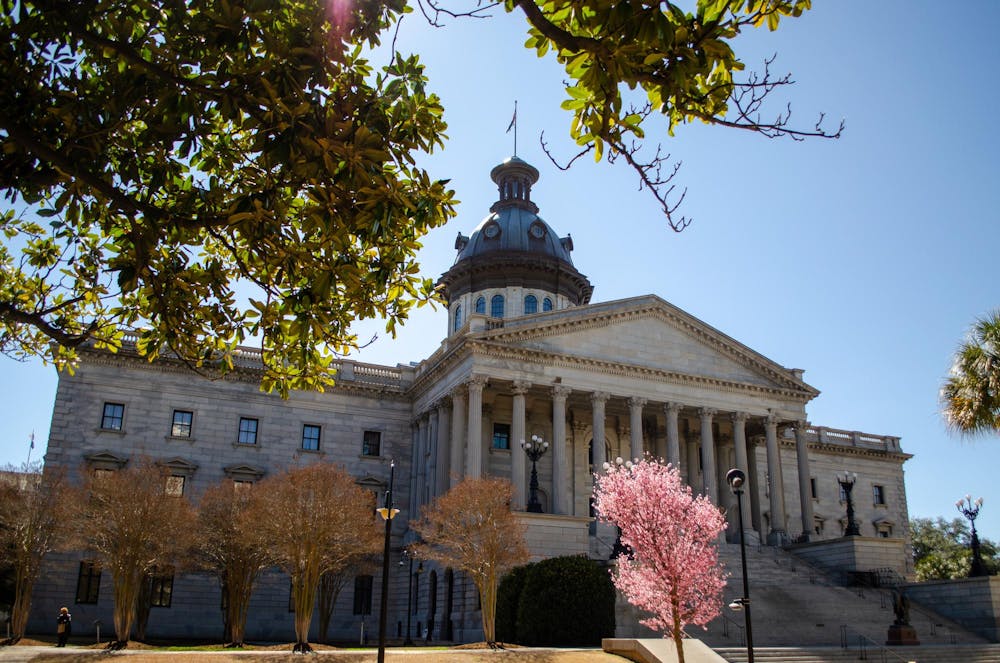
South Carolina Rep. Jim Clyburn, 85, is expected to run for reelection this year in what would be his 18th term. The Daily Gamecock asked 40 USC students their thoughts on older politicians in regard to representation, effectiveness, and limits on age and term.
The current U.S. Congress is the third oldest in American history, with an average age of 58.9 years old.
When asked if they felt represented by older politicians, 27 of the 40 students said no. Eight students said their answer depends on other factors, four said yes and one was unsure.
The students who said they felt unrepresented cited the generational gap, outdated values and the politicians’ motivations as reasons.
“I feel like they don’t know what the younger generation wants,” first-year psychology student Aiyanna Spears said. “They think that since we’re younger, our opinions don’t matter.”
The life experience of a senior politician and a young college student are vastly different due to our changing world, second-year nursing student Fiona Novak said. She said the disparity has resulted in different ideals and values.
First-year public health student Emily Keffer said some older politicians are not attuned to issues like the cost of living in the U.S. Career politicians care more about the money they earn than advocating for their constituents, she said.
"It is not about representing the people anymore," Keffer said.
The students who do feel represented said politicians focus on matters that affect them and that they haven’t noticed negative effects.
“My life hasn’t gotten any worse for the policies and politicians I voted for,” fourth-year finance student Kyle Perry said. “So maybe I’ve gotten lucky in that sense, but I also feel I’ve been represented.”
Second-year biochemistry and molecular biology student Jaylen Johnson said if he was asked if he felt represented a few years ago, he would have answered no. But now, Johnson said there are more politicians focusing on the issues that affect him.
Eight students said their answer depends on other factors like who the politician is, their cognitive health and their openness to listening to young people.
“I don’t believe age has to do with anything, as long as the person is confident and can speak fluently and knows what they’re doing in their job,” third-year criminology and criminal justice student Christopher Diesso said.
Second-year biomedical engineering student Jacob Webster said some older politicians apply their life experience to modern issues.
Effectiveness
Seventeen students said older politicians’ effectiveness is dependent on other factors, and three were unsure. Seven of the 40 students said older politicians were effective, 10 said they are not and three said their answer fell between yes and no.
“Being older, your brain starts to slow down,” first-year marine science student Thomas Frank III said. “I think it really just comes down to the politician, and how are they effective?”
In 2019, the Centers for Disease Control and Prevention published a brief on subjective cognitive decline, which it defined as "the self-reported experience of worsening or more frequent confusion or memory loss."
The CDC found that in adults aged 65 and older, the prevalence of subjective cognitive decline was 11.7% compared to the 10.8% prevalence in adults aged 45-64 years old. The brief reported that half of adults with subjective cognitive decline experience related functional difficulties with everyday activities, like household chores and work outside the home.
The seven students who said older politicians are effective pointed to the politicians' life experience and knowledge of the system.
"I would say they are effective and that they know what they're doing and what they're talking about," second-year nursing student Katelyn Cannon said.
Cannon said they need to work harder to understand the younger generation, though, because the new generation is entering the workforce.
Students who said older politicians are not effective cited declining cognitive ability and a lack of adaptability to modern times.
“They’ve had so long to build loyal supporters who will kind of go with whatever they say,” third-year marketing student Avari Walker said. “But I don’t think they’re effective in furthering society.”
Keffer, whose answer was between yes and no, said older politicians are knowledgeable on how Congress works but fall short on representing their constituents.
“(They have) experience that comes with age,” Keffer said. “And they’ve played golf for 20 years with everyone in Congress, so they know how that gets done."
Term limits
There is no current limit on how many terms members of the U.S. Congress can serve. Members of the House of Representatives and the Senate can serve unlimited two-year and six-year terms, respectively.
NOTUS reported Rep. Clyburn, D-S.C., is expected to run for reelection this year for what would be his 18th term, though he has not yet announced his plans.
Twenty-four of the 40 students said they believed Congress should institute term limits for its members, while 12 said it should not. One student was unsure, one declined to answer and two said term limits should be conditional.
Some students who supported term limits said it enforces fairness and even representation.
“The same way they limit the presidency, it avoids too much power for that particular person,” first-year visual communications student Kai Challenger said.
Third-year public health student Isabella Robbins said she did not support term limits because there could be negative effects.
“It rules out the possibility of someone actually being good and helpful despite their age,” Robbins said.
A second-year international business student, who asked to not be identified by name, suggested term limits should be implemented with an override option. If the politician has a certain approval rating, then the limit should be adjusted, he said.
Third-year sport and entertainment management student Mekhi Gibson suggested term limits should fall within an age range. Representatives should be able to serve as many terms as they can within the range, Gibson said.
Maximum age limits
To serve in the U.S. House of Representatives, candidates must be at least 25 years old, and the Senate requires candidates to be 30 years old. Currently, there is no maximum age to serve in the U.S. Congress.
Thirty of 40 students said they thought Congress should implement a maximum age limit. Eight students said there should be no maximum age, one student said maybe and one declined to answer.
Of the 16 students who proposed an exact number for an age maximum, the average answer was 71.25.
Second-year psychology and sociology student Madeline Raffo, who supports a maximum age limit, said older politicians are not the people most affected by the measures they vote on.
“I personally believe that if you make a decision, or if you create a policy, you should have to live with it and the consequences of it,” she said.
Other students mentioned concerns about cognitive depreciation in older politicians.
Fourth-year neuroscience student Shelby Laine said older people experience a decline in synaptic plasticity, which controls communication between the brain's neurons and affects learning and memory. This means older politicians are less likely to change or be open to differing opinions, she said.
Two students referenced how other industries approach older professionals. Third-year integrated information technology student Jacob Tippett said the aviation industry's required retirement policy for pilots 65 and older contrasts with the lack of a maximum age limit in Congress.
Robbins, who studies public health, said screening revealed older physicians are experiencing cognitive decline and reduced awareness. Several associations of medical professionals have recommended cognitive reevaluations for older physicians, and some U.S. health systems have implemented them.
Robbins said deciding an exact age limit would be difficult and that a cognitive diagnostic should be the gatekeeper for older politicians.
Eleven of the 30 students who supported an age limit provided maximum age ranges, with the most common answer being 75 to 80 years.
Frank said he believes an age maximum should rest around 70 to 75 years.
“We have got to seriously start considering, 'Is this best for the country?,'” Frank said.