
As a doctoral student studying the fragile X full mutation at the University of North Carolina at Chapel Hill, Jane Roberts came across questions she was unable to answer. Families with children that had the fragile X premutation wondered what was going to happen to their children.
At the time, she couldn't answer questions about the premutation, but now as a Carolina Distinguished Professor and the executive director of the Carolina Autism and Neurodevelopment Research Center, Roberts is able to, with help of the new grant.
USC has been ranked No. 1 in fragile X research involving grants, according to Roberts. With that, Roberts and two other professors have been awarded the National Institutes of Health Center of Excellence Grant that will further fragile X research. Over the next five years, over $6 million will be used to show how fragile X affects children and adults.
“We’re going to answer a lot of questions, but we’re also going to uncover a lot more questions,” Roberts said.

According to Roberts, the National Institutes of Health sets aside certain funding for fragile X research, called Fragile X Centers of Excellence. Every five years, a worldwide competition takes place to win the funding for the center, she added.
“It’s very prestigious because everybody competes, and it’s a real accomplishment to be one of the three that are selected,” Roberts said.
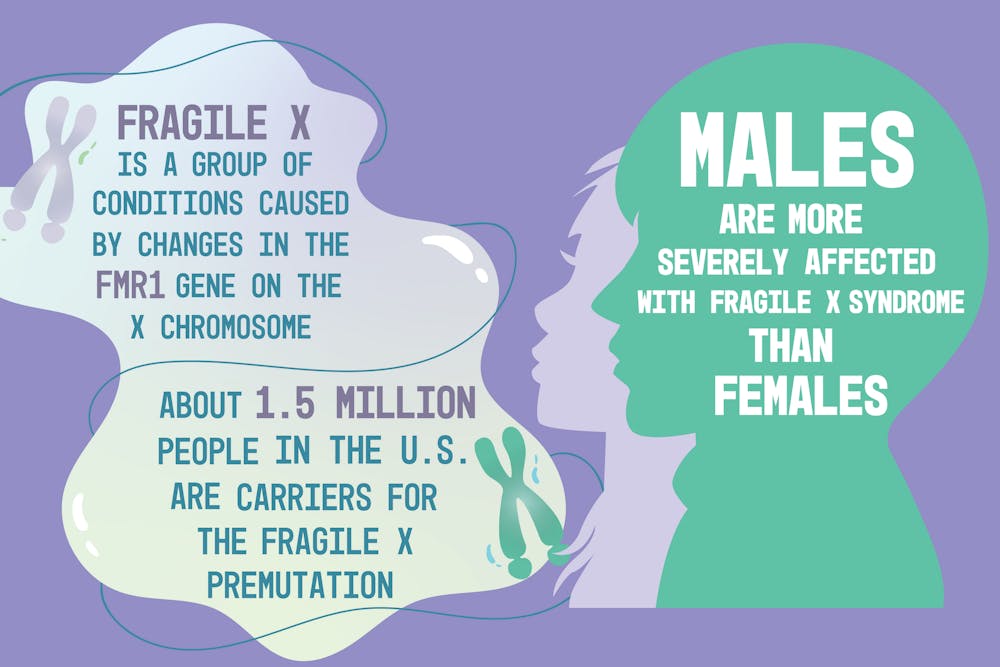
Fragile X is the general term used to cover several related conditions caused by changes in the Fragile X Messenger Ribonucleoprotein 1 gene. This includes both a premutation and a full mutation, which vary in different risks and conditions.
Fragile X disorders are some of the most common yet unknown neurological disorders. They are the most common inherited form of intellectual disabilities and autism. Both males and females are affected, with males normally impacted more severely.
Advancing fragile X research
The two studies awarded for this grant will study the fragile X premutation across a lifespan, something that couldn’t continue without this grant due to lack of funds.
The first project, led by Roberts and assistant professor at the Arnold School of Public Health Abigail Hogan, focuses on social communication and sensory processing in young children who have the premutation.
The second project, led by Associate Professor of Arnold School of Public Health Jessica Klusek, focuses on adult women with the premutation, which includes mental health and movement.
The grant will be split to about $1.2 million a year over the next five years. It will be used to ask deeper, more extensive questions, Roberts said.
“It really puts USC on the map in some ways as being a really strong fragile X-focused institution,” Roberts said.
This is also a part of USC’s expansion of brain health research. Roberts said the expansion of USC brain health involves a multitude of areas such as Alzheimer's, strokes and aging. Her work, along with the other professors, will primarily focus on the lifespan and younger ages.
“Our work, which is looking at brain health from a single gene disorder, and how those individuals either have healthy or unhealthy outcomes, is also part of brain health,” Roberts said. “We focus a lot on these younger ages, but now we're able to go across this whole lifespan. So, we're answering questions about brain health that'll impact a lot of individuals.”
With a standard grant of $500,000 a year, Roberts is able to look at babies starting at 6 months up until 3 years old. However, she was unable to follow them past that until she received the center's grant.
This grant is also called a multi-disciplinary grant because it brings together multiple fields, such as geneticists, neurologists, speech language pathologists and others to make discoveries for people who need them.
For Klusek, this grant not only allows her to start a new study but also continue to do something she is passionate about.
“The research is not just like what I do is my job," she said. "I feel it's very important to collect the data and then publish the studies because there's so little known about it."
What is fragile X?
When a mutation takes place on the Fragile X Messenger Ribonucleoprotein 1 gene on the X chromosome, it causes fragile X disorders.
The gene provides instructions for making a protein important for cognitive development, Klusek said. This protein is known as Fragile X Mental Retardation Protein.
This mutation then causes a DNA part to expand, which then leads to either the fragile X premutation or the full mutation. The complete loss of this protein can lead to fragile X syndrome and other health related risks.
Individuals with the premutation are also referred to as carriers, and those with the full mutation have what is called fragile X syndrome.
“So, when the FMPR, the protein, is reduced, like in fragile X syndrome, it affects everything else too,” Klusek said. “It’s a really central gene for cognitive development.”
Outcomes of the mutations
The full mutation, fragile X syndrome, is an inherited genetic disorder that can lead to intellectual disability and autism spectrum disorder. Despite being the leading genetic cause for autism, fragile X syndrome is considered a rare disease, with 1,625 people affected by it in the state.
The full mutation's primary risk is intellectual impairment, Roberts said. This includes behavioral and learning challenges, physical characteristics and autism spectrum disorder.
However, the fragile X premutation is not considered rare.
“The estimate of the premutation is about 1.5 million in the U.S.,” Roberts said. “There are thousands of individuals in South Carolina with the premutation.”
Roberts said a carrier with the premutation has the possibility of some disabilities or none at all.
“You might have a subtle learning disability, a touch of ADHD, some anxiety, or you may not,” she said. "But all of those conditions are elevated in the premutation, which is important to know about.”
Fragile X in children
Roberts' study focuses on young children with the premutation. Roberts was only able to follow these children for a short amount of time. Now, with the grant, she can complete the picture.
"We don't have the money to follow them after they're 3," she said. "This center study lets us follow them at 3, 4 and 5. Then we're going to get a much more complete picture."
Fourth-year neuroscience student Maddie Haynes studies the parental stress levels and parent-child relationships between neurotypical, autism spectrum disorder and fragile X premutation children as one of the projects in Roberts' lab.
As a neuroscience student, Haynes is required to have a research credit, either doing research herself or taking a class that gives the credit. After taking a class taught by individuals working in Roberts' lab and knowing another person there, she decided to sign up for it.
There, Haynes focuses on coding the behavior of an infant and mother playing together through a video. Haynes is able to watch the interactions between the mother and infant and accurately code the interaction.
“I code them based on how well they work together, how well they play together, if there's any sort of tension,” Haynes said. “Maybe they’re not comfortable with each other, and then you relate those and see if there’s any sort of trends between maybe the kids who have this fragile X premutation or just the neurotypical kids.”
Haynes said within the lab, others are looking at respiratory rates, heart rates and the infant language.
“It’s really cool that there's so many different parts, and they all kind of work together to eventually show maybe this greater picture,” Haynes said.
Fragile X within adults
Klusek's study funded by the grant is based on an age-related disease, fragile X-associated tremor/ataxia syndrome, which is associated with being a carrier of the premutation. Through this, Klusek will be able to discover more about this syndrome in women, who have been historically excluded from these studies.
"My project in the center grant is going to try to figure out what percentage of women with the premutation develop FXTAS," Klusek said. "What are some of the precursors? Can we predict who's at risk, both in terms of genetic risk factors as well as clinical risk factors?"
As a carrier, one can endure fragile X-associated tremor/ataxia syndrome later in life. This is an age-relating disease associated with being a carrier. Motor decline, balancing issues, tremors, cognitive decline and potential dementia are all symptoms of this syndrome.
However, fragile X-associated tremor/ataxia syndrome is more common in males who have the fragile X premutation than females because of the genetic differences between men and women. Women carry two X’s, and the second X’s tends to compensate a little bit, Klusek said.
Because women were mostly excluded from studies, it was unknown if women got fragile X-associated tremor/ataxia syndrome.
"Women who are carriers, a lot of them have cared for their fathers, who were carriers and developed FXTAS, and they were the caregiver, and so they've seen it,” Klusek said. “Then in the back of their mind, they're like, ‘Is this going to happen to me? I'm a carrier too.’ We just don't have the data.”
However, she hopes that through these studies, more information can become available to women who are struggling with symptoms and that they can receive the support they need.
Klusek will also follow the same cohort of women that she’s been following up to 10 years. These women have been a part of different studies she has done, all relating to aging women who are carriers.
“We’re going to continue following them if they’ll continue,” she said. “That's really important because I think there's just so much that we don’t know about aging and women who are carriers.”
For Roberts, being able to answer those questions about the premutation means making advances in both science and research.
“The answers we will get will really translate and help people have more information so they can make the best choices for themselves and their families,” Roberts said.