
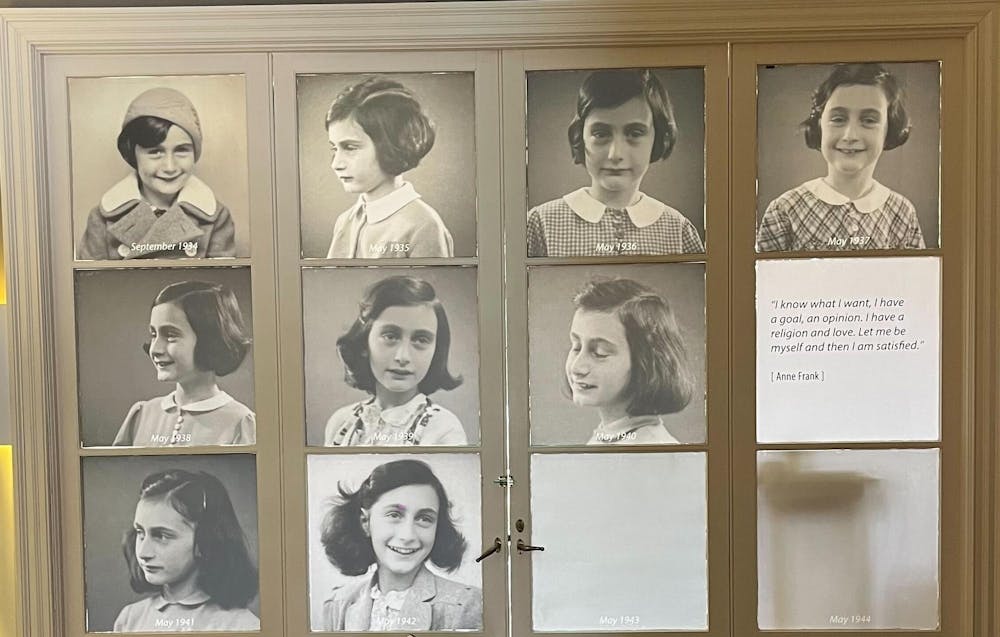
When Asaru Buffalo gives tours at the Anne Frank Center, he starts in the year 1889 — the year that Otto Frank, Anne Frank's father, and Adolf Hitler were both born.
The two men had more in common than just being born in the same year, Buffalo said. Both were soldiers, and both considered themselves German. However, the two men had different meanings of what it meant to be German.
“Two men who were saying the exact same word, but meaning two completely different things,” Buffalo said. “And that’s the paradox of language that goes into the identity that eventually leads to dehumanization.”
Anne Frank was a young Jewish girl who hid in a secret annex with seven others for two years during World War II before being discovered and arrested by the Nazis. She later died in a concentration camp February 1945. Her father, Otto Frank, was the only survivor and later published her diary that she kept during that time.
The Secret Annex in Amsterdam has now become a museum and is partnered with the Anne Frank Center at USC, connecting with the Jewish community in Columbia and the first-year students in University 101 classes.
The center creates this complex comparison between Otto Frank and Hitler to help set the theme of identity for the tours, and, as an education specialist, it is Buffalo’s job to make sure these themes are taught.
“The reason why we put a lot of identity in our tours is because we have to understand; you can’t understand dehumanization without understanding identity,” he said.
Alicia Rothamel, a rabbi at Beth Shalom Synagogue in Columbia, said the center’s presence makes the Columbia Jewish community very proud and allows for further education, especially for younger children.
“It makes their history come to life,” she said.
The center tells stories of life in Germany during World War I and the years after, leading up to World War II. Then, the story of World War II is told through the eyes of a young Anne Frank.
“We want to make sure, at the heart of the story that's being told, it's always about this little girl who was just inspired and excited about life,” Buffalo said.
The replicated rooms explore the life and legacy of Anne Frank herself. Pictures, quotes, videos and artifacts are present throughout, bringing the tour to life. Buffalo said that sparks conversation.
“When we say 'real conversations,' does that mean it’s going to be a little sad? Yes,” Buffalo said. “Does it mean it’s going to be inspiring at times? Yes. Is it going to be a little scary at times? It’s going to be all things because that's what Anne experienced.”
Athletic academic advisor Storm Blitz, who is Jewish, said the topic of race is talked about in the first room. The idea of race had a different meaning than just the color of one's skin during the Holocaust, she added.
With that, Blitz said that it's important for people to understand that the Holocaust was more than just being Jewish because of the nuances and identity that goes into Judaism.
"We say Judaism is a race, a religion, an ethnicity; it's everything. It's a whole culture," Blitz said.
She said the center does a good job explaining what it was truly like for Jewish people during that time.
“It was through your blood. It didn’t even matter if you were practicing or not," she said. "And that it was just a different construct of race than what in the U.S. that we were used to."
Six million Jewish men, women and children were killed during the Holocaust, according to the Holocaust Encyclopedia. For the executive director of the Columbia Jewish Federation, Jessie Dowsakul, numbers are often used to represent the impact of an event. These numbers, she said, can take away from the personal, human element.
“And what I want people, as they go to the Anne Frank Center, to experience is more of a humanistic feeling as they’re there, to understand that what happened with a tragedy that affected individuals just like them, Jewish or not,” Dowsakul said.
The first time Blitz brought her University 101 class, she assumed the students knew the history of Anne Frank. She quickly learned that some of her students did not.
“I was really surprised they did not know who Anne Frank was,” she said. “I was like ‘Oh my God, this is going to be dramatic; I should have prepared them.’”
She noticed that after the tours, the students always gave her positive feedback about the experience.
Buffalo said part of Otto Frank’s legacy was peer-led education, meaning students are teaching students.
“We want the students to be the ones who are leading and engaging in these conversations,” he said. “Because of the goals of Uni 101 lining up with Anne’s legacy, there are multiple reasons why the Uni 101 tours have been prioritized.”
Buffalo said Anne Frank was someone who was excited and hopeful about life. She approached situations with love, was thankful for everything her family did and tried to live in hope, even with fear in the back of her mind, he said.
While Anne Frank and most of those hidden away with her were killed, the center keeps their stories alive.
“We're not here to tell you how they died,” Buffalo said. “We're here to tell you how they live.”