
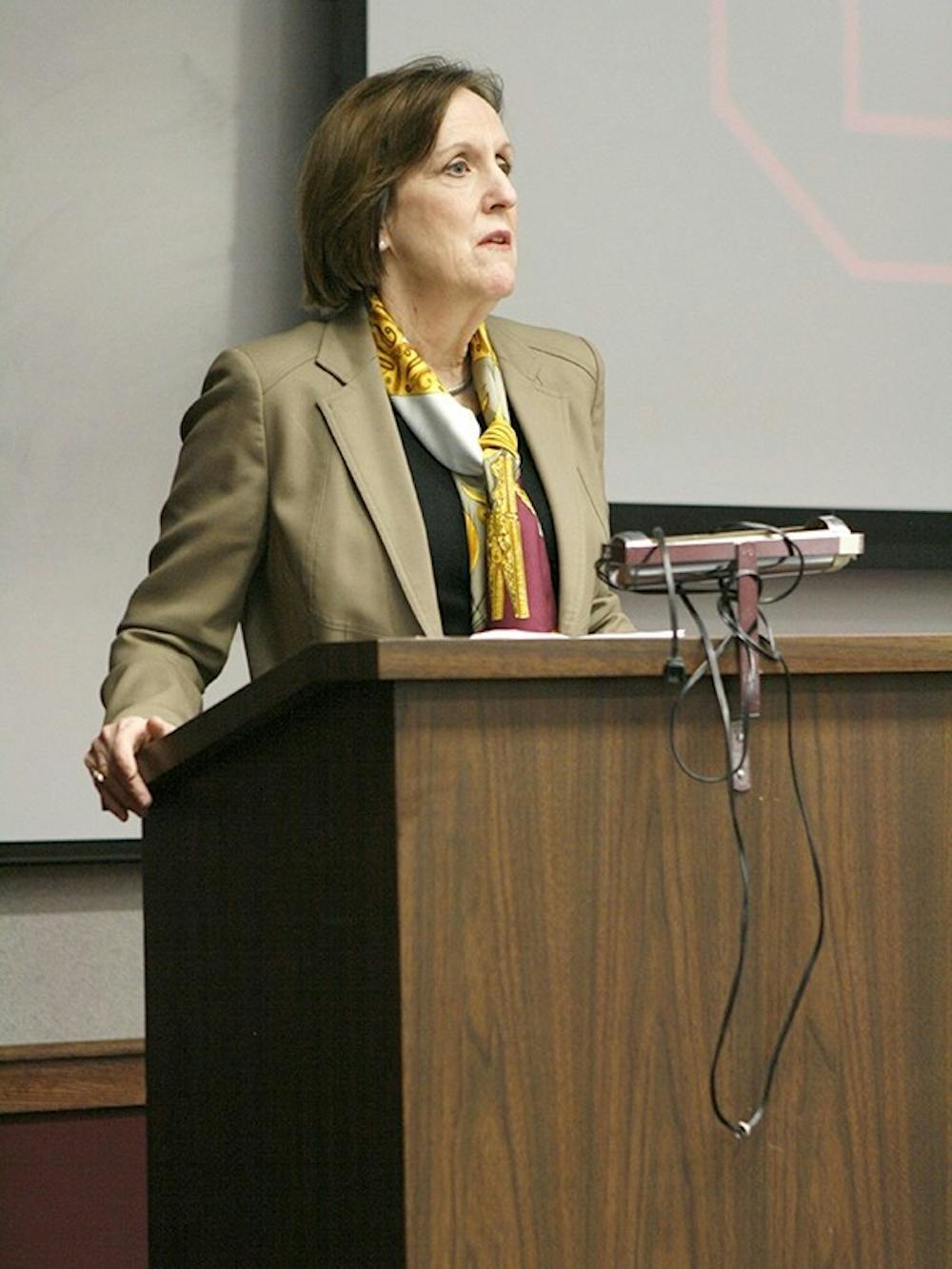
Tumulty: Divided Washington can’t ‘get its act together’
Karen Tumulty has been covering Washington, D.C., for 30 years.
Now a political correspondent for The Washington Post, the veteran journalist used one of the biggest issues during the Reagan Administration — the 1983 Social Security compromise — to illustrate how severely polarized American politics have become in a lecture to students and members of the public Tuesday afternoon.
“It has always been extremely dangerous for anyone to go near Social Security, but the two parties agreed on the fact that there was a problem and agreed it had to be fixed,” Tumulty said. “The president put a plan before Congress on Jan. 25. By March 9 ... the House passed it by an absolutely overwhelmingly bipartisan vote. On March 21, the Senate passed it 88-9. And the House and Senate, which were as torn apart as they are now, took two whole days to put aside their differences and make a solution.”
Although Congress’ polarization was similar to that of today, Tumulty said that’s where the similarities stop.
“From start to finish, they were able to come to a consensus and pass it. Everybody joined hands and jumped over the cliff together,” Tumulty said. “I tried to imagine that happening today, and it just wouldn’t.”
Tumulty’s talk was aptly titled “Why Can’t Washington Get Its Act Together?” Her answer was what she called almost unprecedented polarization not only in Congress, but across the American populace.
“All you have to do is look at the U.S. Congress. It has an approval rating of 16 percent — That makes them only slightly more popular than bed bugs,” she said. “It’s not until all the way back to the 1890s that the Democrats and the Republicans had so little ability to agree on anything.”
Tumulty cited a study that said the most liberal Republican senator is more conservative than the most conservative Democrat. She also said the difference between approval ratings for President Barack Obama by party was more than 70 percentage points and that nearly all congresspeople come from districts that were carried by their party’s presidential candidate in November.
The representatives from these highly partisan congressional districts would face tough primary elections if they strayed from their party’s views, Tumulty said.
“It’s not surprising at all that we can’t get anything done,” she said. “The country has divided into these little enclaves of thought. There are so many outside forces ... that the parties cannot protect their incumbents the way they used to.”