
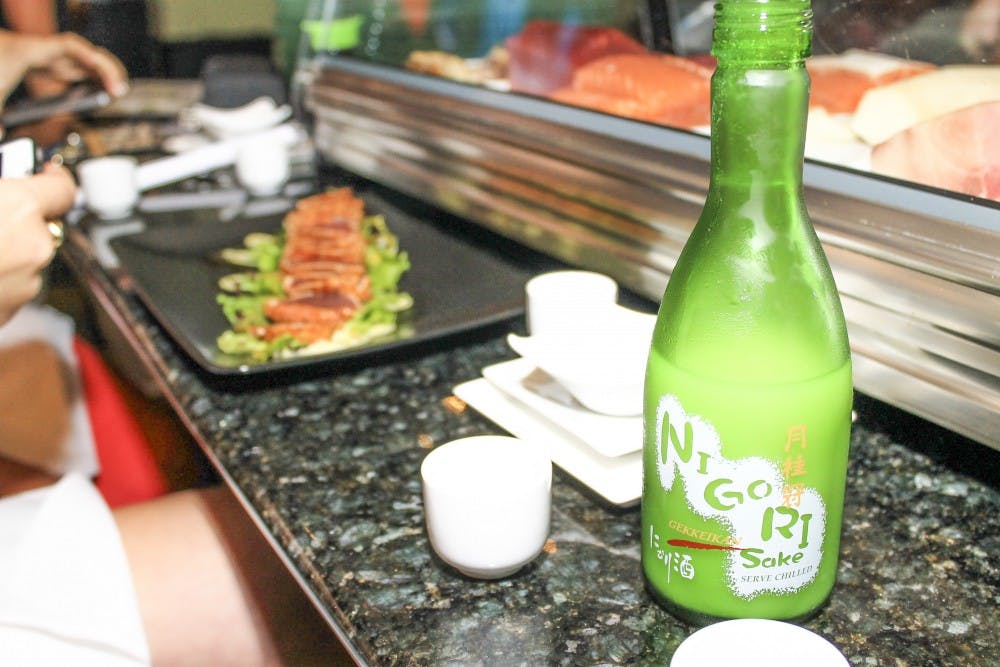
With a variety of different restaurants offering sushi, it can be difficult to narrow down the choices available. SakiTumi, located in the heart of The Vista, uses sex appeal to entice customers in, and keeps them around by serving quality food that includes both sushi and options from the grill.
The sushi experience at SakiTumi is possibly one of the best you’ll get in Columbia. The restaurant gets its fish shipped within 24 hours to them, packed in ice, so the fish is never received frozen. Ryan Cleary, part-time manager, comments that sushi is an art form, saying that even to be in the position of being trained by someone that knows sushi and knows how to cut the fish is extremely difficult. “Cutting the fish is a true art form,” he said.
Executive chef and managing partner Larry Thompson is exceptional at this art. Not only does each piece of fish melt in the mouth, but the sushi rolls he makes are great for those more skeptical about eating plain raw fish. Thompson said that most sushi places try to impress customers with lots of sauces on top of their rolls, but that SakiTumi’s goal is to serve the best quality sushi without dressing it up too much, focusing on freshness in particular. The Fire Island Roll is particularly exemplary for those that like a little bit of spice, but nothing too hot. Tempura shrimp and avocado make up the inside of the roll, and it is topped with diced tuna mixed with sriracha, Japanese mayo and tempura flakes; there is enough of a spice to be noticeable, but the tempura and avocado even out the flavor.
Thompson has been in the culinary field for 19 years, and has been at SakiTumi for seven. What he loves about SakiTumi is that, “There is something on the menu for everyone, even if they don’t like sushi.” His employees have an advantage over other Japanese restaurants in Columbia due to the fact that Thompson is from Okinawa, Japan and has been training for years. Cleary praises Thompson, “If you get under a great chef, like Chef Thompson, he’ll teach you the ins and outs, which is very difficult, especially for non-Asian or [non] Japanese people to get into; it’s a rare field, it’s one of those arts that they kind of keep to themselves.” Difficult indeed; Cleary said that 20 years under your belt is classified as a, “good start.” In fact, if blowfish (fugu in Japanese) is cut incorrectly, you can die from it.
Thompson said that a traditional sushi chef in Japan had to be an Asian male, because of the belief that women are warmer than men, and the warmth of their hands and the oils that are produced in the hands will cause the raw fish to discolor quicker than if males handled the fish. However, that belief is not followed anymore. He compares becoming a sushi chef to how he learned martial arts: “You start off with a family […] and if you’re accepted to the dojo you stay with them for life. Unless you move on or whatever, but there’s no belts, there’s no like, graduation ceremonies; you’re awarded your next lesson. Sushi, we maybe spend the entire year learning rice.”
Thompson is bursting with knowledge on the subject, explaining how sushi originated in China and the process the Chinese went through to get their fish in a time where it took a month to get fish, a perishable item: Thompson said they would take regular rice, steam it, add sugar and rice wine vinegar to the rice after and put the rice in a chest, where the meats and perishables were eventually stored for travel. Japan took this idea and transformed it, eating the fish with the rice instead of throwing the rice out.
Thompson also explains how sushi came to America. “Think about the melting pot that is America,” he says, “G.I.’s, soldiers coming home, bringing the people from the different countries, what’s gonna happen? It’s no different from an American going to Germany, or Japan, and missing their Southern barbecue, or their Creole, or their gumbo, they’re gonna miss something. So think about the immigrants coming over here. We miss it. What turned into, this could be a good club or hangout for people to feel like they’re at home again became more marketable.”
SakiTumi was the second sushi restaurant in The Vista, and Thompson said that everyone has their own style and technique. “The integrity of sushi is very important. Is my sushi traditional sushi? It can be. But it’s also, the really awesome thing in a restaurant, is make your own rules. Am I commercial? No. Am I sell-out sushi? No. It’s new style. Everything starts off with tradition. You take something that’s traditional and add your own flair to it,” Thompson notes. His trademark at SakiTumi is sex appeal, explaining that the most important thing about sushi is presentation; no different from a sandwich shop that starts with a formula and doesn’t do anything except follow the formula. “That’s great,” Thompson said, “but are you turned on by it?”
Thompson said SakiTumi now receives a large amount of clientele from Japan, which means he has a lot to prove when those customers walk through the door. “Japanese people are very critical, especially when you’re copying something of theirs.” However, it is also a test for his non-Japanese clients who come into the restaurant when eating. “People are like oh my god it’s raw, you know, I can’t eat this, I can’t eat that, and I’m like, man I’m pretty sure there’s been worse in people’s mouths, you know, like a chicken McNugget or a hot dog […] you only live once,” he laughs. He admits he aims to make people happy at SakiTumi, and that if a customer requests that he make something not on the menu, he will, but not without adding his own style.
At the end of the day, Thompson accomplishes his goals of freshness and serving customers delicious, well-crafted sushi. It is clear he loves the field he works in and will not stop aiming for the best SakiTumi can offer. “Never settle for second best has always been the saying I go by. It’s tough, cause I miss home. But this is one of the places I will eat, even buy, something, because I know what I’m ordering.”