
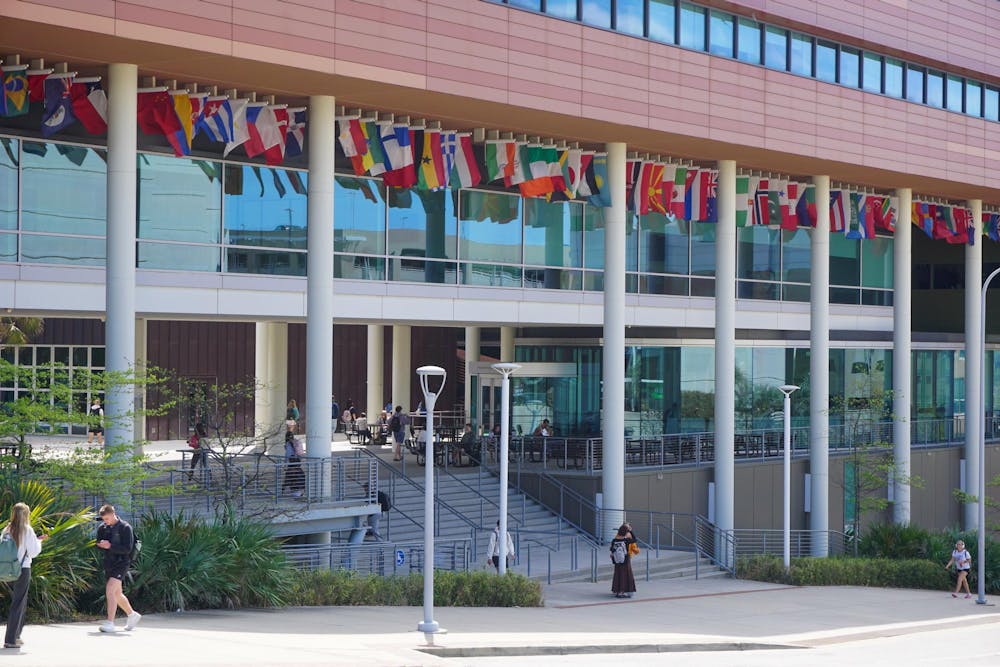
Over 1.5 billion people — almost 20% of the world population — live in Africa. With the highest fertility rate out of any continent, its role in the global economy will only grow more and more important every year. One might expect, then, that students of the No. 1 international business program in the United States would be able to study in a variety of countries in this critical continent — or, at the very least, more than the grand total of four that are currently available.
A significant part of the international business program at the Darla Moore School of Business's clout comes from its network of foreign partner universities available to its students. It’s part of the major — all IB students will study abroad at an exchange partner for a semester, allowing students the opportunity to immerse themselves in their second language of study, learn from and network with professionals in international industries and see firsthand how business is conducted in foreign countries. Thus, having a wide range of destinations is incredibly important, in order for the university's definition of “international” not to end up looking like a famous musician’s “international” pittance stops on their album tour.
Alas, though, the fact that a grand total of four countries (Egypt, Morocco, Senegal and South Africa) all hugging the coast represent the whole of Africa is just one example of how the current slate of IB exchange partner schools currently leaves some areas of the world woefully ignored.
Another example: since the start of the war in Ukraine, USC has suspended its partnership with Saint Petersburg State University in Russia. That was the sole exchange partner located in a Russian-speaking nation, and despite Russian being one of the languages taught at USC, and the lingua franca of much of Central Asia, there is still no substitute.
The same is true across other diverse regions of the world, too. Central America is barren - Tec de Monterry is a strong program, but it's a bit of a stretch to call Mexico part of Central America in the first place. The easternmost university in the Eastern Europe category is in Hungary. Meanwhile, over in Western Europe, the university has four partners in France alone, and three in Germany.
A pattern becomes quite clear here upon closer inspection: the university has plenty of options for students looking to study in a developed country like Germany or Japan, but nothing for students seeking to travel to an emerging economy like Saudi Arabia or Nigeria. This pattern is a problematic one — for example, many students within the IB major use their study abroad semester to travel to a region where they can practice their second language of study. However, as aforementioned, there is no university in a Russophone nation among the current exchange partners of the university.
Additionally, students studying Arabic have partner schools in Egypt, Morocco and the United Arab Emirates available, but the Arabic language has many different dialects between countries — a student seeking to learn Levantine Arabic only has the Hebrew University of Jerusalem as an option close by.
Another issue with the current bias towards Western Europe specifically is that IB students have less opportunity to be exposed to cultures in developing countries, which differ much more radically from their own. The business practices of the United Kingdom, even just by virtue of it being an English-speaking country, will likely be far more familiar than those of Bangladesh, where personal connections and informal rapport play a key role in trade, unlike in the west. And what better way is there to build relationships than in person — like one would on a foreign exchange semester.
When looking more broadly at global economic trends, the skew seems even more problematic. The International Monetary Fund projects the economies of emerging market and developing countries to grow by about 4% annually in 2026 – more than double the 1.6% it predicts for advanced economies. India recently surpassed China in population in 2023, making it the world's largest consumer market while Kyrgyzstan and Cambodia – passed over by the IB exchange – have a higher rate of economic growth than the United Kingdom.
The story being told by the data is quite clear: the world’s economy is shifting from the Global North to the Global South. Developing countries are making up a greater and greater slice of the pie every year, as developed economies stagnate — or, in some cases, even contract. The future of business is increasingly not going to be within the glittering offices of cities like New York, London and Shanghai, but rather in ones like Mumbai, Jakarta and Lagos — and the Darla Moore School of Business currently doesn’t partner with any universities in any of those cities.
While Tokyo and Paris will no doubt remain invaluable destinations for students, the university might find its graduates, in the coming years, looking for jobs in an economy where connections with professors in Riyadh are more valuable than a relationship with a recruiter in Tokyo.
And it’s not just employers in Los Angeles or Atlanta who might be shifting their priorities — in our own state, right alongside traditional powerhouses like BMW and Michelin, companies like Birla Carbon and Fine Organics, both Indian multinationals, are among the many global corporations putting massive amounts of money into building new manufacturing plants in South Carolina cities. And yet, undergraduate IB students in South Carolina's flagship university have no exchange partner institutions in India — potential networks and intimate cultural knowledge with our state's up-and-coming business partners are nipped in the bud before they could even exist.
Thankfully, this is a problem with an immediately identifiable solution: create more exchange partnerships with universities in areas where there does not yet exist one. IB majors at USC will then have the opportunity to learn the business practices of, and make connections within, the countries from which the next mega multinationals will emerge. The university has already put in the effort to maintain the No. 1 IB program's ranking for decades — now is the time to put in the effort to ensure it stays there for decades more.
If you are interested in commenting on this article, please send a guest column to sagckopinion@mailbox.sc.edu.