
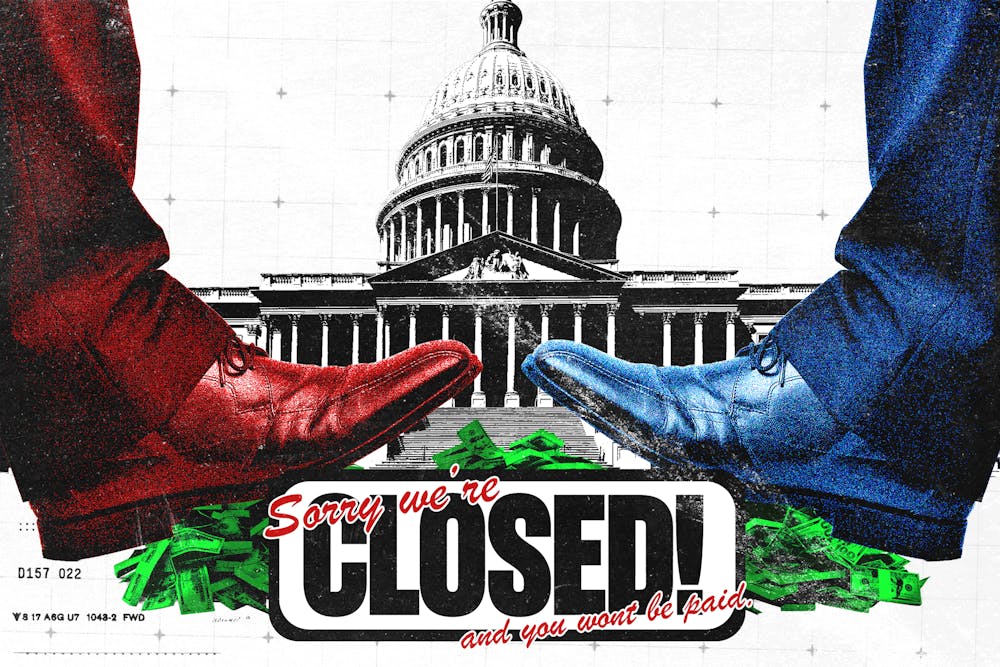
After 43 grueling days last fall, the longest government shutdown in U.S. history finally ended on Nov. 12, 2025. And just like every shutdown prior to this one, it concluded in the same way: after weeks of disruption, the side that lit the match didn’t get what it claimed was non-negotiable.
For Congress Democrats, it was non-negotiable for the 2026 Fiscal Year Budget to include an extension of the soon-to-expire Affordable Care Act and to reverse Medicaid cuts. Naturally, Congress Republicans wouldn’t stand for this and pushed to pass the budget without adopting these demands. Because the two parties couldn’t come to an agreement on how the money should be allocated, the government shut down.
But after failure to distribute monthly Supplemental Nutrition Assistance Program payments to millions of Americans and chaos over cancelled flights, pressure increased for Congress to reopen the government. On Nov. 10, seven Democratic senators and one independent caved, settling with a deal to fund the government through Jan. 30 and hold a Senate floor vote in December on extending tax credits. Two days later, the House approved the temporary funding bill, which passed with a 222-209 vote. President Trump signed it into law, signaling the end of the shutdown.
So what was the point of holding federal workers hostage for 43 days and disrupting the lives of everyone else? The shutdown’s primary demand to protect the ACA’s enhanced tax credits didn’t make it into the reopening deal. Instead, Democrats got a promise of a December vote.
That promise has now been tested and found worthless. The Senate held the vote on Dec. 11, 2025, and it failed. The enhanced tax credits expired on Jan. 1, and families are now confronting steep premium increases because Congress chose gridlock over governance.
Continuing to allow government shutdowns to happen is preposterous. Time after time, shutdowns have proved to be useless as bargaining tools and devastating as public policy.
In 2013, a 16-day shutdown occurred after Republicans demanded the repeal of the Affordable Care Act. Obamacare wasn’t paused or rolled back, only adjusted to add stricter eligibility checks. In 2018, Democrats forced a shutdown to implement protections of illegal immigrants who came to the U.S as minors. After three days, they compromised for a vote on a protection bill. Four votes were held and all of them failed to pass such a bill.
The longest shutdown prior to 2025 happened during President Trump’s first term in 2019. A 35-day government closure resulted from Trump’s demand for $5.7 billion to build a border wall between the U.S and Mexico. He received $1.38 billion.
As time marches on, shutdowns are lasting longer and longer and at the expense of the American people.
Almost 42 million Americans rely on SNAP for access to food. With the government closed, the program's distribution stopped on Nov. 1, sparking chaos for citizens. Twenty U.S. States attempted to issue full SNAP benefits, but the Trump administration ordered states to rescind their actions. After plenty of back-and-forth between the U.S District Courts and the Trump administration, states were told they would be responsible for the consequences that come with issuing full monthly SNAP payments.
It seems the protocol for government shutdowns is to punish the American people and then punish the states for trying to help them. How patriotic.
Federal workers bear much of the burden of government shutdowns. Air traffic controllers and health center workers at the Centers for Disease Control and Prevention and the National Institute of Health are just a few of the many federal jobs deemed “essential” in the shutdown. These workers are required to continue doing their jobs but won't receive regular paychecks. Although they’ll receive back pay when the shutdown ends, having to go more than a month with no cash flow makes it hard to pay the bills and demoralizing to go to work.
Over the duration of the shutdown, nearly 900,000 federal employees were furloughed, and about 700,000 had to work with the promise of back pay. The irony of the matter is, the congresspeople who made this happen didn't have to miss a paycheck. If lawmakers suffered the same consequences as other federal workers, it’s indisputable that shutdowns wouldn’t be happening.
And they shouldn’t be. The U.S. is the only country where government shutdowns frequently occur, an embarrassing indicator of our inability to cooperate. It's likely this trait of American politics will continue to be displayed for the world to see over the next few months, with the FY 2026 budget still up in the air and temporary funding holding the country together.
What this shutdown proved, like all the ones that came before it, is the people who lose the most aren’t the ones seated in the Senate. Families who depend on government assistance for food and federal workers trying to make ends meet did not choose this, but still have to endure the struggles they weren’t prepared for.
Shutdowns have become a symbol of petty party drama, shoving U.S. citizens into the middle of a catfight.
If you are interested in commenting on this article, please send a guest column to sagckopinion@mailbox.sc.edu.