
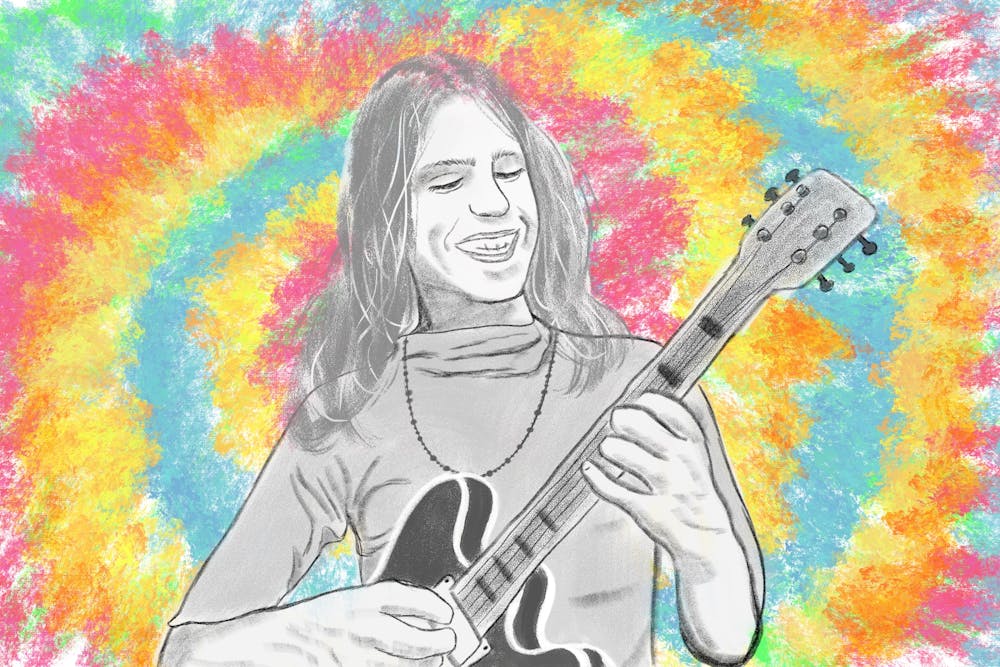
The 1960s saw the emergence of psychedelic rock powerhouses such as Pink Floyd, The Doors and Jefferson Airplane. However, you simply cannot discuss the music and countercultural explosion of the era without addressing the Grateful Dead. More than just the pioneers of jam music, the Dead became a living, breathing entity embodying what it meant to be an American. The freedom and acceptance manifested not only through on stage experimentation but in crowds across the country. Bob Weir stood at the center of this experiment. His creativity, innovation and dedication were the most influential pieces in the creation of an undying legacy.
On Oct. 16, 1947, Bob Weir was born in San Francisco, California. He began playing guitar at age 13 and was heavily influenced by the flourishing blues scene in Haight-Ashbury and its surrounding boroughs. Three years later, the 16-year-old Weir walked into Dana Morgan's Music Store in Palo Alto, where he met a legend of the local scene, Jerry Garcia. This meeting ignited a spark that led to the formation of the Grateful Dead.
In the years following that initial meeting, Weir and Garcia started and played in a jug band together called Mother McCree's Uptown Jug Champions. The lineup featured another eventual founding member of the Grateful Dead, Ron "Pigpen" McKernan. The band later changed its name to The Warlocks and shifted its focus to electric blues following the addition of drummer Bill Kreutzmann, bassist Phil Lesh and, later, drummer Mickey Hart. This lineup, which would become the first iteration of the Grateful Dead following another name change, played its first show at Magoo's Pizza Parlor in Menlo Park in May 1965.
In the years that followed, Weir and the Grateful Dead played more than 2,300 shows across three continents. During this time, Weir pushed the boundaries of rhythm guitar, forming his own unique style that is still studied and admired today. While hardly flashy, Weir's playing and use of unique chord voicing shaped the course of American rock music for the generations that followed. Fans often cite Weir's harmonic genius as the glue that held the band together and allowed Garcia and Lesh to truly take flight on stage. His genius can be heard on recordings such as "Weather Report Suite," "Sugar Magnolia," "Cassidy" and many more.
In tandem with the release of Weir's 1972 solo album "Ace," he contributed hundreds of songs to the Dead's catalog including songs like "Mexicali Blues," and "One More Saturday Night." These song's became cultural events within themselves and paired with the creation of a brand-new style of music: jam music, America's most authentic contribution to rock music. Jam music is defined by long improvisational conversations between musicians in which every night was different, and no two performances of the same song were ever the same.
The improvisational aspect made the audience part of the performance and helped provide fans with an experience that couldn't be had anywhere else. This sound went on not only to define the Dead but also to inspire a worldwide cultural movement and a litany of bands and musicians to put their own spin on the genre.
Following the death of Jerry Garcia in 1995, Weir continued performing the Dead's catalog in various outfits, including The Other Ones, Wolf Bros and eventually Dead & Company, which featured John Mayer, Jeff Chimenti, Oteil Burbridge, Mickey Hart and Bill Kreutzmann when it formed in 2015. The band toured for 10 years, culminating in a 60-year celebration where it all started in Golden Gate Park in August 2025.
Weir saw it as a personal mission to keep the culture going as long as possible and to share the songbook with as many people and generations as he could. He was a touring musician for his entire life and valued the fans, giving them unforgettable experiences that could only be had at a Dead show night after night, year after year. He saw it as a personal mission to be the primary caretaker for the music and the culture, selflessly sacrificing retirement to continue sharing joy and memories with the community.
Weir stated in interviews that he wanted the songbook to continue for 300 years, a mission echoed by Dead & Company bandmate John Mayer at his celebration of life ceremony, following his death on Jan. 10th, 2026, and upheld night after night by musicians in local clubs around the world.
In my opinion, this is Weir's greatest accomplishment. It would have been easy to throw in the towel and ride off into the sunset. Instead, Bob kept innovating and pushing boundaries. He constantly made improvements to songs and live performances, from breathtaking visuals at the Sphere in Las Vegas to adding a jaw dropping outro section to the legendary Dead tune, "Eyes of the World."
There is a certain responsibility that comes with playing and enjoying Grateful Dead music. It is not only something to be enjoyed, but a way of life. For over 60 years, fans across the country dropped everything to go on tour with the band and its various offshoots. For so many, the music and community formed by the Dead became a second home.
Throughout the country, grassroots festivals and shows celebrating the legacy and everlasting cultural significance of the Grateful Dead continue to this day. In Columbia, the annual Five Points Jerry Fest draws crowds featuring local tribute acts. Jerry Fest, as well as other regional festivals such as the Grateville Dead Music Festival in Louisville, Kentucky, serve as further reminders of the legacy and everlasting commitment to community Weir left behind.
As John Mayer stated in his eulogy to Weir, "The hours before the next show existed only to bring the next show closer to us all." There is no better summary of the impact Weir left on the hearts and minds of millions of people. At a Dead show, people from all walks of life come together for a three-hour journey, and for that duration, nothing else matters. As someone lucky enough to see Weir perform live five times, the only concern in the world was what song he would launch into next, putting a smile on my face and everyone else's that lasted long after we left the venue. The music will never stop.
If you are interested in commenting on this article, please send a guest column to sagckopinion@mailbox.sc.edu.