
In an effort to increase water quality awareness and open opportunities for people to be part of local water monitoring, Carolina Water Club plans to partner with the South Carolina Department of Environmental Services to host an on-campus water certification workshop.
Adopt-a-Stream is a volunteer-run organization that relies on citizen science to collect data samples throughout the state's waterways. The program was founded in 2017 as a partnership between Clemson University’s Center for Watershed Excellence and the South Carolina Department of Health and Environmental Control. Several other states have similar projects that were launched in response to citizens wanting to be part of water quality monitoring.
"The Adopt-a-Stream program is great for anyone to attend, whether they have years of experience in water quality or are new to it,” said Lexi Thomason Toole, the Adopt-a-Stream Program Coordinator. "You can learn science communication skills; you can learn water quality basics. Even if you don't want to go out and monitor every month, just having a little better understanding is valuable too.”
In their training, volunteers learn skills through the Environmental Protection Agency-approved Quality Assurance Project Plan. This means that volunteers are collecting high-quality and usable data. Each volunteer samples a variety of creeks, streams or other water bodies all over the state in this data collection program.
"I think (Adopt-a-Stream) is an opportunity for a lot of people to see something that they might not have otherwise known was there, and get a little taste of water sampling and just environmental work and water work in general,” said Nathan Auten, Carolina Water Club president and fourth-year civil engineering student.
Accumulating a wide range of data across the state allows SCDES the ability to identify patterns and changes that can be traced back to influences in surrounding environments, Thomason Toole said.
"The goal with this program is to collect long-term baseline data in waterways across the state ...,” Thomason Toole said. "We want to have an understanding of what our waterways have looked like before changes around them happen so that we can see those impacts.”
Secretary for Carolina Water Club and fourth-year environmental science student Parker Walsh is currently the only member of the organization with an Adopt-a-Stream certification. Walsh grew up spending his childhood by a local stream with neighborhood friends, Walsh watched firsthand as his playground became degraded as water quality was overlooked during the development of the area.
Walsh said giving waterways a voice drove him to obtain his certification so other kids could grow up with healthy ecosystems to enjoy.
"Here in South Carolina, we have over 22,000 miles of fresh waterways here in the state that are all under constant threat,” Walsh said. “South Carolina is one of the highest growing populations of any state, and so those waterways are only going to be under more and more threats.”
Walsh said he’s able to see the impact he and other volunteers' part in Adopt-a-Stream is creating. The program has already identified over 160 cases of illegal pollution in the nine years since its establishment.
Walsh feels citizen science such as Adopt-a-Stream serves as a means for filling in the blanks where the federal government doesn’t oversee, especially for local creeks and streams.
"It takes the volunteer boots-on-the-ground people that have the care and have the ability just to go out there, use their eyes, use their hands to ensure that if the government isn’t going to step in and protect our waterways and ensure that future generations have these waterways to enjoy, then it's our responsibility and duty to do that ourselves,” Walsh said.
Columbia is surrounded by three major rivers: the Saluda River, the Congaree River and the Broad River. With these waterways encapsulating the city comes the opportunity to enjoy these natural resources, as well as the threat of anthropogenic harm.
"I think the more water you have near your city, the more responsibility you have,” Auten said. “We don’t all just have one river to worry about; we have three of them, and they are pretty sizable rivers as well. I think it's just more responsibility, but also more opportunity to learn and test and protect.”
Paying attention and monitoring the quality of water bodies becomes key since this is where pollutants begin to build up. Without mitigating these pollutants to acceptable levels, significant damage can degrade environments, Auten said.
The Adopt-a-Stream program focuses on smaller streams that then drain to larger water bodies, making them crucial points to monitor.
"There is a cumulative effect when pollution get into larger waterways," Thomason Toole said. "If we can stop them closer to the source, when they're still in these smaller tributaries, that's also a much easier fix than when it becomes a massive headline news story, we've got a huge problem that costs billions of dollars.”
While major pollutants dispersing into waterways often catch attention quickly, Thomason Toole said small, everyday actions add up to either have positive or negative impacts on local environments.
"Nonpoint source pollution is the biggest concern for our waterways, and that individual actions can actually have an impact on that,” Thomason Toole said. “Don't throw the trash out your window; don't wash your car on the pavement and let all the suds and grease wash down; pick up your dog poop so that bacteria aren't washing into our waterways. Small changes like that can have an impact on local streams.”
While the degradation of waterways is a major concern, Auten said communities not understanding the implications of their actions can be just as worrying.
“It would be more beneficial for more people to understand what all can go into the water because I think one of the biggest issues we face with mitigating environmental damage right now is just a lack of knowledge,” Auten said. “People don't really realize how much you have to account for."
Carolina Water Club is looking to hold a "day without water" scenario, along with the upcoming workshop. Students are encouraged to think of water as a resource that shouldn’t be taken for granted by understanding its journey to their faucets.
"Learn where your water comes from and realize that it is probably not too far from your backyard,” Walsh said. “That is the water that we are trying to protect, and it is the water that we should all be protecting.”
Walsh said he’s gained a sense of connection with sites he’s sampled and believes others can find this same relationship with their local streams or creeks.
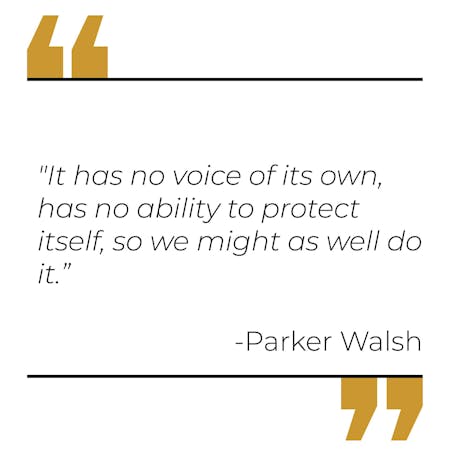
"I think it just allows us to have a good context and good frame of mind,” Walsh said. “To internalize that water is right at our back door. It’s there whether we know it or not. It has no voice of its own, has no ability to protect itself, so we might as well do it.”