
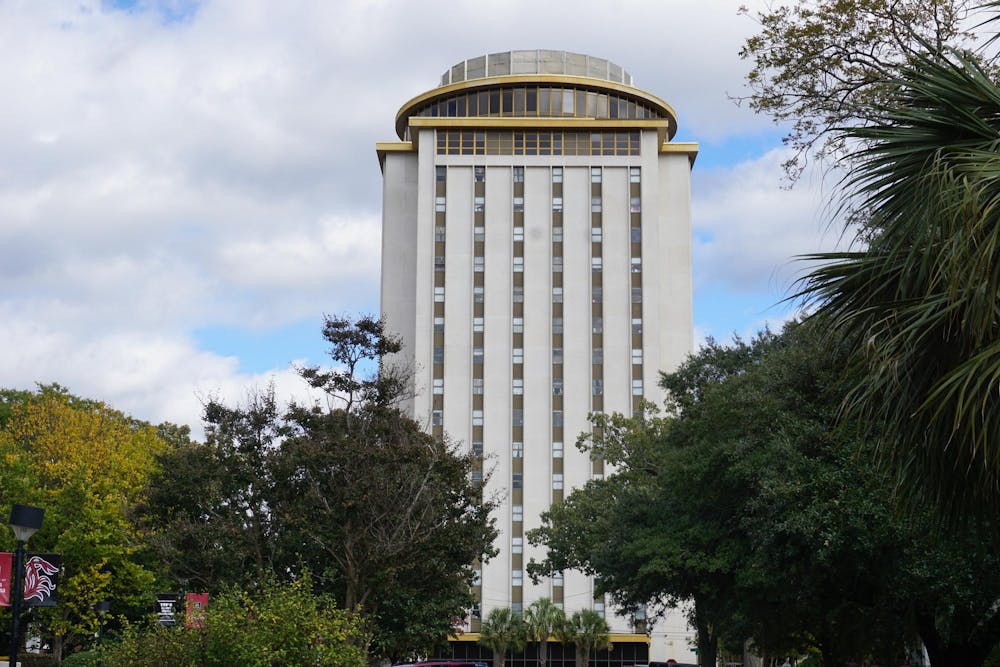
USC architect Derek Gruner provided an update on the ideas for the university’s facilities based on the USC Next master plan.
According to Gruner and Jeff Stensland, associate vice president of university communications, projects such as the Russell House expansion and South Main Street construction are currently conceptual. Stensland said these projects are still awaiting approval and aren’t guaranteed to happen.
Russell House expansion
Based on a university study done on the Russell House in 2023, Gruner said the main takeaway was that to meet student demand, it needed to grow by 50%. The Russell House is currently about 200,000 square feet, and the goal is to expand it to 300,000 square feet.
The areas with the greatest need for renovations are spaces for recreation, casual meetings and student organizations, according to Gruner. He said the number of student organizations on campus has significantly increased over the past 10 years, and the Russell House doesn’t currently have enough space to accommodate them.
Gruner said the original 2023 study was done when the university was contemplating fully replacing the Russell House, but said a complete replacement is not feasible.
“It's really not practical to think that students can go two or three years it would take to build something like this without a student union, without adequate dining facilities to serve them,” Gruner said.
One of the strategies the university is considering is taking parts of the current building that are beyond their use and fixing them through replacement or renovation while also expanding them, according to Gruner.
This could potentially include removing the old student health building near the Russell House and using that space to add to it. Another potential area of renovation could be creating a larger ballroom and west wing to include more space for student organizations in the Russell House, Gruner said.
One of the priorities is to make sure the areas around the Russell House that students use as walking paths remain open for that, according to Gruner. He said certain areas of improvement could be adding more areas to the basement for student recreation, courtyard level dining and including rooftop lounges for students.
Gruner said none of these plans are set in stone, and plans involving the Russell House expansion could change going forward.
“A project that is as complex as this requires an enormous amount of study, which has not yet occurred, and (this project) really could evolve quite a bit,” Gruner said.
On-campus housing
According to Gruner, there will be multiple residence halls on campus that are renovated or replaced in the next few years, which include Woodrow, McBryde, Honors and Capstone.
One of the main goals of the USC Next master plan is to have more students living in and around the Horseshoe. Thornwell was recently renovated for this purpose, and Woodrow is now under renovation for the same reason, Gruner said.
The biggest housing construction project is McBryde, which will be a complete replacement, according to Gruner.
“We're replacing McBryde with a six-story residence hall that is going to really more than triple the number of beds so that we can have more students living in the core of our campus,” Gruner said.
The replacement of McBryde is scheduled to be completed by fall 2028, Gruner said, and it will be able to house 900 students. Gruner said the construction will include adding a common area in the center of the new building for students to socialize. The new building will also have a courtyard behind it and a rooftop garden for students.
According to Gruner, the university is looking to construct the final wing of the Honors residence hall that was originally conceived when the building was built. The addition of this wing will allow Honors to house around 200 more students, Gruner said.
The renovation of Honors and the replacement of McBryde will create a gateway, and the goal is to have their architecture be compatible rather than identical, according to Gruner.
Capstone will be undergoing the least extensive renovation, Gruner said, but students would not be able to live there for at least a year and a half. The renovations will most likely include replacing all mechanical and electrical systems as well as the windows and renovating the restrooms, according to Gruner.
“At the end of the renovation, while it may look still very similar on the outside, (on) the inside, it's a new building, and it renews the life of that building for another 30 to 40 years,” Gruner said.
Main Street
The university is currently looking into developing parts of Main Street, which, according to Gruner, are owned by the university, the university’s foundation, the state of South Carolina and the Baptist Collegiate Ministry.
Much of USC’s development of Main Street will focus on the Burns Building and its block, as the building is currently owned by the university. According to Gruner, the university is also looking to use Main Street to add more parking structures to meet demand.
“We've been informed by some studies, and we have a lot of thoughts that this might be a good place to concentrate retail at the street level,” Gruner said.
According to Gruner, the new building would most likely be six stories tall, and above the first floor, which would contain any retail, would be housing. Gruner said these housing units would either be student housing or market-rate housing.
According to Gruner, the main goal of the Main Street project is to make it a place that is active for the whole year and not just during the academic year.
“The idea here with Main Street is to not make it quite so university-centric, but to make this a place that the citizens of Columbia might come and shop here,” Gruner said.
Campus Updates
Gruner discussed other projects that the university is currently looking into on campus. Some of the projects include previously announced construction on the Thomas Cooper Library, McKissick Museum and Barnwell College.
Gruner mentioned that the university is planning to build a new science building, which is currently in the programming and design phase.
On March 18, the university opened its new Brain Health Center. This is a part of the USC Next master plan and its Brain Health Initiative. This center is part of USC's School of Medicine, which is having a new building constructed to house it. According to Gruner, the structure for this new building is entirely in place, and the next phase includes the exterior work and mechanical systems.
Other projects include the neurological and rehabilitation hospital that is part of the Brain Health Initiative, which was approved by the board of trustees at its March 19 meeting. The university is looking to expand the Strom Thurmond Wellness and Fitness Center and improve the university’s parking garages and surface lots.
Construction on campus
With these projects, Gruner said there will be extensive construction on campus in the coming years to make these projects a reality.
“In 2027, a lot of the projects that we have under design right now are now going to be under construction,” Gruner said. “There will be moments in 2027 and 2028 when the construction activity on campus is particularly intense.”
According to Gruner, the university will work to make sure that students can still get safely around campus while construction is occurring through strong messaging to students, faculty and staff.
The Thomas Cooper Library will most likely still be under construction in 2030, Gruner said. He said that while there is no definitive timeline for the Main Street project, he believes there will be construction by 2030.
Gruner said the university still wants to ensure that students have a strong college experience while the construction is occurring and have access to essential spaces. This is why buildings such as the Russell House and Thomas Cooper Library won’t be completely replaced, according to Gruner.
Even though the construction will significantly change the campus in 2027, Gruner said that the long-term benefits will be worth it.
“There is a little bit of a price to pay in the first couple of years, but the benefits for the campus for the next 50 years are just tremendous,” Gruner said.