
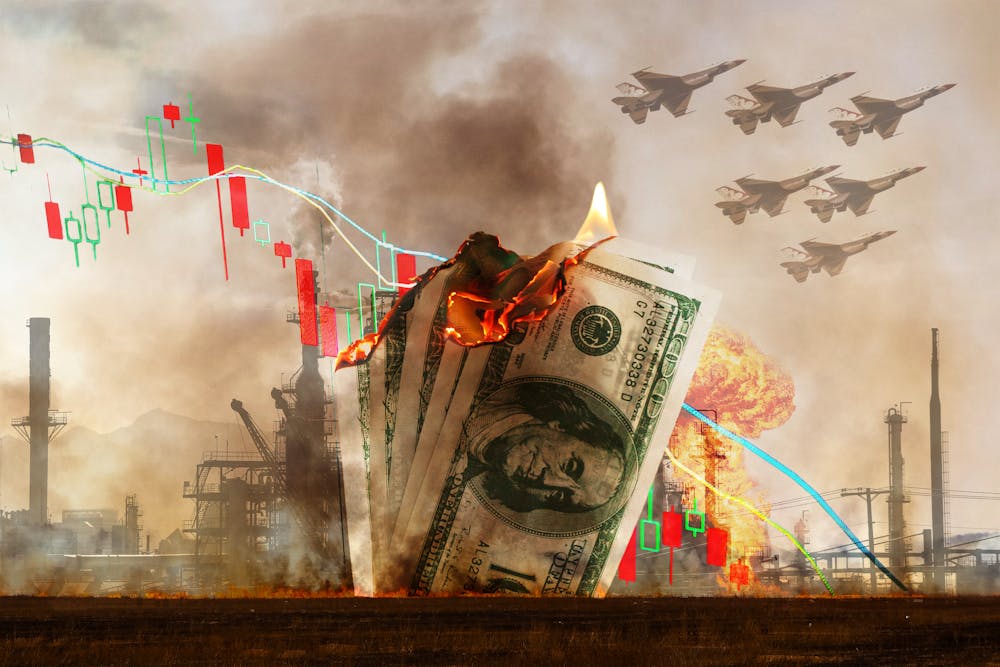
Over 7,000 people have died since the start of the war between the Islamic Republic of Iran and the U.S.-Israeli coalition on Feb. 28, 2026 - including Iran's (now former) Supreme Leader, Ali Khamenei. Across the Gulf Coast, oil refineries are burning. American military assets worth hundreds of millions of dollars are being hammered by Shahed drones. Yet, when the fog of war clears, this conflict might end up causing its greatest long-term damage to something unexpected: the ballooning U.S. national debt.
Besides the death and destruction, one significant development out of this war has been the fact that ships currently transiting the Strait of Hormuz to deliver oil are being charged a toll by Iran that is denominated in Chinese Yuan or cryptocurrency. And, for the currently $39 trillion of debt the American government is in, this has profoundly ominous implications.
These two things might not seem to be correlated at first glance. But, after all, as of the 2025 fiscal year, the American government only collects around $5.2 trillion in taxes, while it spends over $7 trillion on building roads, hospitals and ballistic missiles. The money to cover that deficit has to come from somewhere because Lockheed Martin won’t accept exposure as payment. So, where does it come from, then?
The answer is U.S. Treasury bonds — the government essentially takes out a loan. The combined liabilities of these loans fundamentally make up our debt. We owe this money to various people: private investors, the Federal Reserve and, importantly, foreign countries. In the December of 2024, about 30% of publicly held U.S. debt is owned by foreign governments or foreign private investors. They pay our government the dollars which go towards, say, job training programs ran by the Bureau of Indian Affairs.
The reason that these foreign investors — from German hedge funds to the Kenyan government — have the dollars to buy American debt is because foreign entities, private and public alike, have to maintain reserves of dollars to even engage in global commerce. Eighty-eight percent of trade between countries involves dollars, after all. In a world with different national currencies, the U.S. dollar holds the role of the most preeminent "reserve currency" — a currency held by banks for use in international transactions.
There are several reasons that international transactions use dollars. The dollar grants access to lucrative American financial markets, and the American state is the foremost power of the current world order, making the dollar a purportedly uniquely safe asset. But one aspect of the global economy makes having dollars a non-negotiable for foreign entities in particular: the most important commodity in the world, crude oil, is priced in American currency.
As various oil shocks have proven across the years, oil is the commodity upon which the entire global economy functions. Shortages of "black gold" toppled formed President Jimmy Carter and are currently shutting down hospitals in Cuba. And historically — even if neither party is based in America — to buy this precious liquid, governments and companies alike have had to use dollars.
American governments have ensured that the "petrodollar" remains stable through a careful system of appeasement and pressure — for example, the informal 1974 agreement with Saudi Arabia which saw military protection exchanged for the promise to price Saudi crude in greenbacks. As of 2024, when this agreement expired, America and Saudi Arabia were the two largest oil producers in the world. With so much of the market now demarcated by dollars, other countries around the Persian Gulf inevitably followed, resulting in the situation for much of the 21st century where, as much as Russia tries, 80% of oil is sold for dollars.
Many analysts have put the pieces together — every government or company that wants to function on a basic level must have oil. To have oil, one must have dollars. And those dollars are used to buy Treasury securities, financing the U.S. deficit.
Thus, finally, the gravity of the fact that Iran is attempting to collect tolls from oil tankers in Chinese Yuan is clear: this is a direct challenge to U.S. dollar dominance in the oil trade, and it, by proxy, threatens the very ability of the U.S. to be able to manage its debt. After all, Japan won’t be able to buy our debt with the Yuan it will need to stockpile to pay the "Tehran Toll" — that's a cool trillion dollars of financing at risk.
Schools have been built by debt. The planes that were flying over Iran — and the bombs that they dropped — were built by debt. Payments to the poor have been built by debt. Where are we going to finance this, then, if the petrodollar collapses, and foreign governments stop giving us loans? Will American taxpayers foot the bill yet again, while we're already struggling under four dollars-per-gallon gasoline? Maybe instead the contracts to build bridges will just get cancelled as the gravy train just comes to a screeching halt.
Indeed, while Iran might be battered to hell and back, if the "Tehran Toll Booth" stands, it might end up being Khamenei, then, getting the last laugh from the grave.
If you are interested in commenting on this article, please send a guest column to sagckopinion@mailbox.sc.edu.