
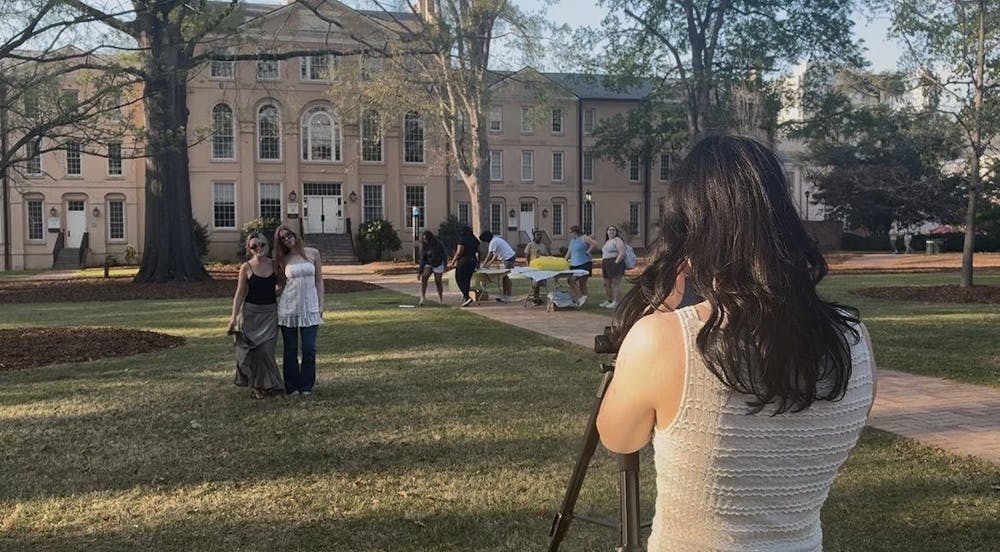
As the sun set over the Horseshoe on March 23, students posed for third-year visual communications student Grayson Edwards as she snapped picture after picture on her camera.
The models weren’t showing off the latest trending styles, but rather outfits they composed from their own closets. A collaboration between Sustainable Carolina and Fashion Board, the Sustainability Photoshoot captured what anti-overconsumption and sustainable fashion could look like.
Third-year retailing student Susanna McCormick is a peer leader for the Zero Waste Team in Sustainable Carolina and initially came up with the idea for the shoot. She said she hoped the event would raise awareness about the potential of sustainable fashion at USC.
“If people on campus see what secondhand can look like, I feel like they’d be a lot more motivated to actually go thrifting and leave fast fashion alone,” McCormick said.
The fast fashion industry is characterized by high-volume production of low-cost, low-quality clothing and a business model reliant on customers continually buying new pieces. Conversely, slow or sustainable fashion refers to clothing or practices that keep the environment in mind, such as thrifting, upcycling or reusing garments.
McCormick said college students are influenced to purchase from fast-fashion sites by what they see on social media. On platforms such as TikTok and Instagram, videos of influencers’ clothing hauls from companies like SHEIN often go viral, displaying the purchase of dozens of garments at low prices. On Instagram, the hashtag #sheinhaul has 1.4 million posts.
According to Forbes, 72% of college students reported shopping fast fashion in 2022. College students seeking budget-friendly clothing turn to fast-fashion sites for affordability, said first-year electrical engineering student Guoxin Zhong, who modeled for the shoot.
“It definitely is all about cost and convenience for people, which is what makes people buy from SHEIN,” Zhong said.
McCormick said buying from fast-fashion retailers can also be a matter of ignorance or unawareness, and Sustainable Carolina tries to educate people on the issues surrounding the industry.
“People don’t really realize the effect that fast fashion has on the environment,” McCormick said. “There’s already enough clothing on the planet to clothe the next six generations. And a lot of people just don’t know, or they just don’t care.”
McCormick said she tries to implement sustainable habits into her fashion choices by thrifting, repairing and upcycling her clothes. Ninety percent of her closet is thrifted, she said.
If everyone were to practice sustainable habits, McCormick saidthe difference would be “insane.”
“Everybody always says, ‘Oh, well, I’m just one person,’" she said. "But if everybody thinks that, then not a lot of change is going to happen. But if everybody thinks that they can make an impact, then an impact’s going to be made.”
Fourth-year retailing student Regan Dowdy is Fashion Board's director of design and oversees the club's photoshoots and style competitions. She said Fashion Board tries to provide clothing of better quality than what students would find at a store.
Fashion Board hosts a monthly vintage market on Greene Street, where local vendors sell vintage clothes, shoes, jewelry and other accessories.
“A lot of our values are (for) quality of clothing, and that’s not really what is offered nowadays for new clothes,” Dowdy said. “Shopping vintage … is something we push because we do want that quality of a garment that’s going to last forever in our closet.”
However, McCormick said the rising popularity of thrifting and the practice of reselling, where secondhand clothes are bought and resold for higher prices on websites such as Depop, are driving up the prices of thrifted garments.
“I don’t think there’s harm in reselling, but I think there’s harm in showing places like Goodwill and the Salvation Army that their clothes are worth a lot more, even though thrifting is meant to be affordable,” McCormick said. “That’s kind of messing up the supply and demand of it … The people who needed those low prices of the thrift can’t get them anymore.”
When she buys new clothes, first-year management and marketing student Kylie Balish saidshe considers the price of a garment and how quickly it can get to her if she’s buying online. Trends also play a role in influencing her style, she said.
Balish and first-year business student Presley McMorrow said they enjoy going thrifting in Five Points, but for them, thrifting is more about fun than being environmentally conscious. According to Greenpeace, the carbon footprint of fast fashion is up to 11 times higher than that of traditional fashion, and the materials used in production can pollute waterways and harm wildlife.
“Sometimes I think about (environmental impact), like when I see a brand has that as a factor, that’s really nice. It makes me want to buy stuff from them,” Balish said. “But I never really think about it too much.”
Balish and McMorrow said they feel college students, including themselves, buy clothes for events and special occasions that they may only wear once.
“I feel like we are probably consuming the most, and we’re gonna use it for the most time in college,” McMorrow said. “In college, you have a lot of events and stuff to go to, and I feel like that makes me shop a lot more. But I try and buy the quality stuff that I’ll have for a long time.”
Balish and McMorrow said Columbia has ample opportunity for thrifting, including the strip of vintage shops and consignment stores that line Saluda Avenue in Five Points and Fashion Board’s vintage market.
“If you’re looking to (thrift), you can find a way to make that happen,” Balish said.