
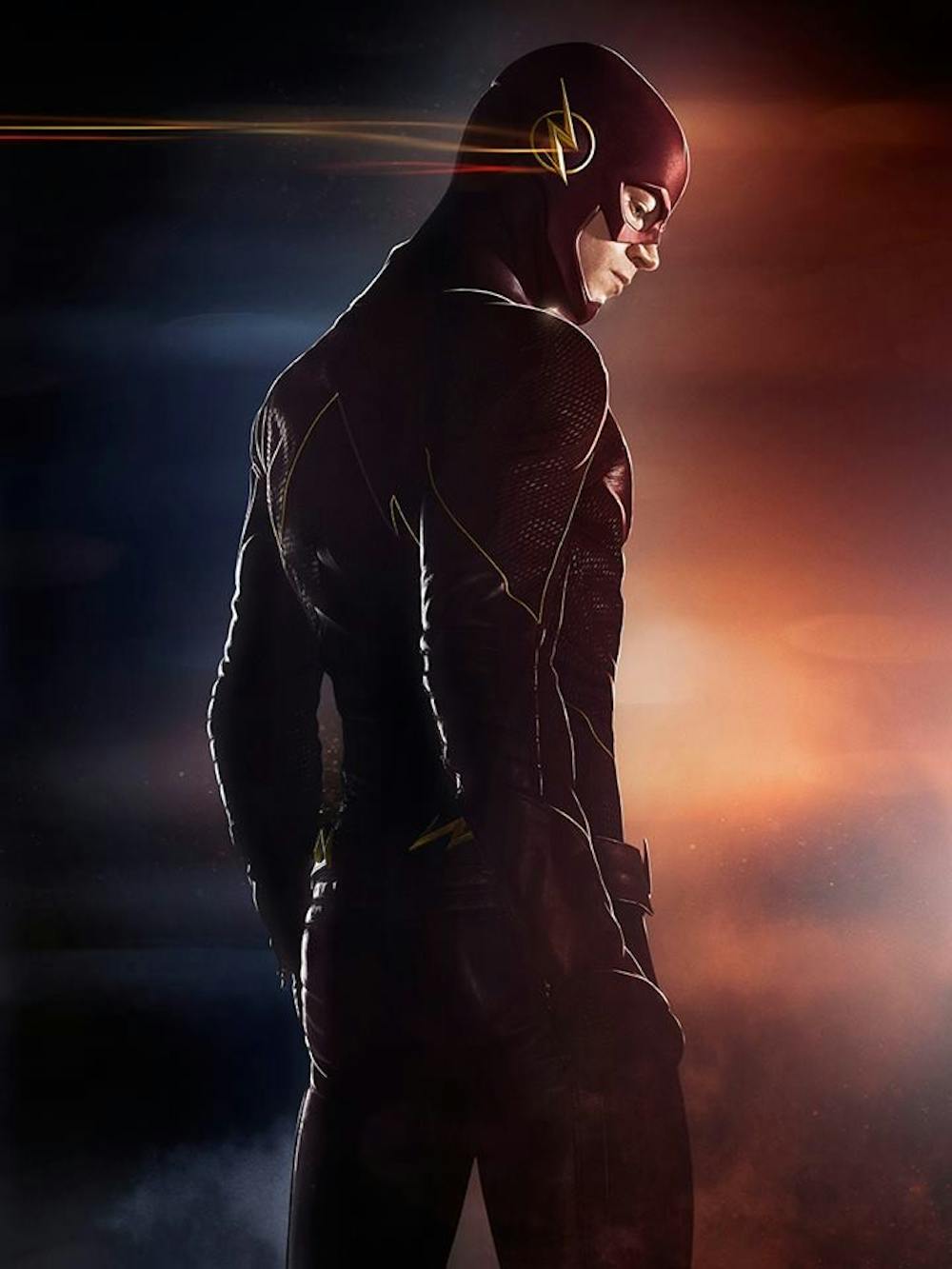
As a spinoff of sorts from The CW's other hit show, "Arrow," "The Flash" follows Barry Allen (Grant Gustin), a chronically late forensic scientist who was caught up in a freak accident after the scientists at S.T.A.R. labs turned on a particle accelerator. Once Allen woke up from his comatose after the accident he realized he had developed super speed, and with the help of workers at S.T.A.R. labs — Cisco Ramon (Carlos Valdes), Caitlin Snow (Danielle Panabaker) and Harrison Wells (Tom Cavanagh) — Allen progresses his newfound ability to learn more about it. He wasn't the only person affected in Central City, though. The others, dubbed as meta-humans by those in S.T.A.R. labs, tend to turn out as the bad guys. Allen, with his team at S.T.A.R. labs, becomes The Flash and fights the crime that plagues the city.
"The Flash" takes on a comic book feel
If "Daredevil" was a graphic novel-esque series, then "The Flash" comes across as comic book-y. "Daredevil" was dark and intense whereas "The Flash" has a more jovial mood. (That's not to say that "The Flash" doesn't get serious sometimes). The humor plays a big factor into this. Allen and his companions (especially Ramon) joke around, and sometimes they get themselves in goofy situations. Anyone can watch an episode midseason and be entertained by The Flash's adventure, even though there are a couple of subplots that they wouldn't understand. When some of the baddies Allen and Co. own aliases with alliterations such as Captain Cold, Weather Wizard and Rainbow Raider, you know it's going to be a fun show.
Two different halves to the pie
For a show about a speedster, the first half of the season moved slow. Background is always necessary to establish early on, but using three episodes at the start of a new series seems too much to devote to background. It would have been more efficient if they used techniques like "Arrow" does to unfold past doings. And, to add to that, it takes four episodes for The Flash to face a real opponent in Captain Cold (yes, even though the name is dumb, he's a worthy adversary for The Flash). Also, the first part of season one's supporting characters — not including S.T.A.R. labs — have bland stories that don't do much for the overall effectiveness of the show. However, this all changes after the midseason finale. "The Flash" goes zero to 500 really quick, dipping into famous Flash storylines and characters that make even the most religious fan get goose bumps.
Some villains are villainous, some are ... meh
"The Flash" sometimes gets in the same rhythm as "Arrow" in that it has a "villain-of-the-week" episode where a bad guy is only in the episode to give the story some conflict but won't be developed too much. The Mist, Multiplex and Pied Piper are all examples of throwaway villains who don't add much to the series. But what these baddies lack, the other villains make up for. As said before, Captain Cold comes in as a main antagonist, and he even begins to form a group called the Rogues — one of the Flash's biggest and most interesting threats. Add him to the ranks of Reverse-Flash and Gorilla Grodd (he's a gorilla that has telepathic ability. Yeah, a little bananas), and you have a seriously menacing group of individuals for The Flash to battle.
The verdict
Even though the first part of the season was uneventful and tedious, the second part picked up the pace and ended with a huge bang, making some of this year's best television. The characters' stories gain momentum, and you actually begin to care about characters other than Allen and those at S.T.A.R. labs (cough, Eddie Thawne and Iris West). The story might come across as cliché, but it works well for the first season of a low-budget series. Just like "Arrow," if you can get past the first half and still be interested, the second half makes up for it in a big way.