
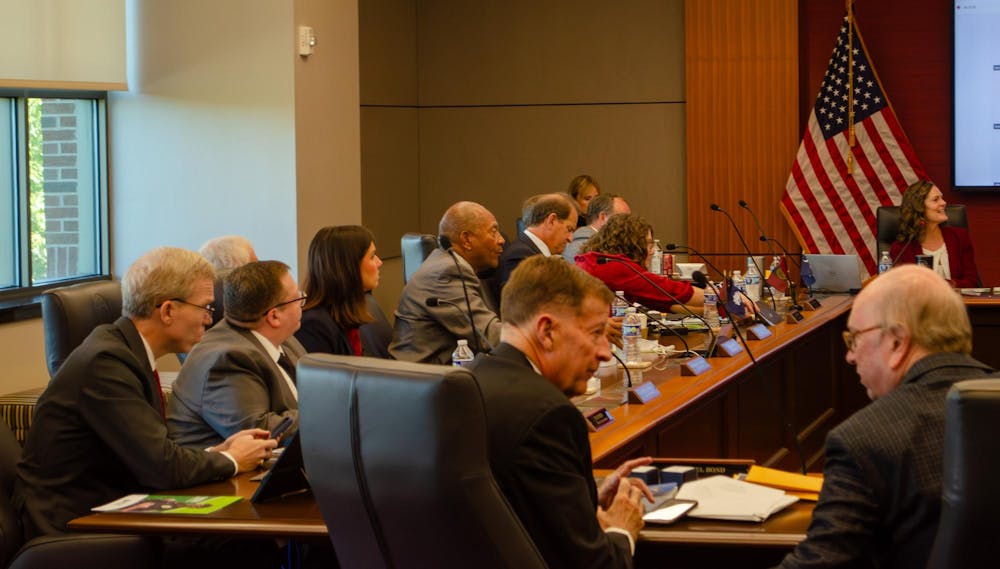
The USC Board of Trustees has approved a new Bullying Prevention Center within the College of Education. Started by special education professor Chad Rose, it will be a technical assistance and research center, and it will support K-12 schools statewide.
Rose said he started a bullying prevention lab at the University of Missouri and spent 12 years involved with it. The center he founded at USC will partner with public and private K-12 schools and districts statewide. One of the goals of the center is to help create a safer place for kids and help them feel like they belong, Rose said. The center will also offer opportunities for undergraduate and graduate students in the College of Education, he added.
The center gives educators skills needed to help students in need, all while helping with their learning and emotional well-being, Provost Mary Anne Fitzpatrick said on the College of Education's website.
“It’s one more example of how USC researchers and educators are addressing real-world problems and strengthening South Carolina communities,” she said.
Rose said the center will focus on three main pillars: policy, professional development and skill-based interventions.
"We make sure school districts, independent schools and state-level policies are in compliance with state and federal regulations but also substantive enough to impact the lives of kids," Rose said. "We want policies to do something. We want them to help kids."
The professional development will not only include educators, administrators and students, but also parents and the community, he said. The interventions will focus more on social and communication skills and development for the students, as well as help them learn how to interact and work together, he said.
Though the center was recently approved, a number of schools statewide have already reached out. Due to waiting for some hires and student involvement, no schools have fully been secured yet, Rose said.
Research
When Rose was first hired at USC, he brought with him three multi-million-dollar grants, he said.
The first, a leadership grant that helps train doctoral students, is a partnership between Northern Illinois University, University of Missouri and now USC. The second grant is an impact grant worth $4 million, and comes from the Institute of Education Sciences, which looks to implement a program called Second Step.
Second Step is a social and communication skills program that has a Bullying Prevention Unit embedded within.
"We're trying to determine whether or not if a school only gets Second Step, and a school gets Second Step plus the Bullying Prevention Unit, does that Bullying Prevention Unit actually work?" Rose said.
This program is being implemented in schools in Milwaukee, Wisconsin; New Orleans, Louisiana; and Chapel Hill, North Carolina. Rose said he and his partners at other universities are examining the extent to which that universal curriculum for elementary students actually reduces bullying.
The last project and grant also comes from the Institute of Education Sciences and is also a $4 million dollar impact grant for professional development.
"We've created this professional development for elementary teachers to learn how to recognize, respond and prevent bullying in their schools, especially as it relates to more vulnerable populations," Rose said.
The grant and project help determine if they will be able to apply what they learned in the classroom to prevent bullying, he said.
Student involvement
While pre-service College of Education students are required to student-teach, if the students decide they want to work in the center, they will get the chance to work with the partner schools, Rose said. Students will also receive hours in the classroom doing implementation of social-skill instruction, he said.
A pre-service student is someone training to become a teacher, but not fully licensed yet. Pre-service students are also in an undergraduate program but are typically involved in field-based student teaching.
For 10 weeks, pre-service students will be put in a school to collect data on whether the interventions are working or not.
If a school is interested in partnering with the research arm of the center, a behavioral risk screener will be used to identify kids who may have low social or communication skills, Rose added.
"We'll train our pre-service teachers to go in and implement some of the curriculum that has either been developed by us or commercially developed," Rose said. "They'll go in once a week, and do that for 10 weeks. We'll collect pre- and post-data, and then we'll determine whether or not the curriculum worked."
If a district or school is interested in doing a social skills intervention, College of Education students will be trained to teach small-group instruction by either Rose, graduate students or affiliate faculty, he said. The students will be trained on how to implement the different types of programs surrounding social and communication skills.
"Generally what we'd do is we'd send two pre-service teachers and two undergraduate students in at once," Rose said. "One would be primarily delivering the instruction, and the other one would be walking around, working with the students in small groups. That is all contingent on us having partner school districts that are interested in this approach."
This model was used for many years while he was at Missouri, Rose said. For now, there will be no physical center, but Rose said he hopes that the center will be able to fully launch during the 2026-27 academic year.
Interim College of Education Dean Angela Baum said bullying prevention is very relevant content for teachers, regardless of the age group they work with.
"We want them to be fully prepared to be able to address issues of bullying if they appear in their classroom," she said. "It's critical content for our teachers to have, so we're excited to have this unique experience for them."