
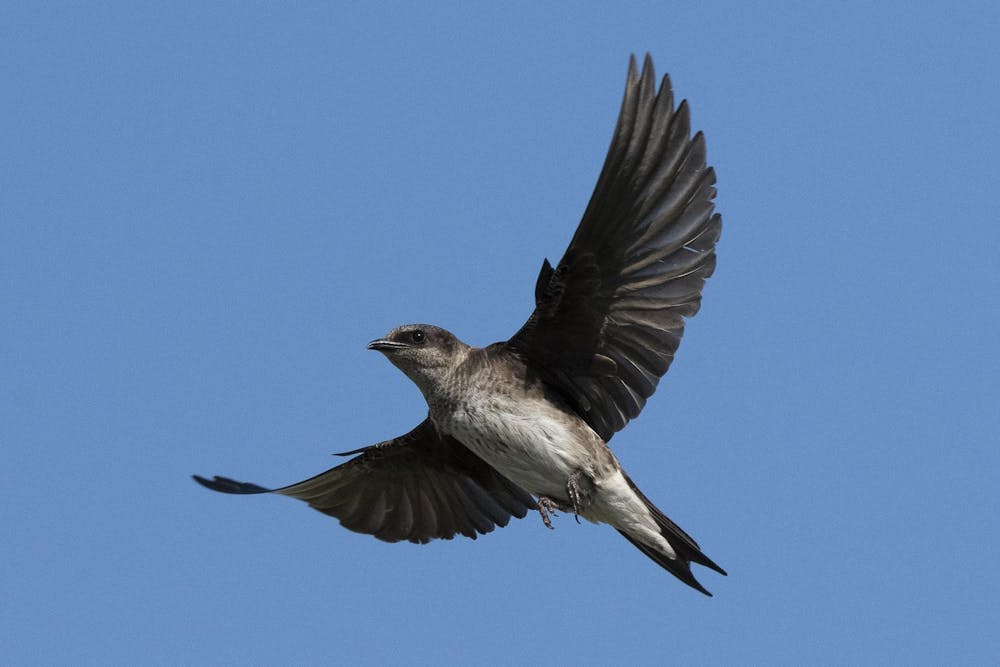
While purple martins are a staple to South Carolina and an example of the biodiversity within the community’s own backyard, the species have an overlooked history involving their relationship with humans.
With the partnership of Wingard’s Market, Riverbanks Zoo and Garden plans to host its first Purple Martin Conservation Workshop on Jan. 31. Naturalist Zach Steinhauser hopes to educate the community on how they can each create an impact within their neighborhood.
“All the tens and hundreds of thousands (of purple martins) we see on the lake in the summertime, they all came from somebody's backyard,” Steinhauser said. “My job and my mission within Wingard’s is to educate all of our customers that they can make a difference just through simply proper gardening practices and become better stewards of wildlife around us and in our community.”
The purple martin's story dates back into America's early history. A naturally cavity-nesting species, purple martins used to nest in dead trees, old woodpecker hollows or any available cavity they could find. Native Americans created a tradition of putting up martin racks that hung gourds for the species to nest near their food sources as a means of pest control. As European settlement grew, this tradition was adopted, but as the landscape drastically changed over the past hundreds of years, purple martins' natural nesting areas began to dwindle, forcing the birds to rely on artificial structures for survival.
“The biggest thing is a lot of folks just don't realize (purple martins) rely exclusively on man-made housing to nest and foster new generations,” Steinhauser said. “It's up to us to keep the birds around.”
According to the Purple Martin Conservation Association, east of the Rocky Mountains, this species now depends on humans to provide housing. Learning this fact at a trade show is what Steinhauser said sent him down a rabbit hole for the next five years, educating people within his community, traveling across the country giving talks, and even creating a documentary on the purple martin's story, “Purple Haze.”
“I got to learn while there's a lot going on elsewhere in the world, there's a lot happening in our backyards that nobody knows about,” Steinhauser said.
South Carolina’s role in purple martin conservation is specifically unique because of Lake Murray being the largest recorded premigratory roost for purple martins in North America, with around 1 million birds estimated to take part in this phenomenon at Bomb Island. USC alum and former Lake Murray ambassador John Tjaarda described the roost as a well-peppered pot of grits.
"If I'm not mistaken, ours is one of the biggest,” Tjaarda said. “It's really cool to see how (the Department of Natural Resources) and the community has really protected Bomb Island to make sure that island, at least due to human interference, won't be disappearing anytime soon, so those birds have that safe space to gather on their migration home after they've been breeding all season.”
Riverbanks garden education specialist Sheila Morris said the zoo’s mission to inspire the community to connect and give back to nature follows the reasoning for this initiative, especially when the story is unfolding in their backyard.
“The fact that we have one of the largest, if not the largest gathering places for purple martins right before migration, it's a conservation topic that is very important locally,” Morris said.
Purple martins eat an estimated 262 billion insects per year, according to the Purple Martin Conservation Association. Along with this natural pest control, Tjaarda said that the species has also become a tourism industry, as visitors flock to Lake Murray to witness the roost spectacle.
“It just illustrates what I think every species of bird is going through in the fight for survival out there,” Tjaarda said. “It ends up being this great big focal point for us to be able to point and look at … There's just so many opportunities for humans and birds to connect, and it be beneficial for both.”
Along with habitat loss, competition with non-native species such as the European starlings and increased pesticide wiping out food sources have led to the purple martin's decline. According to the Purple Martin Conservation Association, over the past 55 years, 2.8 million birds were lost, resulting in a decline of 24.1% for the species.
“The loss of any animal is sad because every animal has a place in their native ecosystem,” Morris said. “Even the ones that we regard as pests or that we're afraid of or animals that are less charismatic. Fortunately, purple martins are very charismatic, so that helps. Every animal has its place.”
Steinhauser said the most impactful step that members of the community can take is to simply make the choice to see if your yard is suitable for a purple martin birdhouse. Over the last decade at his job, Steinhauser said he’s noticed that as more people learn, awareness and appreciation for the species has spread.
“As long as you can give somebody a tool to get started, then they're going to go ahead and get started,” Steinhauser said.
Even if those in the community don’t have the perfect habitat to set up their own purple martin birdhouses, Morris said that there are still actions they can take to help.
“Having a sheltered bird feeder will make a huge difference,” Morris said. “If (the community) can't directly help the purple martins, they can help other animals. If they don't understand why it's important, I suggest that they get on a boat and go out to Bomb Island, in the late summer or early fall, and see the spectacle. It's profound. It's really incredible.”
Fourth-year biological sciences student Alex Childs serves as the secretary for the Midlands Bird Society. Childs describes the club as beginner-friendly, welcoming students with all different levels of experience. Continuing to spread knowledge to her generation is key for purple martins' future, Childs said.
“The problem is most of these people who are providing these nesting sites are 50 or older, 90%,” Childs said. “Eventually these people are going to pass on or they're going to move, and these nesting sites are going to need to be maintained. Younger generations aren't doing this at the same rate … Maybe that knowledge has been lost over the generations.”
While potentially not choosing to highlight purple martins next year, Morris said that this conservation event serves as an example for how Riverbanks can give other backyard wildlife their moment in the spotlight for the future.
“Really the most important thing about zoos is conservation,” Morris said. “Part of that conservation is exposing people to the animals because it's hard to care about something that you don't know anything about. Education is a big part of what we do at the zoo.”
While Steinhauser said he wants people to take as much action as they can and become eco warriors after his talks, his main message is to spread awareness and create hope for this developing conservation story.
“The bigger picture is for folks that are tired of the doom and gloom environmental journalism, ‘Everything's going to go extinct, and the climate's going to ruin the world,’” Steinhauser said. “Folks don't know where to start. This would be a great opportunity as a starting point to get involved and find out what you can do to help your local wildlife. I think there's a phrase going around like, ‘Think global, act local.’”
While the purple martin's dependence on humans could have resulted in its extinction, Tjaarda said that the action of communities coming together has helped to protect the species through a variety of projects driven by what is known as citizen science. When birdwatchers and those with birdhouses report data, scientists can better understand large scale distributions and movement patterns, a sign that individual actions added together can create a roost of data to provide hope for the community.
“Get out there and bird,” Tjaarda said. “Go look at a bird. Go see a bird. Even if it's just a cardinal that hits your feeder every day or a great blue heron that stands in the water out by your house. Just take a look at these creatures for a minute and just revel in their magnificence. Like these things can fly, they can choose anywhere to be in the world right now, and they're hanging out with you. I think that's really cool, and from there, I think your conservation grows.”