
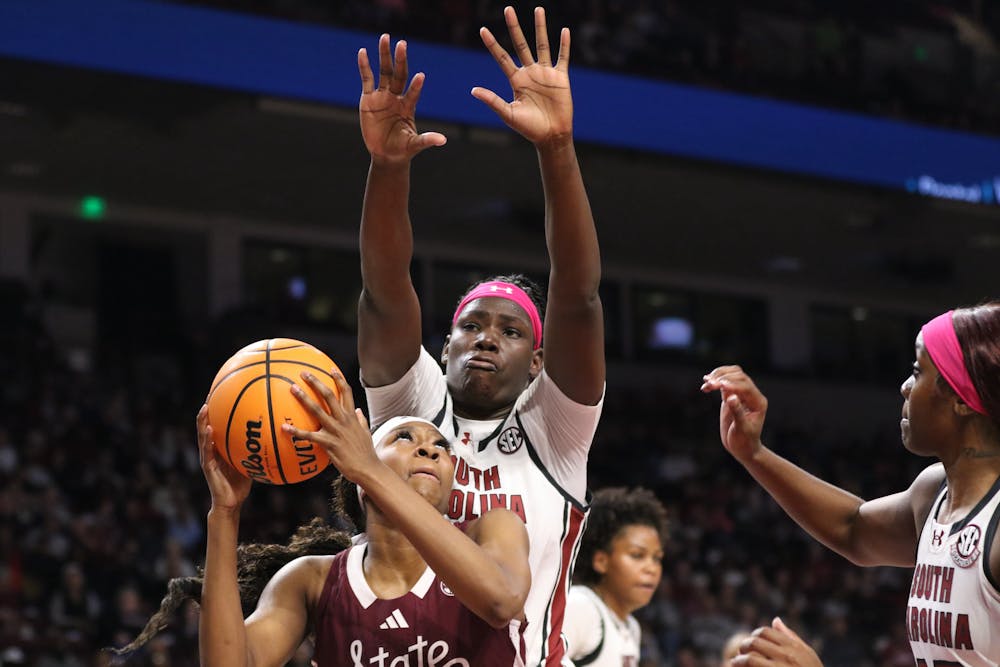
South Carolina’s 88–45 win over Mississippi State was less about offensive fireworks and more about imposing control through size, balance and defensive discipline.
Even without senior guard Ta’Niya Latson and freshman guard Agot Makeer, the Gamecocks dictated the game from the opening minutes and never allowed the Bulldogs to gain traction.
The most telling number was 45, the total points Mississippi State managed across four quarters. The Bulldogs never reached 20 points in any quarter and were held to just 6 points in the third quarter, the stretch that fully separated the teams. South Carolina turned defensive stops into sustained pressure, eliminating clean looks and forcing Mississippi State into uncomfortable possessions.
That control was amplified by lineup decisions. Head coach Dawn Staley deployed senior center Madina Okot, sophomore forward Adhel Tac and freshman forward Alicia Tournebize together, marking the first time this season the trio shared the floor. The trio stands at 6 feet, 6 inches, 6 feet, 5 inches, and 6 feet, 7 inches, respectively, and the result was immediate.
South Carolina controlled the paint, limited second-chance opportunities and overwhelmed Mississippi State with length. The Bulldogs had no viable counter, and the game quickly became lopsided.
Offensively, South Carolina relied on balance rather than one dominant scorer, though sophomore forward Joyce Edwards still found her moments to take over. Edwards led all scorers with 21 points, setting the tone early and consistently answering Mississippi State runs before any sufficient damage could be done.
In doing so, she also reached a milestone. She became the fifth-fastest player in program history to reach 1,000 career points in just 64 games, compared to A'ja Wilson who didn't break 1000 until her 69th game.
Despite the significance, Edwards downplayed the accomplishment postgame, keeping the focus on the team rather than the record. Her humility matched South Carolina’s approach throughout the night. Staley praised Edwards’ scoring instincts and composure.
“She can put the ball in the hole, and we’re not surprised at how quickly she got it,” Staley said. “We’re just happy she’s on our team."
The scoring load didn’t stop with Edwards. Five Gamecocks reached double figures, and nine scored overall. Ayla McDowell stretched the floor with timely 3-pointers, while Okot provided interior scoring and rebounding. That depth allowed South Carolina to maintain intensity even as the rotation expanded.
Defensively, the Gamecocks never relented. Mississippi State struggled to generate offense inside or out, frequently forced into late-clock situations. South Carolina’s ability to rotate fresh bodies while maintaining pressure kept the Bulldogs from building any rhythm, particularly in the second half.
By halftime, South Carolina led 38–22. By the end of the third quarter, the advantage ballooned to 68–28, effectively sealing the outcome.The third quarter for Mississippi State was pretty desolate. The Bulldogs only managed to get six points on the board against the Gamecock defense, shooting just 2-14 for the quarter. Two of the six points were from free throws, however they turned the ball over six times as well.
The fourth quarter became a formality, with South Carolina continuing to execute rather than coast.
Staley also addressed the absence of junior guard Tessa Johnson, clarifying that the decision was precautionary.
“We just, you know, opted to keep her out and get her ready to play for the Tennessee game,” Staley said.
In the end, South Carolina won because it stayed true to its identity. Size, defense and depth overwhelmed Mississippi State, while Edwards’ milestone night provided a quiet reminder of the talent within the system. The 43-point margin wasn’t excessive; it was an accurate reflection of control.