
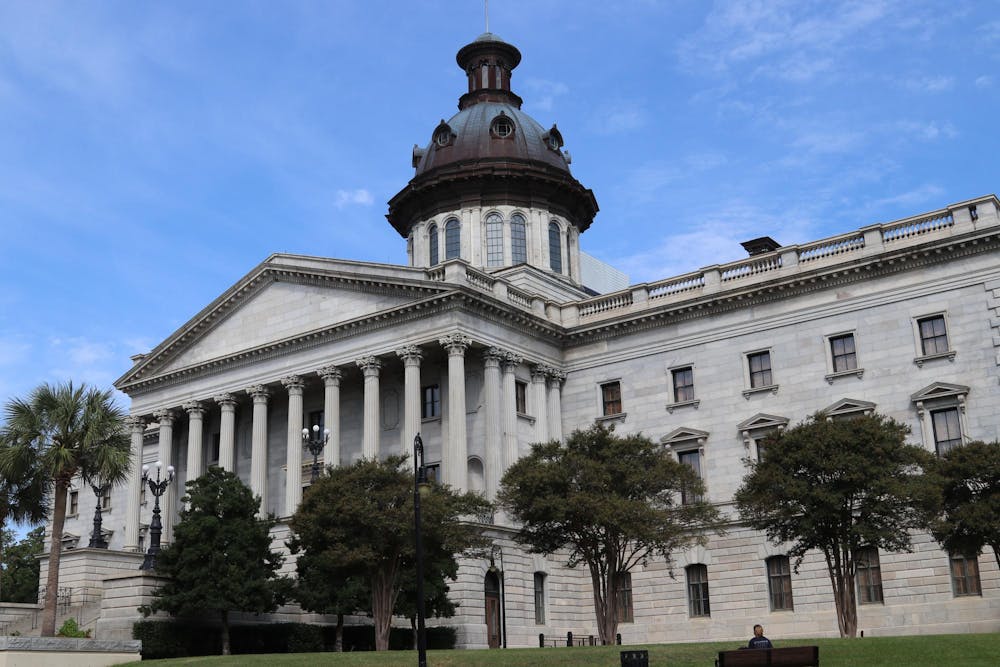
A bill requiring the Ten Commandments to be posted in every public school classroom in South Carolina is making its way through the state legislature.
The South Carolina House of Representatives introduced H. 3217 in late 2025. The bill has since garnered 14 sponsors in the House and been referred to the Judiciary Committee.
If passed, the bill would require a poster of the Ten Commandments to be displayed “in a conspicuous place” in every public school classroom in the state. The bill stipulates that the poster’s contents must be written in “a size and typeface that is legible to a person with average vision from anywhere in the classroom,” and it allows the allocation of public funds to provide them.
Statewide opinion
Four out of five students surveyed were against the bill, and all four cited the separation of church and state as to why.
“I don’t think that it should be required for all classrooms to have it,” said second-year exercise science student Olivia Frost. “Education does fall under ‘state’ ... It shouldn’t be that students are forced to look at or learn about the Ten Commandments. That’s more of a church issue.”
Two surveyed students, Frost and first-year political science student Trista Walter, said that despite their own religious beliefs, they don't agree with displaying the Ten Commandments in classrooms.
“I would loosely consider myself a Christian, but I don’t think it makes any sense to have a poster of the Ten Commandments in schools because that kind of just violates separation of the church and state,” Walter said.
Frost said students shouldn't be made to see the Ten Commandments in their classrooms without the equal representation of all religions displayed.
“If parents or anybody wants students to learn about the Ten Commandments, there are church schools, Catholic schools, private schools that they can attend, but I don’t think it’s necessary to go in classrooms where students of all religions are present,” she said.
First-year finance student Andrew Dato, who supported the bill, said having the Ten Commandments in classrooms could help instill their values in public school students.
“I think today those values are really important because of the divide in our country, and I think it’s just good to get them instilled in kids early,” he said.
Dato, a Catholic, also said learning about the Ten Commandments at a young age could help students decide their religious beliefs later in life.
His view is similar to what proponents of the bill say the goal is. South Carolina Rep. Kathy Landing, a supporter of the bill, said displaying the Ten Commandments in classrooms could improve and strengthen education.
“For our young children to be exposed to that, to be able to ask questions and maybe even be able to debate and discuss sometimes some of those commandments is not a bad thing,” Landing told the South Carolina Daily Gazette on Jan. 23. “It actually helps strengthen the education process, and Lord knows we need plenty of that.”
Though religion can certainly have a place in the classroom, it should be properly contextualized and age-appropriate, said assistant professor of religious studies John Mandsager.
“Just placing the Ten Commandments on the wall doesn’t necessarily lead to civic or moral education but instead could signal that … the state of South Carolina is endorsing that religious perspective above other ones,” Mandsager said.
National landscape
If the H. 3217 bill passes, South Carolina will become the fourth state to mandate posted Ten Commandment signage in K-12 schools. Texas, Arkansas and Louisiana have already passed similar bills.
These bills are facing challenges in court on the basis that they violate the Establishment Clause, a section of the First Amendment that bars the government from endorsing or upholding one religion over another.
A federal court of appeals heard lawsuits from Texas and Louisiana on Jan. 20, according to NBC News. This hearing is the latest in a series of appeals by these states.
Kirk Randazzo, a political science professor, said South Carolina’s bill would likely face similar legal challenges if it is passed into law.
In 2022, the Supreme Court abandoned the Lemon Test, a three-prong test used to decide Establishment Clause court cases for over 50 years. If a government policy failed any part of the Lemon Test, it would be declared unconstitutional.
Three prongs of the Lemon Test
- Have a secular, or non-religious, purpose
- Do not advance or inhibit a religion
- Do not promote an extreme entanglement with religion on the government’s part
Since 2022, the court has used the historical traditions test, Randazzo said. Using this test, the court will “look at history and see what it says” to determine its decisions, he added.
Randazzo said originalism, a legal philosophy in which the court interprets the Constitution as it believes the Founding Fathers would have, could create inconsistencies in legal rulings because the Founding Fathers rarely agreed on everything.
“We now have a doctrine used by the Supreme Court … that does not acknowledge that history is a horrible guide to help us figure out what's going on,” Randazzo said.
Jay Thomas, fourth-year political science student and general officer of the USC American Civil Liberties Union, said the ACLU will likely argue that the bill is unconstitutional because it "favors Christianity."
"Even though there are some things within it, like 'thou shall not commit murder,' ... that are easily agreeable to in a non-religious standpoint, ... it still has a connection to Christianity because it is copy-and-paste from the Bible," Thomas said. "If we're going to pass a law that favors Christianity, why not allow texts from other religions?"
The abandonment of the Lemon Test and the current conservative-majority makeup of the Supreme Court could give Ten Commandments posters a foothold in classrooms, Randazzo said.
"I think there is a better-than-even chance that statutes like this will be successful in court," Randazzo said. "If you would've asked me this a year ago, I'd say there's no way. Now I'm not so sure."
Though the test to determine the constitutionality of religious laws has changed, Randazzo said he believes the bill is still "highly unconstitutional."
“As soon as the government endorses an aspect of religion, whether it’s a poster on the wall, Bibles sitting on the desks, prayer in a classroom, … we have crossed the line that the Establishment Clause was designed to protect,” Randazzo said. “We’ve picked winners and losers when it comes to religion.”