
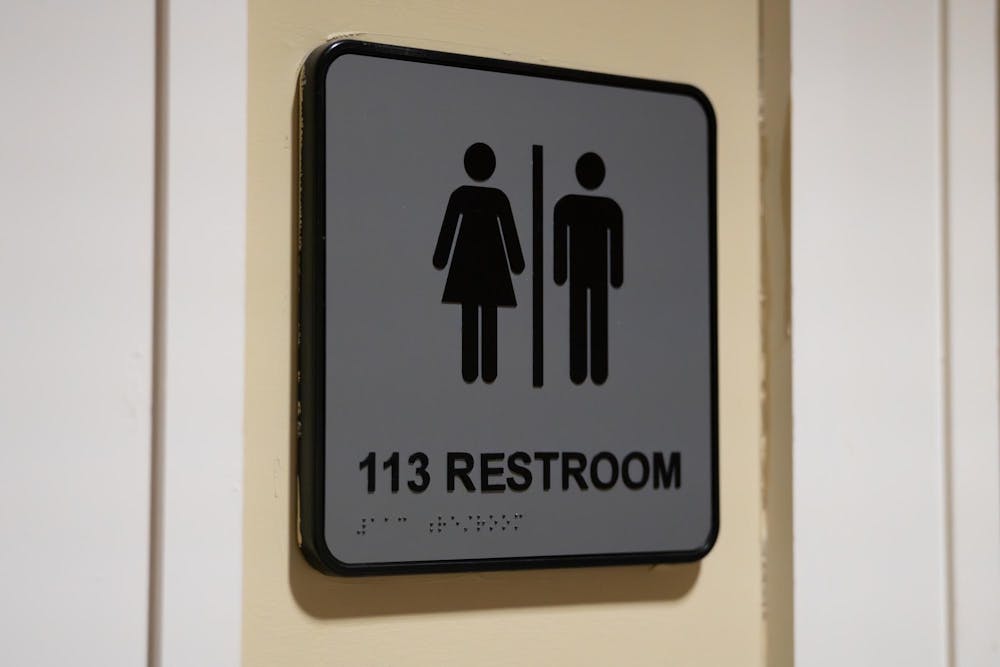
South Carolina legislators may prohibit students at public colleges from using bathrooms that do not align with their sex assigned at birth.
The House passed H. 4756 on Jan. 29, which would extend an existing K-12 law on bathrooms and changing rooms to include state-funded institutions of higher learning. The Student Physical Privacy Act would withhold 25% of state funding for institutions that fail to comply. It gives students and staff the ability to privately sue a school or university if they encounter someone of the opposite sex in the relevant facilities.
“At its core, this legislation is about something very simple: the right of women and girls … to privacy in intimate spaces,” said Rep. April Cromer (R-Anderson) on the House floor on Jan. 19.
Opponents of the bill include the American Civil Liberties Union and LGBTQIA+ organizations, who say the law discriminates against transgender students and would invite harassment toward both transgender and cisgender people.
How are students impacted?
The bill puts transgender and nonbinary students in a position where they can face bullying, said Cristina Picozzi, executive director of the Harriet Hancock Center in Columbia.
Under the effect of the existing K-12 rules, one young, nonbinary student served by the Harriet Hancock Center used a single-occupancy restroom until their school’s administration barred them from using it, Picozzi said. That student then used the girls’ room, which corresponded with their sex assigned at birth. But their androgynous appearance led to harassment, according to Picozzi.
“That’s the bathroom they’re told that they should be using,” Picozzi said.
The opportunity for civil lawsuits brings suspicion, rumors and accusations against students using public facilities, said Paul Bowers, communications director of the American Civil Liberties Union of South Carolina. Other officials with the ACLU have spoken against the bill in previous committee hearings.
“This bill will also harm the cisgender girls you claim you want to protect,” ACLU advocacy strategist Mikayla Mangle told legislators on Jan. 14.
Some USC students already actively avoid campus restrooms out of fear of discrimination, according to third-year performance and choreography student Lavender Grant. They are the president of Individuals Respecting Identities and Sexualities, an LGBTQIA+ student organization at USC.
Almost half of transgender youth said they sometimes avoid public bathrooms, according to a 2024 study by the International Journal for Transgender Health. The study also reported that 38% of these students stopped eating and drinking throughout the day to avoid the need for bathroom breaks.
“These are daily decisions for young people that are an affront to their dignity and can actually be dangerous for their health,” Bowers said. “It is not safe to have to hold it in all day for fear of a law like this.”
The House amended the bill to add a mandate that schools and institutions of higher learning have single-occupancy restrooms available.
During debate on the amendment, Rep. Travis Moore (R-Spartanburg) said most educational institutions already have these available. His statement came as other representatives questioned the fiscal impact of such a mandate.
University of South Carolina spokesperson Collyn Taylor confirmed that single-occupancy, unisex restrooms are available on campus.
The availability of these facilities varies from building to building, according to Grant. The band and dance facility has only one gender-neutral bathroom, reserved for faculty members, while the College of Social Work has multiple open options, they said.
“It sort of depends on the culture of each college, is what I’ve gathered,” Grant said.
The bill’s section on single-occupancy restrooms does not specify whether they must be available to students.
The rule would not alleviate the overall issue, according to Picozzi.
“I think it kind of puts a band-aid on it,” Picozzi said. “There’s still this bigger problem of you're still able to make assumptions about people’s bodies.”
The University of South Carolina is already in compliance with the bill and does not anticipate any changes as a result, according to a statement from Taylor. USC suggested to the statehouse that the bill would not result in a financial impact to the university, according to a fiscal impact report by the state.
What’s next for the bill?
The similar bill in the Senate will have a subcommittee meeting on Feb. 18. There will be an opportunity for public comment there.
The ACLU will continue to show up to public hearings on the bill, Bowers said. The organization’s main tools are education and advocacy. While the ACLU has a reputation for legal action, that is a last-resort option and not announced in advance, Bowers added.
Should the bill pass, both the ACLU and Harriet Hancock Center will continue their educational work.
“Our lawmakers have made a priority out of targeting a very small and vulnerable population in our state,” Bowers said. “So there’s still a lot of work to be done in just building basic understanding.”