
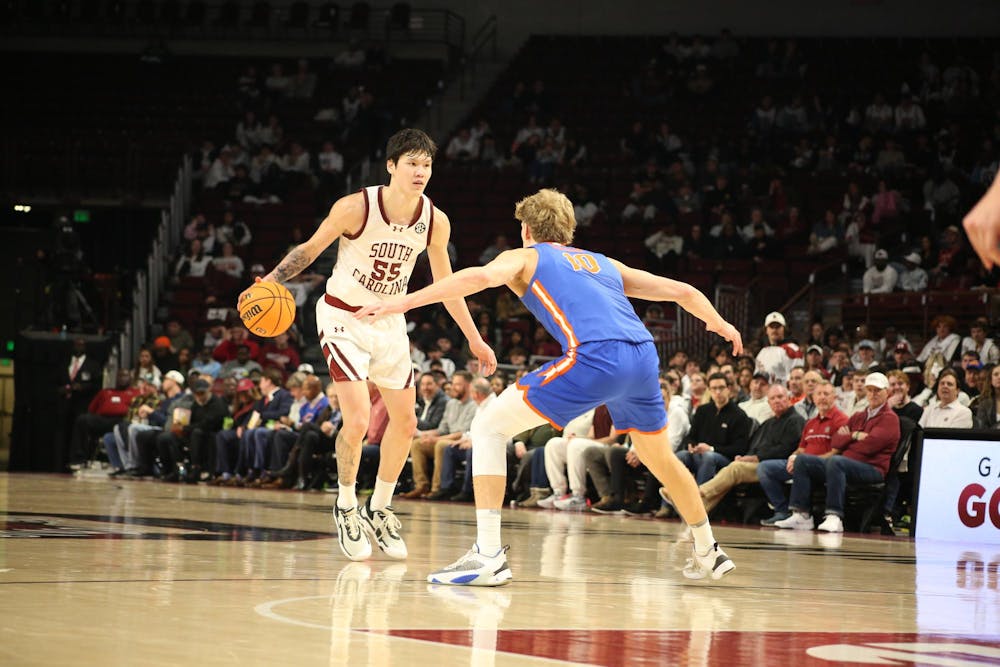
The Gamecocks loss to No. 12 Florida was not defined by one drought or one decisive scoring run. It was defined by the way Florida was able to capitalize on South Carolina's shortcomings on the glass and in transition.
Live-ball turnovers turned into fast-break layups. Missed shots became extra possessions, and South Carolina’s brief surges were repeatedly erased within a possession or two.
“Between second-chance points and transition points, that was the vast majority of what their offense was,” head coach Lamont Paris said postgame.
The Gators outscored the Gamecocks 27-15 in second-chance points and held an 18-11 edge in points off turnovers and transition opportunities, a 19-point swing that closely reflected the final margin.
When redshirt senior guard Meechie Johnson knocked down a 3-pointer in the first half, Florida answered immediately with a 3-pointer from senior guard Xaivian Lee. When junior forward Elijah Strong opened the second half with a jumper just 10 seconds in, Florida junior forward Alex Condon converted a layup 17 seconds later.
Each South Carolina push was met with an immediate Florida counter, preventing the Gamecocks from stringing together stops or building sustained momentum. That inability to stack productive defensive possessions proved costly.
Midway through the first half, Condon rose for a dunk that pushed the lead into double digits for the first time. This demonstrated Florida’s ability to finish through contact and control the paint.
South Carolina managed to stay within reach through free throws and timely baskets from Johnson, redshirt senior guard Kobe Knox and senior guard Mike Sharavjamts, but defensive lapses kept the deficit from shrinking meaningfully. By halftime, Florida’s 39-29 advantage reflected control of tempo and efficiency in the paint.
The second half followed a similar script. Strong’s early jumper offered a spark, but Florida quickly restored order. By the 17:27 mark, the Gators had extended the lead to 15. The separation widened through sequences rooted in execution.
At 15:16 to go, a Sharavjamts turnover led directly to a Condon layup. Moments later, Lee converted a fast-break finish to make it 50-37. A steal by sophomore guard Isaiah Brown at 13:23 disrupted another South Carolina attempt to build rhythm.
Paris emphasized Florida’s competitiveness as another difference-maker.
“They’ve got a competitive team,” Paris said. “As you look, what’s most important in the college landscape to me, how competitive guys are, competitive spirit wins the day.”
That competitive edge showed up in the margins. Florida consistently won 50-50 balls, finished possessions and answered baskets with baskets of its own.
When Johnson converted both free throws at the 11:55 mark to trim the deficit to 55-41, Florida responded with a 3-pointer. When Knox halted a run with a layup, Condon added at the line and junior forward Thomas Haugh buried another three to reestablish a 20-point cushion.
Even the final sequence reflected the theme. With the outcome decided, freshman guard CJ Ingram secured an offensive rebound on the last possession, allowing Florida to drain the clock. It was a small moment in a settled game, but it underscored which team had consistently controlled the glass.
South Carolina showed flashes of offensive aggression. Johnson attacked the rim and generated points at the free-throw line. Knox and Strong provided energy. But without consecutive stops or control of the boards, those moments never coalesced into a sustained threat.
In quantifiable terms, the difference was clear: a 10-point halftime deficit that ballooned to 20, driven largely by second-chance and transition scoring. In practical terms, it was about competitive consistency. Florida capitalized on mistakes, finished possessions and responded every time South Carolina hinted at a run.
As Paris framed it, competitive spirit won the day. And in the areas that mattered most — extra possessions and points off turnovers — Florida’s edge proved decisive.