
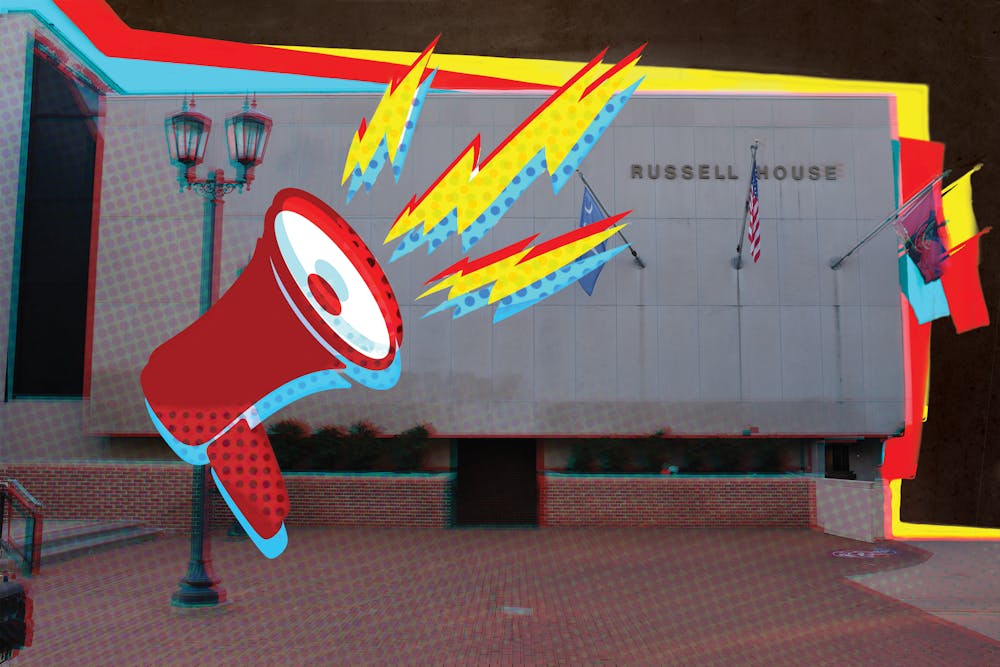
On Sept. 18, 2024, right-wing activists Gavin McInnes and Milo Yiannopoulos spoke to a room with empty chairs at the Russell House. Metal barricades caged the stage and South Carolina Law Enforcement Division officers stood guard — some even say there were roof snipers surveilling the event.
Uncensored America, the organization hosting the event, called it a free-speech victory. After all, why wouldn't it? It had sued and generated headlines that gave it more attention. When the student senate voted to deny funding, conservative media called it censorship. The Foundation for Individual Rights and Expression called the denial "in clear violation of the First Amendment."
But after the dust settled, nobody seemed to connect the dots. The funding denial was not a setback. It was the strategy. The lawsuit generated headlines. The headlines generated pressure. The pressure generated a spectacle — barricades, snipers and empty chairs — that would play on loop as evidence of persecution.
The free-speech movement had learned what the student senate never did. Sometimes losing the vote is how you win the war.
But the movement's commitment to open discourse ends where its own critics begin. When criticized, the same men demanding platforms rush to sue their detractors into silence.
In 2019, long before coming to USC, McInnes filed a defamation suit against the Southern Poverty Law Center for labeling the Proud Boys a hate group. He invoked the First Amendment to preach violence, yet when others used their speech to represent him accurately, he sued.
The attack on education
Conservative think tank Turning Point USA claims to champion free speech. Yet it maintains a Professor Watchlist targeting hundreds of academics across the country.
Charlie Kirk, late founder of Turning Point USA, said the site "gives parents and students a way to decide if they need to look deeper and learn more." But PEN America, a nonprofit organization focused on free expression and academic freedom, saw it for what it was — "noxious purveyor of precisely what it claims to deride: the intimidation and ostracization of those who express controversial views on campus."
What does that look like in practice? At Diablo Valley College, a far-right organization edited professor Albert Ponce's lecture on white supremacy into a two-minute clip.
"It ended up on Fox and Breitbart," Ponce said. "Once it hit that ecosystem, it was gone."
Hate mail turned into death threats against him and his family.
People began posting photos of his family online, including his then-9-year-old daughter. He told a public radio show that he stopped letting her even touch the mail. College administrators were flooded with demands that he be fired.
"For anyone who touches these issues now, it's open season," Ponce said.
At Arizona State, Turning Point's Professor Watchlist targeted writing instructor David Boyles for his advocacy of a drag queen reading program. In October 2023, two Turning Point USA employees waited for Boyles outside his classroom, followed him across campus, and demanded he answer questions about his sexuality, while filming.
Boyles was slammed to the ground, his head cracking against the concrete plaza. He was left bloodied, with scrapes and bruising across his face. Both employees later admitted guilt in court.
"This is the kind of outrageous conduct that you would expect to see from bullies in a high school cafeteria," Arizona State University President Michael Crow said.
An organization cannot demand that universities platform speakers while running a database designed to intimidate professors into silence. That is not a free-speech position. That is a my-speech position.
Legislating 'wrong' speech away
Simply attacking people you disagree with is not enough — after all, you still have to face the courts. So the movement wrote laws instead.
In 2025, conservative state legislators introduced more than 70 bills restricting what professors can teach, which books students can read and which perspectives universities can value in hiring — and seven have become law. In 2025 alone, 21 censorship bills became law in 15 states — the highest single-year total on record. Every single one of those legislatures was Republican-controlled.
At Texas A&M, a student filmed a professor teaching that there are more than two sexes — a scientific fact — in a children's literature class. A Republican state lawmaker posted the video online. Gov. Greg Abbott publicly called for the professor's dismissal. Days later, the professor was fired and two administrators were demoted from their leadership roles.
PEN America documented 6,870 book bans in the 2024-25 school year across 23 states and 87 public school districts. Over 80% came from just three states — Florida, Texas and Tennessee. The American Library Association reported that 72% of censorship demands came from pressure groups and government entities — including elected officials, board members and administrators.
Utah made it law. Under HB29, if three school districts pull a book, every public school in the state must follow. The rule treats books more strictly than guns — adults with concealed carry permits can legally bring firearms into Utah schools, but students cannot bring their own copies of banned books. A Utah State Board of Education member, when asked what should be done with the books, said he did not care if they were shredded or burned.
Chilling speech in the classroom
The Foundation for Individual Rights and Expression's 2024 faculty survey of 6,269 professors found that 27% feel unable to speak freely. One professor said they almost did not fill out the survey itself.
"(I) waited about two weeks before getting the courage to take the risk," they said.
That fear is not just an isolated example; that same survey found 35% of professors report self-censoring in writing — softening or avoiding contentious points to prevent backlash — about four times the rate during the McCarthy era.
At USC, we already have an official policy for this. In 2021, Gov. Henry McMaster signed the Reinforcing College Education on America's Constitutional Heritage Act, mandating what aspects of American history universities must teach. The South Carolina Commission on Higher Education then began collecting syllabi and auditing a sample of course sections each year for compliance. Kirk Randazzo, graduate placement director of USC's Department of Political Science, said people "may just avoid discussing controversial subjects out of fear" and "that's really part of what a university is supposed to do."
Then the congressional delegation made it personal. An open letter signed by six South Carolina Republicans — including Ralph Norman and Nancy Mace — called on university presidents to "eradicate" critical race theory. The letter named USC education professor Allison Anders directly.
Faculty called for the administration to defend academic freedom, but the university that brands itself a free-speech leader couldn't find the words. The 2025-26 state legislature session brought H. 3184, banning Diversity, Equity and Inclusion in admissions and employment, and Bill 368, prohibiting Diversity, Equity and Inclusion offices statewide.
Distracting the kids
How has USC responded to all of this? With bouncy houses.
During Uncensored America's event, over 1,000 students gathered on Blatt Field for Blatt Bonanza — free food, bouncy castles, Spikeball and a rage room.
The student body president at the time told WACH, "This is the event on our campus. It’s not an alternative or counter event."
At the time of the event, Kristen Issa, a graphic design and illustration student, told the Daily Gamecock that she went because she "didn’t feel safe protesting and didn’t feel like there was anything that would actually come out of it." Criminology and criminal justice student Jarissa Adams said at the time of the event, she went to Blatt Bonanza so she "would be safe and not in the presence of bad vibes."
University President Michael Amiridis condemned the speakers' "vile and juvenile rhetoric" at the time of the event and quoted Supreme Court Justice Louis Brandeis on the value of more speech over enforced silence. The president claimed neutrality, then showed up at Blatt Bonanza for selfies. Bouncy houses are not a free-speech policy. They are an admission that the university knows exactly what it is platforming and would rather distract than confront.
Act wise, get a surprise
One year later, the U.S. Department of Justice sent a letter to the University and the SC Attorney General after Kirk's assassination at a Utah university. USC administrators had told Turning Point USA and Uncensored America that "controversial speakers and activities will no longer happen outside for the rest of the semester."
It labeled Kirk a "known disrupter to a population" — without defining either term. Assistant Attorney General Harmeet Dhillon closed the Department of Justice letter: "U of SC—act unwise, get a surprise!" The administration that hosted bouncy houses folded once again instead of standing its ground.
Then came the firings. At Clemson, a professor was fired for sharing a post that criticized Kirk's gun positions and explicitly condemned violence; a Republican legislator threatened to defund the university. In Tennessee, a professor shared Kirk's own words about gun deaths being the price of the Second Amendment.
Sen. Marsha Blackburn posted his photo and contact information publicly. He was fired — then reinstated with a $500,000 settlement after the university admitted it hadn't followed its own termination procedures. Nationwide, at least 350 educators faced discipline for commenting on Kirk's death. Free speech for the provocateur but termination for the professor.
And once you see the pattern, the slogans stop sounding like principles.
Conservatives sued for $3,577 and called it a First Amendment victory. They ran a database that sent death threats to a professor's family and called it information. They shoved a man to the ground for his sexuality and called it journalism. They fired educators for their opinions and called it accountability. They burned books and called it protecting children.
It was never about free speech. It was always about my speech.
Editor's note: This article was initially published in our February print edition. JC Vaught is no longer writing for The Daily Gamecock due to a conflict of interest.