
Deborah Billings doesn’t believe in objectivity.
Billings is an affiliate faculty member in the Department of Women's and Gender Studies. She has been studying and advocating through reproductive healthcare since she was 15 years old, when she ended her own pregnancy with an abortion.
“It's very personal to me,” Billings said. “I remember how scary that was and complicated it was and also so thankful that I was able to access it.”
According to the Guttmacher Institute, almost one in every five pregnancies ended in abortion in 2020, and this number is rising. Since Billings ended her pregnancy, she has done research all over the world on subjects such as prenatal care, midwifery and the effect of Medicaid on natal health. While Billings said her published work may look impressive, that’s not what's important to her.
“It's about making a difference, right?” Billings said. “I'm all for science, for science sake, because we need that too. But that's just not me.”
Since the fall of Roe v. Wade in 2022, South Carolina legislators have imposed restrictions on reproductive healthcare, including a six-week abortion ban. Proposed legislation includes criminalizing abortion-inducing medication and identifying fertilized human eggs as human beings.
According to the National Library of Medicine, 40-60% of fertilized eggs don't come to term, meaning that the embryo never becomes a child, which could criminalize a miscarriage or necessary abortion service.
Billings said if legislators cared about life, they wouldn't propose the legislation.
"They'd be working so hard on laws that provide housing and access to education," Billings said. "They would support Medicaid expansion and job creation. They don't do any of that. They're on a mission. They are misogynists."
Billings said she hopes her research and advocacy experience helps others fight against legislation limiting reproductive justice.
“Unless either we as researchers or somebody else ... can take what we do and translate it to legislators, to students, to physicians,” Billings said. “Then I think we're all just sort of waiting for our paycheck every two weeks.”
Frameworks
Billings said abortion controversies exist within a larger framework of reproductive health issues.
When people think of limiting abortion restrictions, they don’t consider situations like infertility treatments, miscarriages and stillbirths, said Kathryn Luchok, the senior instructor in the Department of Women's and Gender Studies.
Luchok is a research professor whose work has brought her to Togo, Nigeria and Nepal. As a feminist and a person interested in healthcare, she wanted to apply her public health knowledge. She decided to do that through reproductive healthcare research.
Luchok said when considering individuals struggling with infertility and miscarriages, abortion prevention actually criminalizes pregnancy.
According to the National Library of Medicine, childbirth is 14 times more dangerous than abortion, and pregnancy complications may require an abortion.
“These are often people that really wanted to have a child too,” Luchok said. “And yet they end up in jail if they have a pregnancy loss. So, yeah, it is interrelated.”
Luchok’s research on reproductive healthcare focuses on women's emotional health during pregnancy and use of maternity services, among other things.
For Julia McReynolds-Perez, a professor at the College of Charleston, choosing the right time and place to begin motherhood is personal.
“I can't imagine what the experience would be like for people who are forced into that relationship and that role when it's not the right time,” McReynolds-Perez said. “When it's not the right partner, when it's not the right place.”
McReynolds-Perez is also department chair and associate professor of sociology. She said she wants to ensure that if others wanted to take on the role of motherhood, they did so on their own volition.
Time, place, situation
Luchok's research has found that for women in homeless shelters and domestic violence shelters, it may not be the right time to take on motherhood. Those women had higher rates of pregnancy.
“One of the ways they handled their fertility was to go ahead and get their tubes tied,” Luchok said. “A permanent end of their fertility because their lives were difficult and they couldn't find ways to (better their) lives, for the most part.”
Luchok said it can be challenging to access maternity services because there are many maternity deserts in South Carolina. A maternity desert is an absence of reproductive care options, such as birthing hospitals, obstetricians and gynecologist care.
“People don't have any way to control their fertility, and they use abortion to do that when they have these unintended pregnancies,” Luchok said.
Billings said the limited options are due to what providers offer, contraceptive affordability and gender-based violence, all of which her work has centered on, she said.
When it comes to abortion itself, Billings’ research found that putting legal restrictions on abortion doesn’t stop people from getting the procedure. It just makes it more dangerous, especially for those who struggle financially.
“Who's really suffering the consequences of the restrictive laws? It's women without access to resources,” Billings said. “If you've got money, you can fly to another country, you can find your private provider and pay that person.”
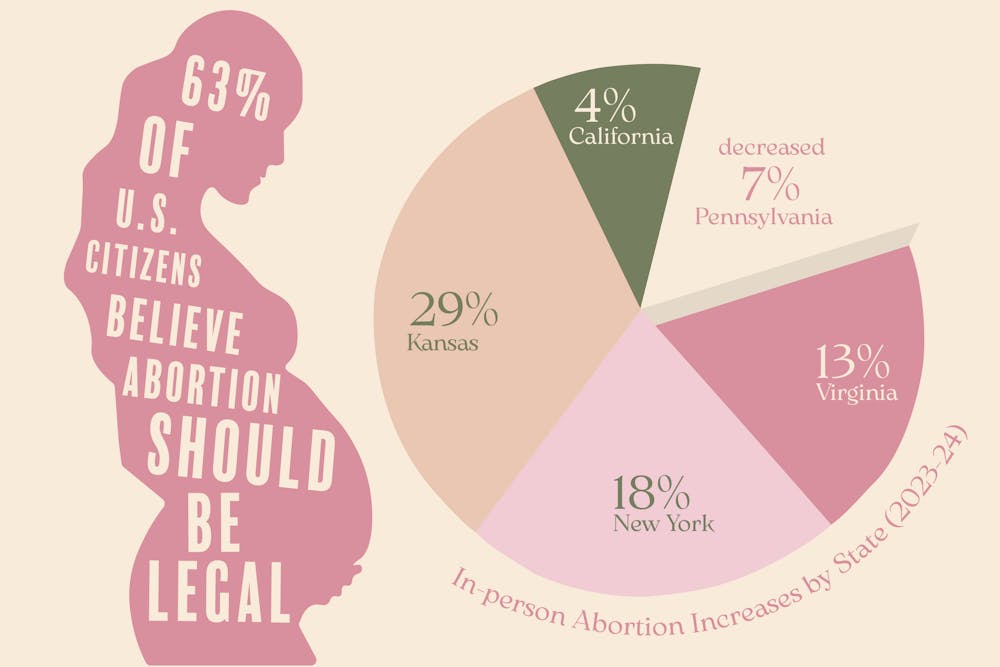
According to the Society of Family Planning, abortion levels increased in 2023 and 2024 after the Dobbs decision. From 2023 to 2024, the average number of in-person abortions in Kansas, New York, Virginia and California has increased.
The system
Underlying this limit of resources is a hierarchical system that will keep all women suppressed, Luchok said.
"Not that people sit down and think that outright so they can talk about it, but it's the tacit understanding, the underneath, that they don't even necessarily realize," Luchok said.
Luchok said society wants to exert control over most natural systems, such as the reproductive system, but there’s more to it than that.
“A lot of the power of the female body is the ability to bring new members of your society into the world,” Luchok said. “And I think that that is seen as dangerous."
Luchok said the same desire for control applies to childbirth. While this may not be realized, it is prevalent in the patriarchy.
“If you can find something that keeps a group of people oppressed, or down, then you have more opportunity to be successful,’’ she said.
But this is untrue, Luchok said. In an inequitable system, everybody suffers.
“If you're thinking about being self-interested, you might be wanting more equity in healthcare, because that would mean your health would also be better,” she said. “We spend more money than any other country in the world on healthcare. Our outcomes are way down.”
A 2023 United Health Foundation study found that infant mortality rates have improved worldwide, but U.S. rates have not improved at the same rate.
Advocating for unity
McReynolds-Perez said individuals often think reproductive advocates are anti-motherhood, but this is a misunderstanding. The reproductive movement centers on the right to choose whether or not to have children, not to glorify one or the other, she said.
“It's not about denying anyone motherhood or parenthood or being against it, but rather taking it really seriously,” McReynolds-Perez said.
Academics aren't the only ones invested in reproductive activism. According to the Pew Research Center, 63% of US citizens believe abortion should be legal in all or most cases.
McReynolds-Perez said it’s offensive that people think they know better than the person deciding whether or not to go through with their pregnancy. Allowing reproductive autonomy is essential, she said.
“People think of abortion or unplanned pregnancy as something that only hits someone's life in unusual circumstances,” McReynolds-Perez said. “It's actually a pretty common thing that people live through and live in fear of for decades of their lives.”
According to the Guttmacher Institute, abortion rates are highest for 20- to 24-year-olds and lowest for 15- to 17-year-olds.
McReynolds-Perez said it’s scary to be a human being in South Carolina among proposed legislation. She said people may have to risk their lives to end a life-threatening pregnancy.
McReynolds-Perez said society values expertise less today. Some examples are the anti-global-warming and anti-vaccination movements.
“This is one of those areas where we know these laws are harmful,” McReynolds-Perez said. “I hope I play some role in the community of experts that lets people know how harmful it is to limit these rights.”
There's an idea that qualitative researchers should be objective about their work; McReynolds-Perez said this is a misunderstanding of their work.
"I've been accused of being more of a journalist than a researcher," Billings said. "That was supposed to be an insult. I never took it as an insult."
Billings said that if people fall silent, restrictions will only get worse.
"I don't want to go to prison," Billings said. "But until you knock down my door and take me away in handcuffs, I'm still gonna be screaming this stuff because this is ridiculous."