
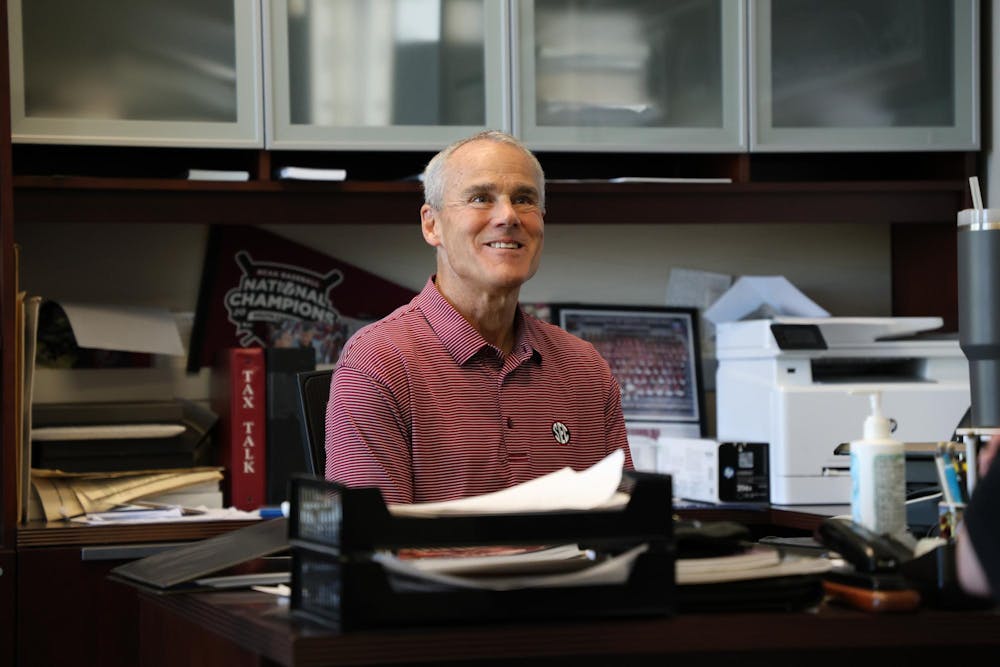
Steve Fink wanted to be an accountant. Over 40 years later, and after 21 years serving as South Carolina’s Senior Associate Athletics Director for Communications and Public Relations, he’s calling it a career. Officially hanging it up this past June, The Daily Gamecock sat down with Fink to talk about his journey through sports media.
Born and raised in a small town in Iowa, he opted to stay close to home and attend the University of Northern Iowa for their accounting program.
“After a semester or two, I realized that wasn’t for me,” Fink said. “I made an appointment and went into the athletic director’s office and said ‘I want to get involved somehow in athletics.’”
He began by helping out in the press box during sports games, running the message board along the top of the scoreboard during athletic events. Fink says the joy he found from being in the press box solidified his desires to pursue a career in sports. He’d finish his time at Northern Iowa with a degree in marketing, before going to grad school for Sports Administration at Western Illinois.
“At that time, there were only about, I think six schools in the country that had a master's program in sports administration,” Fink said. “It’s just growing. Everyone’s got one now.”
The program required Fink to have an internship, which he landed with the Denver Bears, a AAA baseball team, as a media relations assistant.
“I was fortunate, and you'll find this throughout, a lot of times it's not what you know, it’s who you know,” Fink said. “And maybe more importantly, who knows you.”
Among connections he’d make in his time with the Bears was the recently promoted Director of Sports Information at the University of Colorado. Searching for an assistant, Fink found his first full-time job as an assistant Sports Information Director in 1984.
He’d stay in the role for two years before the Bears, who had since changed ownership, were in need of a Public Relations Director. Now the Denver Zephyrs, Fink returned to minor league baseball for two seasons.
“Everybody in minor league baseball, whether you're a player, a coach, the manager, front office, the goal to get to the big leagues, right?” Fink said. “I was like everybody else. I'm sending out letters every year and resumes and, ‘Hey, if you have any openings, I’d be interested’, blah, blah, blah.”
That big league call came from the Kansas City Royals. Fink and his wife moved to Kansas City in December of 1987, where he’d join the team as an “assistant PR guy.”
Fink’s time with the Royals would last over 12 years. He’d receive a multitude of promotions until becoming the Manager of Media Relations, a title held by just 30 in the MLB. The job itself came with many perks, but Fink felt his life at home deserved to take higher priority.
“A lot of fun traveling everywhere, spring training and all that, which is great, especially if you’re a young single guy,” Fink said. “When you’re married and now have two small kids and I’m gone all the time, it got to be a bit of a challenge for a personal standpoint. My wife was raising her kids by herself.”
Amidst the search of a better work-life balance, he received a call out of the blue from the head women’s basketball coach at TCU Jeff Mittie. Mittie had worked for Fink as an intern with the Royals, and reached out to his former boss to see if he knew anyone who may be interested in an SID job at the school.
“I wasn't even a hundred percent sure I knew exactly where (TCU) was,” Fink said. “He talked about it, I said ‘Yeah I do know somebody who might be interested, it might be me.’”
He and his family packed up and made the move to Fort Worth, where they’d stay from 2000-05. TCU’s Athletic Director at the time, Eric Hyman, brought Fink on to head media relations for the school’s 19 intercollegiate athletic teams. In 2005, Hyman took the Athletic Director job at the school Fink would learn to call home.
“Eric said, ‘Do you want to come along?’ And I said, ‘Yeah, never been to South Carolina, but okay, let's go for it,' because I believed in him and what he was doing,” Fink said.
Fink noted the humor in the recent “second wave” of TCU products joining the Gamecocks, with current Athletics Director Jeremiah Donati and first-year offensive coordinator Kendal Briles both making the move to Columbia from Fort Worth. Accompanying him in his first season at South Carolina was a head coach who’d leave quite the legacy.
“I'm driving home one day and my phone rings and I look at it and Steve Spurrier’s name pops up and it was like, 'What the heck?'” Fink said. “He had just been named coach here that winter before … He called me just outta of blue just to welcome me aboard and knew that I was coming and looked forward to working with me.”
There were few head coaches as opinionated around the microphone as Spurrier.
“As a PR guy, it was always interesting because you never knew what he was going to say,” Fink said. “The best days of Gamecock football (were) under his watch.”
Spurrier frequently bumped heads with journalists in his time at South Carolina, going so far as to even ban one from his availabilities. Being on the opposite side of the media was something Fink enjoyed in his role.
“I’ve always enjoyed being part of the team and kind of being on the inside of what’s going on,” Fink said. “I like to think of myself as a positive person… More of a cheerleader to a sense than what a journalist can be.”
As a part of the team, Fink helped Gamecock football see 13 players earn First-Team All American honors. It was the role of Fink and South Carolina’s PR staff to ensure the school’s best athletes received deserved national attention.
“I tell the players this: The more success we have as a team, the more individual success, awards, accolades you’re going to receive as well,” Fink said. “There’s only so much a PR guy can do if you’re not winning enough.”
Setting players up to maintain strong relationships with the media was an aspect of the job that Fink prioritized.
“It helps when the guys are willing to speak to the media and open up a little bit so people get to know them a little bit more,” Fink said. “At the end of the day, writers, whatever you’re voting for, you’re people to. If you’ve been treated well by the players, you see it in the Hall of Fame all the time for guys that get in right away. Other guys have to wait because they’ve been a jerk along the way.”
The landscape of college football changed over the course of his time at South Carolina, which in turn has resulted in his duties evolving as well. In 2017, the Gamecocks Media Relations Department was renamed to the Athletic Communications and Public Relations Department.
“We’ve seen a lot of change from the old sports information,” Fink said. “We’d get calls from ‘Hey, we were talking in the bar last night, and can you tell me who the leading rusher in 1972 was, we’re arguing over’ and so it was more sports information in a sense that you’d (get) all kinds of questions about stuff. It’s just become a lot more than that with all social media now. The job’s quite frankly a lot different than it used to be.”
Under Fink’s leadership, South Carolina has been recognized as the recipient of the Annual Super 11 Awards in four of the last five seasons, an award that’s voted on by the Football Writers Association of America to honor the best performing sports information departments in FBS.
“A lot of that goes to your head coach too, and how much access he allows and how cordial he is with the media in helping them,” Fink said. “It’s not a coincidence that part of it’s that Shane Beamer is the head coach. I’ve been doing this for a long time … never won it before Shane.”
Despite residing at a university nearly 1,000 miles from his hometown, Fink calls Columbia home, and he plans to stay as he enters retirement.
“My daughter still lives here, and she and my wife have been tailgating for years, same spot. So it’ll be different ‘cause I may be joining them,” Fink said.
While he joins his family in the tailgate lots outside of Williams-Brice Stadium, he’ll finally be able to enjoy the stress-free nature of simply being a fan.
“I've been doing this for 42 years and it's basically 24/7, 365 where you don't know when that phone's gonna ring and it's a coach who needs something, a student athlete maybe just gotten in trouble for some reason and now you're, you know, putting out a fire,” Fink said. “I mean, anything can happen at any time, and it is just gonna be weird to not have that phone ring.”
After over four decades of surrounding himself with sports, Fink has no plans of losing interest in Gamecock athletics.
“We’ve still got tickets, I’ll be at every game that I can be at,” Fink said. “That’s why I got in it, ‘cause I love sports. I love being around it, and that hasn’t changed.”