
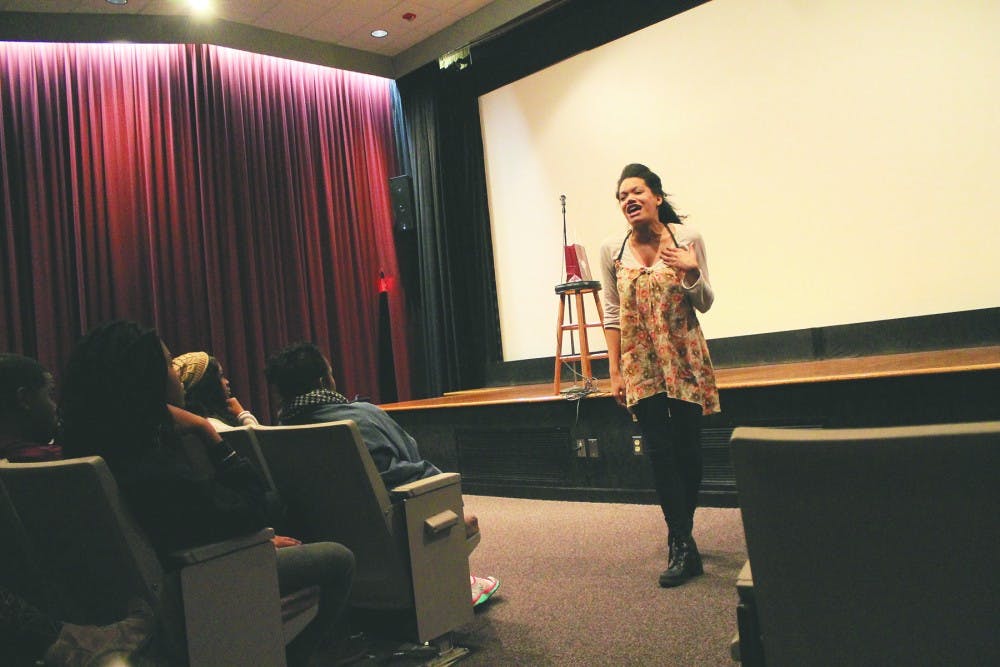
Accomplished spoken word artist brings passion and verve to USC.
Alysia Harris is still in college.
That seems absurd. Her poetry has the sophistication of a veteran of the craft, jumping from themes of ancestry to love to loss, mixing complex lyricism with direct, forceful diction, leaving the question: How could someone in college write and perform this well?
But then again, her youth is part of what makes her poetry tick. She’s one of the human poets, the kind that builds verses on bridges of experience and interaction and life, and her journey is clearly visible in her poems. Each event is still fresh, and her performance reflects it; you can see in her eyes that she’s in a different place as she recites her verses.
So, Harris is still in college and is a truly masterful poet. But here, “in college,” means pursuing an master’s degree in poetry at NYU and a doctorate in linguistics at Yale and teaching at both institutions, all while she performs with her spoken word collective Strivers Row.
She’s exceptional, and she brought her energy to USC last night at a Carolina Productions-run spoken word show. Her performance was raw and emotional, and dealt with some very near and dear subjects.
“There’s nothing that I’ve written that I think is too personal,” she said.
That philosophy shone through as she opined on the South and her family’s mixed-race history.
Continuing on her theme of identity, she performed an impassioned piece on the conflict between Christianity and Islam, drawing from her own spiritual alignment with both religions.
The heart of her performance lay in the seven years she spent getting over a relationship. She shared a poem from the first year, a poem from two years — when she thought she was over him — and a poem from this year where she found she was actually over him.
Like her verses about spirituality, she saw her struggle to get out of the weight of their relationship universally applicable to anyone that’s struggled.
“I think that when you release certain things and you share certain things with people around you, it gives other people the kind of freedom to do the same things,” she said. “There are other people in the audience that are living through the same thing and don’t feel like they can share it with people.”
The way she saw it, the release of poetry is universal.
“I don’t do well with feeling shame or guilt, so for me, it’s the act of confession that frees me of that,” she said. “So I’ve confessed my most beautiful moments in poetry, and I’ve also confessed my most ugly moments in poetry.
“You deserve to live and so does everyone else around you,” she said forcefully. “I think that’s why for me, performance is a life-taking but also a life-giving event, when you can bond with someone and be like, ‘I’ve been through that same thing, and we match in that way.’”