
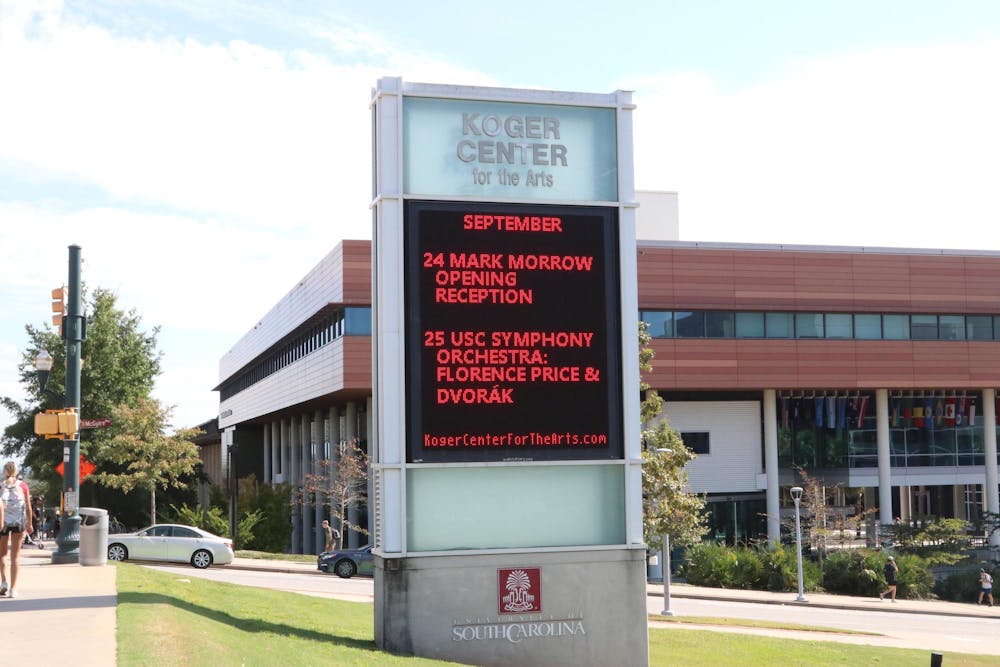
With a deep connection between Florence Price and Antonín Dvořák's music, USC Sarah Bolick Smith Distinguished Professor of Music and Director of Orchestras Scott Weiss said he wants to offer a joyful piece to begin the semester's performances.
"It's a really joyful work," Weiss said. "As we start the academic year and start our concert season, it's nice to have something that is just unabashedly joyful to come to in rehearsal every day and then perform."
The USC Symphony Orchestra's first concert of the semester will feature Price's Concerto No. 1 and Dvořák's Symphony No. 8. National touring violinist Melissa White will be playing as the violin solo during the concerto, with the orchestra playing along in the background, Weiss said.
Dvořák traveled to the United States to help American musicians establish their own musical culture, and Price was a Black composer in the middle of the twentieth century, Weiss said. This led to Price being inspired to create music from Dvořák.
Weiss said he chose the eighth symphony because it is Dvořák’s penultimate work and the orchestra had played the ninth symphony that ties in African American culture in 2017. He wanted it to follow after Price’s concerto to close off the performance, he said.
“Antonín Dvořák, a Czechoslovakian composer, embraced the music of both the Native Americans as well as the African Americans and incorporated it into his own music,” Weiss said. ”He was sort of a pioneer of American music and somebody that really influenced Price.”
Mac Tollefsen, a third-year music education and violin performance student, said the concerto had been lost and was never played but was rediscovered in 2009 during a house renovaton after Price's passing.
Tollefsen said one of the difficulties he noticed for this performance is playing with a violinist he had not played with before to accompany her solo. However, he said he will take this opportunity to learn from White's technique and how she interprets the music because she has a career set already.
“The challenge with the Florence Price (concerto) is you're supposed to be accompanying the violin and being supportive to the solo, and that's tricky knowing how to time everything and not cover up the violin,” Tollefsen said.
Elle Senn, a third-year doctoral student, said they have previously performed some of Price's compositions, but they will not perform in the first half. They said they will instead experience the music from the audience, before joining the orchestra in the second half of the performance.
“She writes a really lush, romantic, full sound that I think people really associate with the orchestra and that people have come to know and love when they hear an orchestra,” Senn said.
Elizabeth Runion, a second-year flute performance student, said the symphony uses its first performance to get to know each other and learn how others play. She has never played a Dvořák symphony before but has previously performed some of Price's works.
Runion said learning Price's concerto can be challenging due to it not being widely performed yet. She said her primary focus has been on learning the notation and articulation points in order to properly interpret the song.
“Learning (the Dvořák symphony) has been so much fun, and it's such a great learning experience for learning the style of it and building up endurance for playing the whole symphony,” Runion said.
The connection between the performers and the audience is what makes the atmosphere electric, Senn said. Being able to have an emotional connection through live music is what is important to them, they said.
“There's something special about that moment right before the orchestra starts playing and right after the orchestra finishes playing before the audience claps,” Senn said. “Those little moments of silence are just like magic in a bottle to me.”
Weiss said he wants students to be able to come and watch the symphony play, so they can remember the performance after graduation.
The performance will take place on Sept. 25 at the Koger Center for the Arts. Students are able to attend for free with their CarolinaCard, and tickets can be found on the Koger Center website.