
An alternative accreditor is continuing toward federal approval, aided by a $1 million grant.
The Commission for Public Higher Education began in summer 2025, when USC and five other public university systems announced their intention to create a public-focused accreditor in a press conference hosted by Florida Gov. Ron DeSantis.
The American Association of University Professors and some faculty at USC are concerned about the project. These concerns have ranged from the standards being vague to risks to academic freedom.
An accreditor is an agency that evaluates universities based on a set of standards. Accreditation helps with transferring credits between schools and affects eligibility for federal aid.
The accreditor-to-be’s next steps
The commission’s board adopted its list of 21 standards last October. The next step is to craft evidentiary guidelines that aid evaluators in interpreting the standards. It does this by defining terms and providing a framework to tell if an institution is in compliance with each standard.
It will take about nine to 10 weeks to finalize these guidelines, according to Cameron Howell, Senior Advisor and Secretary to the Board of Directors for CPHE. The draft guidelines will be sent to a self-formed faculty group this week, as well as a working group of academic affairs professionals built by the commission.
The guidelines will become available for public comment in about three weeks, Howell said.
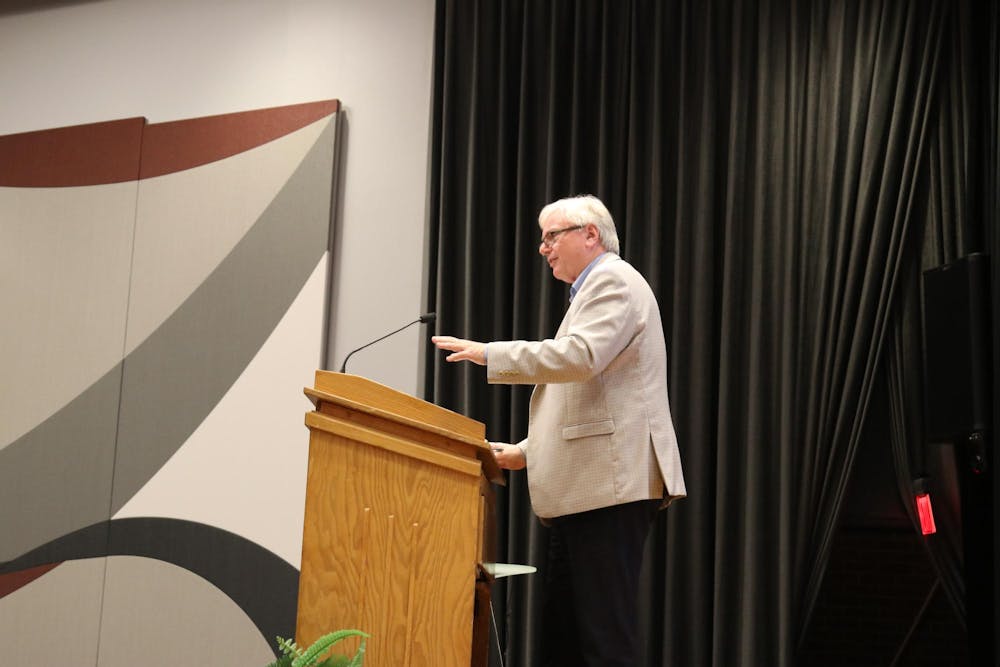
Howell was the secretary for USC’s Board of Trustees. The university sent Howell to serve on CPHE's staff while still paying his salary, The State reported.
Ten universities in Florida, Georgia, Texas and North Carolina will make up the first cohort of schools to be accredited by CPHE. These institutions have to go through the process with their existing accreditors as well, since the commission has not received federal approval. CPHE is using the funds from a recent $1 million federal grant to cut the costs these universities face with dual accreditation.
After this trial run, CPHE will gather feedback from the universities and revisit its policies, Howell said.
“We’re going to be going back over the accreditation standards and back over the evidentiary guidance to say, ‘Did this work?’” Howell said. “'Was it sufficient? Did it help the institutions the way we wanted to help them?’ And we will improve that document before we start working with more institutions.”
The commission announced it is seeking applications for peer reviewers to take part in the accreditation of the initial cohort last October.
A CPHE business plan predicts federal approval between December 2027 and June 2028. It is important for the commission to get approval while President Trump is in office, according to DeSantis.
Responding to faculty concerns
Faculty at participating universities received a request for feedback on its draft standards last fall. The amount of feedback reached around 450 pages, Howell said.
The most common response from faculty to the draft accreditation standards was that they were too vague, Howell said. The evidentiary guidelines will fill in gaps in the details, he added.
The commission aims to reduce the length of the guidelines as compared to existing accreditors, Howell said.

“We’ve been aiming for something more refined,” Howell said. “We didn’t want to create something enormous.”
Carol Harrison, a history professor and the president of South Carolina’s American Association of University Professors, is concerned by one CPHE standard that calls for “intellectual diversity,” she said.
The 13th standard reads, “The institution’s policies and practices support the intellectual diversity of its faculty and students in academic and co-curricular life.”
The standard alone is not the problem but it is rather a lack of clarity on how intellectual diversity would be defined, Harrison said.
“Obviously, universities shouldn’t be places where everybody thinks and walks in lockstep,” Harrison said. “But I have no idea what they mean by that.”
While the evidentiary guidelines that would define the term are still under review, the goal of the standard is to ensure students are exposed to varying perspectives through their studies, whether those perspectives are political, ideological or methodological, Howell said.
There are some cases where a program favoring a certain view would not be an issue, Howell added.
“It may be perfectly reasonable for an applicant to a doctoral program to have selected that program on the basis of some kind of specialization and even some kind of specialized way of looking at the world,” Howell said. “That’s not necessarily the problem.”
The commission may be getting in early on a wider trend regarding the concept, Howell said.
“The commission believes that it’s going to be the first to use a standard about intellectual diversity,” Howell said. “But we have very good reason to believe that the other accrediting agencies very soon will begin to use similar if not nearly identical standards, in which case we’re not going to stick out as being abnormal.”
At a September 2025 faculty assembly, associate professor of English Robert Kilgore from USC Beaufort asked Thad Westbrook, the chair of USC's board of trustees, what type of risk analysis was being done, particularly for smaller campuses like Beaufort.
The smaller size of system schools makes them more vulnerable to risky changes, Kilgore told The Daily Gamecock in January.
“What’s a pebble in Columbia, because there’s a ripple, by the time it gets out to the system, it’s a wave,” Kilgore said.
In response to Kilgore’s question, Westbrook said the university would seek input from these system schools and from Beaufort’s chancellor, Al Panu, who has experience in accreditation. As for risk, the ability to monitor the initial cohort of colleges will help USC make an informed decision on switching, Westbrook said.