
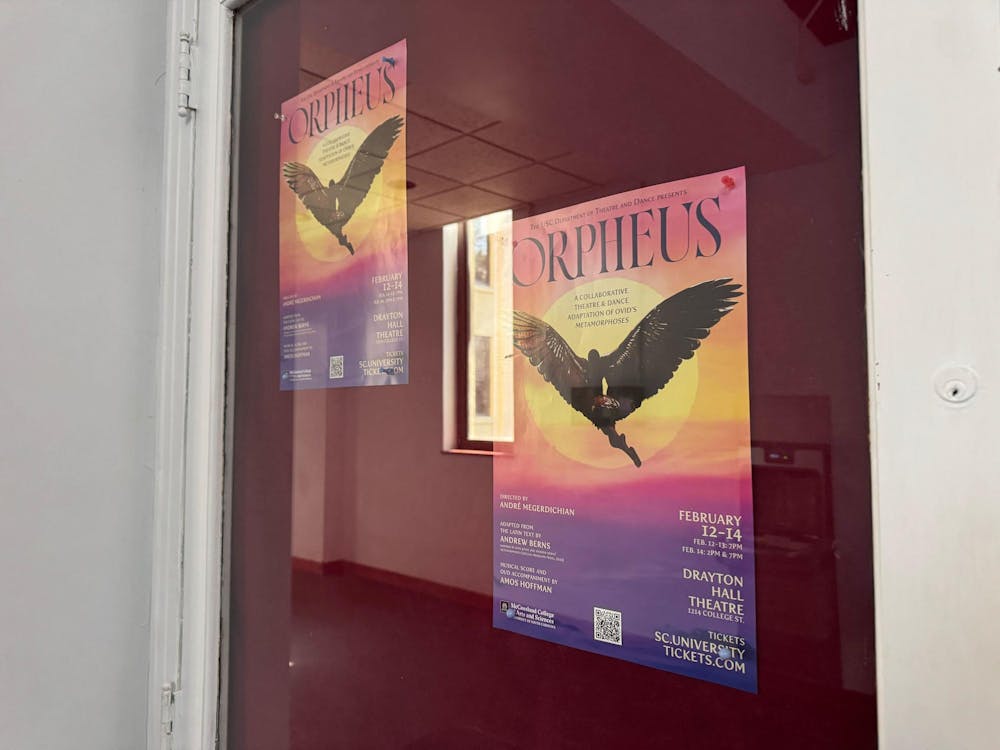
Dance and theatre students will join together in a unique collaboration between departments to put on “Orpheus,” a play based on Ovid’s “Metamorphoses” that was translated from Latin by USC history professor Andrew Berns. The play will premiere on Feb. 12 and run until Feb. 14 at Drayton Hall.
Dance and theatre professors André Megerdichian, Jennifer Deckert, Marybeth Gorman Craig, Lauren Wilson and Dustin Whitehead created the play alongside Berns. Students in both departments will perform it.
Berns initially translated Ovid's "Metamorphoses" for his friend Kate Joyce and her book in 2020. Joyce presented her photograph book, "Metamorphoses," at USC, catching the eyes of USC professors Deckert and Megerdichian. They wanted to make a dance performance out of it, which prompted the collaboration, Berns said.
"It is, without question, the most collaborative, interdisciplinary, creative thing I've ever done," Berns said.
Megerdichian and Berns worked together on the rough draft of the play. Then, Deckert, Craig and Wilson joined the production.
The play follows Orpheus, who falls in love with a woman named Eurydice, then loses her to the underworld. Unlike the popular musical “Hadestown,” “Orpheus” does not end with the couple's separation.
“Our play starts with Orpheus and Eurydice but then continues with Orpheus' death," Berns said. "And then poses questions about why he died and how he can come back to life as a servant."
In order to teach Orpheus how to redeem himself, Ovid guides Orpheus through other myths: Deucalion and Pyrrha, Arachne and Minerva, Procne and Philomela, Python and Apollo, and Icarus and Daedalus.
The play covers various themes like transformation, love and forgiveness.
“(Orpheus) is just devastated and feels that the gods have all the power and don't know how to show mercy,” Craig said. “What can the humans do? And so, Ovid is kind of the master storyteller of all of the myths. He is sort of bringing Orpheus to a reckoning within himself … and to forgive himself.”
Berns said his journey is intended to be universal. At first, Orpheus rejects Ovid’s teachings, but over the course of the play, he comes to see that Ovid's work is a guide to living a better life, and he learns how to share his gift freely once more.
Berns worked with renowned Israeli oud player Amos Hoffman to create an original score. The Middle East-inspired score reflects the tension that the characters face. That style of music was also chosen because historians don’t know what Ancient Greek music sounded like, Berns said.
“There's more tension and less resolution,” Berns said. “It creates a kind of undulating motion … and that also relates to the theme because, just like a wave in the ocean crashes on the beach predictably, but not in the same spot, so too is Orpheus’ journey — one of ebbs and flows, and our music is trying to convey that process.”
Berns wanted music that would be loose enough to allow dancers to express themselves while remaining structured enough to tell a story.
The choreography utilizes the visualization provoked by the narrative. When a scene uses descriptive imagery, the choreography interprets the imagery, Deckert said.
“There’s a section that I created that was about Deucalion and Pyrrha and them throwing stones,” Deckert said. “And then how stones lost their hardness and grew into humans, and so creating a movement phrase sort of just based off of that image was actually ... lovely."
Deckert said the dancers have a large amount of creative control. Interpretation is crucial for the dancers. The dancers have one costume, so they must embody the characters through their movement rather than articles of clothing, second-year dance student Liv Dermody, said.
“There's actually this kind of sensitive scene in the middle of the production,” Dermody said. “Basically, one of the main characters unfortunately rapes the other character. We kind of have to portray that in a dancer's way and just really emphasize sharp, dynamic movement.”
Dermody is part of an ensemble of dancers that play various characters such as grass, water, stones and the emotions of other characters. The dancers also interact with the actors, which brought challenges because they don't normally work together.
The actors and dancers must trust each other to create a seamless, fluid piece, Deckert said.
"At the beginning of that play ... there are four dancers that launch themselves at (Orpheus) to catch them," Craig said. "There's leaps and jumps ... and they have to really trust him ... The trust that is happening when you can literally take a leap of faith and trust each other, it says a lot about our program."
Tickets are available at $15 for USC students.