
Movie: “Iron Lung”
Release Date: Jan. 30, 2026
Director: Mark Fischbach
Runtime: 2 hours, 5 minutes
Genre: Horror/Sci-Fi
Rating: B-

When a Youtuber best known for screaming at horror games decides to write, direct, star in, produce and edit a feature-length sci-fi horror film, most might expect the result to be a fascinating passion project or a spectacular disaster. Mark "Markiplier" Fischbach's "Iron Lung" firmly lands in the more interesting middle ground.
It's an ambitious and deeply earnest attempt to translate a cult indie game into a suffocating, claustrophobic movie experience that clearly understands what makes its source material so unsettling. At its best, the film traps you in a metal coffin and dares you to sit with the silence. At its worst, it reminds you that ambition and execution don't always move at the same pace.
"Iron Lung" takes place in the distant future, where an event known as "The Quiet Rapture" caused all planets and stars to suddenly disappear, leaving only those in space stations alive. The remaining population is governed by the Consolidation of Iron, which administers criminal punishment through a system called conviction realization, forcing prisoners into compulsory service for the collective good. One of the strangest anomalies discovered since "The Quiet Rapture" is the appearance of massive oceans of blood on otherwise uninhabitable moons.
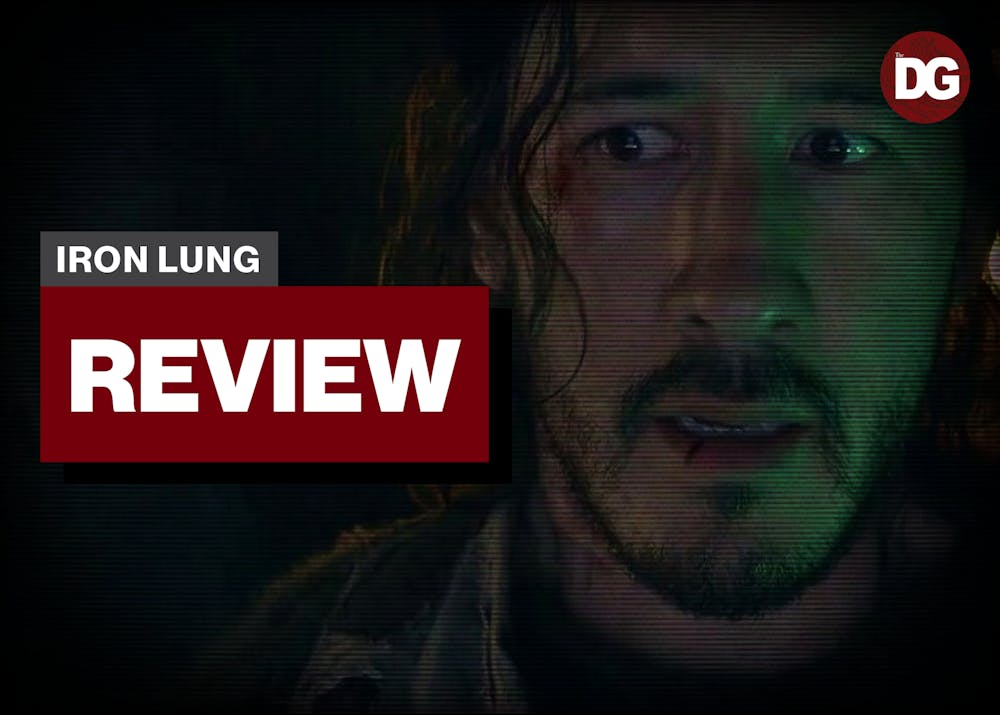
To explore these moons, the Consolidation deploys cheap, barely shielded midget submarines, relying entirely on elementary instruments and cameras. Simon (Mark Fischbach), a convict charged for his alleged involvement with the destruction of a space station, is tasked with piloting one of these submarines, SM-13, to explore and document the blood ocean of moon AT-5. If he succeeds, he’s promised his freedom. If he fails, he’ll likely die where no one can reach him.
From a purely technical standpoint, "Iron Lung" is impressive. Fischbach, a first time filmmaker, clearly understands why the original game worked, not because of jump scares or graphical fidelity but the feeling of isolation and a creeping sense that you are somewhere profoundly wrong. The cinematography and sound design do much of the heavy lifting.
The films leans hard into the claustrophobia of the submarine, framing tight detail shots of the cramped space and machinations in a way that make the sub feel less like a vehicle and more like a coffin. The constant metal creaks, distant rumbles and otherworldly groans remind you that the environment itself is hostile. Even when nothing is happening, the movie makes you feel like something could happen at any second.
Where the film falters is in its pacing. The first hour or so is frankly a slog. We watch Simon move from one task to the next with sparse hints of worldbuilding or tension. Slow cinema and restrained horror can be effective, but here the buildup often feels less like deliberate suspense and more like dead air. There's a difference between letting the dread simmer and simply letting scenes run too long without adding new information or emotional pressure. By the time the film starts to tighten the screws, it's already tested the audience's patience more than it needed to.
Fischbach's performance is solid overall, especially as the film moves into the final stretch, and Simon's emotional state becomes more volatile. He's convincing when the character is angry or pushed to the edge. The trouble comes from the quieter moments, where some line deliveries feel a bit stiff and awkward. Part of that may be performance, but part of it sits squarely with the script. Simon is on screen for nearly the entire movie, yet we get little of the characterization needed to fully invest in his internal struggle, especially early on when the film most needs something to latch onto.
That issue extends to the supporting cast as well. Ava (Caroline Kaplan), Simon's handler and one of the only characters with a semi-significant role, functions entirely as an exposition machine. She exists to explain the world, the mission and the stakes, and does so with the subtlety of a freight train. Instead of feeling like a person with her own perspective or emotional weight, she often feels like a plot device in human form. The broader script suffers from this approach. The world is interesting, the lore is compelling, but the characters who inhabit it are too thinly sketched to fully carry that weight.
And yet, it's hard to dismiss "Iron Lung" outright. The film's production value, cinematography and sound design create a genuinely oppressive atmosphere, and its more Lovecraftian touches seep through the cracks in ways that feel true to the source material. There's a clear sense that this is a project made by someone who deeply loves the world he's working in. Given all the ways Fischbach is involved with the film it makes his first outing commendable.
"Iron Lung" is a movie defined by its tension between craft and storytelling. On a technical level, it often excels; on a narrative level, it struggles to maintain momentum. The result is a film that's easy to admire and hard to fully love. It's an ambitious passion project with real atmospheric fervor but noticeable cracks in its writing. Fischbach proves he has a strong visual sense and a clear feel for mood. If future projects can pair that with tighter scripts and more confident character work, he could end up making something truly great. For now, "Iron Lung" stands as a flawed but fascinating directorial debut.