
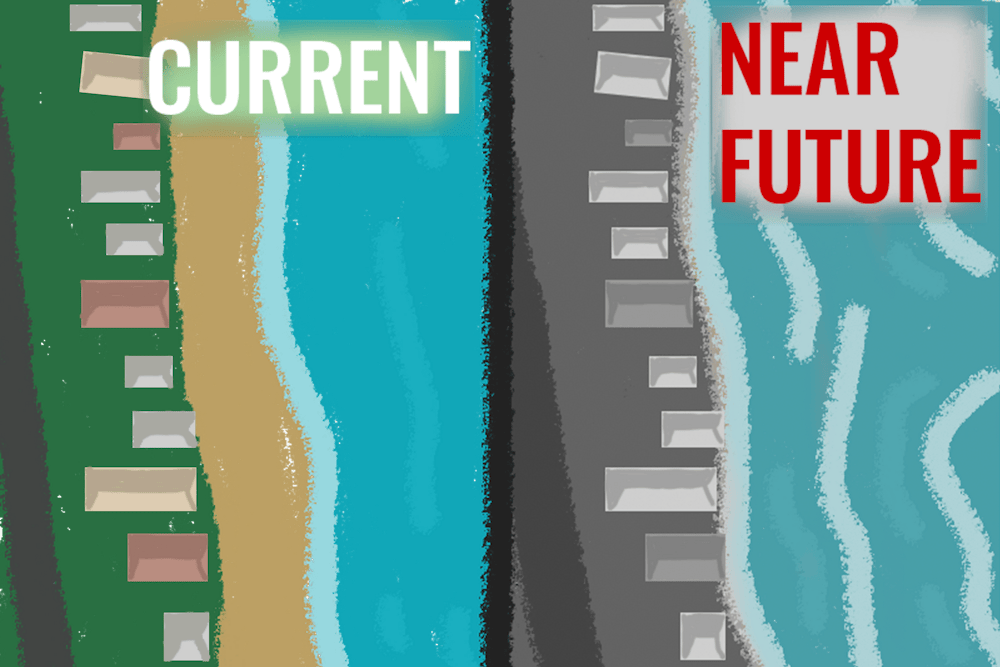
On a warm summer morning on the coast of The Palmetto State, the waves are crashing, seagulls are squawking and families are setting up beach chairs for a relaxing day. The smell of sunscreen and salt lingers in the air while kids dig in the sand and splash in the ocean.
For generations, this experience has been a keystone to South Carolina’s identity, an experience shared by locals and tourists alike. Myrtle Beach alone welcomes over 17 million visitors yearly, a testament to how important the coast is to South Carolina’s economic success.
But the shoreline that has built these traditions won’t be here for generations to come.
Economic consequences
The sea level is rising, and it’s rising fast, and it will destroy the South Carolina coastline that many Americans grew up visiting. Cities such as Charleston, which is one of the fastest-growing cities in America, already has significant flooding events and it will continue to worsen.
The National Centers For Coastal Ocean Science predicts that in Charleston, there will be an average of 60 flood days per year by 2051, as opposed to just four hours total of flooding that took place in 1950.
Recent observations show this trend is in the works, with Charleston experiencing an average of 49 minor flood events per year from 2010 and 2020. However, many of these flood events are influenced from variables such as hurricanes and storms while the predicted flood days in 2051 are solely from high tides and a rising sea level.
This significant jump will not only have an obvious impact on day-to-day life for residents, but also on the economic prosperity of the city and surrounding areas.
Flooding on that scale would ripple far beyond minor inconveniences. Charleston is not just a historic coastal town. It’s an economic powerhouse for South Carolina. It draws in millions of tourists yearly, generating millions of dollars in revenue from tourism alone, while also hosting a crucial port for the East Coast.
Disruptions to the port are pretty much guaranteed. Rising waters and stronger storm surges can and will disrupt the port, likely causing damage and delays, which will strain the supply chain that many businesses depend on.
Science behind South Carolina's risk
These predictions are not random. It is driven by climate change. As global temperatures continue to rise, it causes ocean levels to rise through two main processes: thermal expansion and the melting of glaciers and ice sheets.
Our oceans absorb more than 90% of the excess heat trapped in the atmosphere. This absorption of heat causes sea water to heat up and expand, a process known as thermal expansion. This process has led to roughly one third of the global sea level rise over the past 100 years, suggesting that even small temperature differences can result in a measurable change in sea levels.
At the same time, melting glaciers and ice sheets across the globe are adding billions of tons of freshwater into the oceans each year. This constant state of increasing temperatures that cause expansion, coupled with an increase in the total volume of water in the ocean from melting ice, spell out disaster for coastlines across the world.
But South Carolina’s coastline is particularly vulnerable. This is due to an effect known as subsidence, which is essentially the sinking of the ground. According to Trevor Ponto, an independent researcher, places such as Charleston are sinking by 4 millimeters a year.
This number doesn’t seem like a lot until you factor in the rising sea levels, which can lead to 7-8 millimeters per year of water rise.But rising seas and sinking land aren’t the only forces acting against the South Carolina coast. The shoreline itself is disappearing.
According to the National Oceanic and Atmospheric Administration, “Surging waters from storms and boat wakes eat up much of the state’s shoreline, at an average rate of almost 2 inches annually.” Two inches may not sound like a lot, but the consistency with which it occurs can lead to the loss of beaches, marshes and natural barrier islands that protect communities from storm surges very quickly.
These surging waters coupled with the rapid deterioration of the coastline puts coastal property at a heightened risk.
With the increase in flood events, intense hurricanes, erosion and current outlook, insurers are putting a premium on costal properties. Reuters found that homeowners living in areas most at risk of getting hit by damaging weather events pay a 82% more than those living in the least-risk locations.
This puts a massive strain on working and middle-class families that likely don’t have the means to relocate easily or pay an increased insurance rate. It also puts a strain on the elderly who have been living along the South Carolina coast for years and no longer have an income to cover unexpected expenses, such as an insurance hike.
Because of this, many of these elderly homeowners also face an increased risk of dropping their insurance, which would lead to an increase in people having nothing after the next big storm.
Some homeowners in Horry County have already had their insurance providers cancel policy renewals, causing many to move out of the costal community. Members who wish to stay in the county are forced to go to secondary insurance markets, which can double, triple or even quadruple the original cost of protecting their home.
This should make it clear. There is a crisis on our coast — one that is slowly and silently growing and can only be stopped by meaningful long-term action from both citizens and politicians.
Combatting the issue
Organizations, such asThe Nature Conservancy and the South Carolina Office of Resilience, are working toward localized solutions to soften the blows of climate change along the coast. They often rely on volunteer work and government grants to fund projects that benefit the entire community.
These organizations are working on Coastal Resilience Implementation Plans and developing Nature-Based Solutions — solutions that restore marshlands, reinforce living shorelines and work with nature instead of against it. This is achieved through risk assessments, securing funding, and then implementing those solutions.
One solution is a living shoreline which is where teams utilize natural materials to mitigate erosion. These solutions will then be placed up and down the South Carolina coast to prevent and negate the effects of climate change and the hazards it brings.
However, these are not a permanent solution to climate change, but rather a temporary solution aimed at mitigating the effects brought about by climate change. Achieving a permanent solution to climate change requires the efforts of the global community.
As the largest historical emitter of greenhouse gasses, the United States should have a sense of responsibility to lead the world in fixing the climate crisis, and set the example for other countries.
This, however, is not the case. The current administration has shown that it has no intention of stepping up to fix the climate crisis or even trying.
Since 2025, the United States has withdrawn from the Paris Agreement which is an international agreement between many countries to reduce the amount of greenhouse gasses released in each country. They have restricted the authority of the Environmental Protection Agency, which regulates emissions while working to protect people and the environment. They have also removed references to climate change from Fort Sumter.
These decisions are detrimental to the future livelihoods of residents along any coastline, but especially South Carolina’s. This is because South Carolina is at an increased risk for catastrophic hurricanes already, and if climate change continues, it will only become more frequent.
If a hurricane were to hit South Carolina, it would not only affect the coast but also the entire state. Thousands of USC students would feel the impact of a hurricane as well. Think back a few years to Hurricane Helene.
It was terrible. School was shut down, students were soaked, property was damaged and nearly 50 people passed away. As climate change continues to worsen, these numbers will only continue to get worse with each storm as climate change continues to worsen. This is the grim reality of unchecked global warming.
But that reality does not absolve the United States of any responsibility, as the United States remains one of the largest historical greenhouse gas emitters, and climate change is cumulative. Responsibility for this crisis is shared.
Given the global scale of climate change, it is necessary that the United States takes a leadership role. The United States can leverage its diplomatic, economic and political influence on the global stage to pressure other major emitters to change their ways for the better.
But leadership begins at home.
It begins with changing policies and committing to meaningful emission standards and funding more environmental protection projects, while also acknowledging that a rising sea is not a partisan issue, but a threat to all Americans.
We act now, petition law makers revise and adapt our policies to combat the rising oceans saving South Carolina’s coastlines for future generations. Or, we choose to keep our current ways and attempt to fight a losing battle against mother nature and her rising seas.