
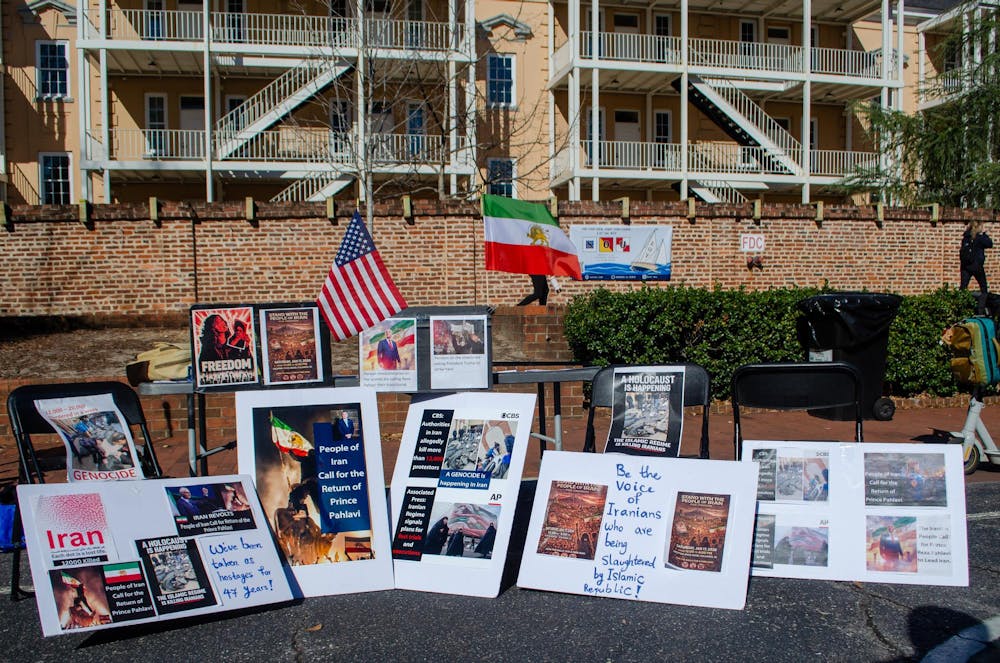
Iranian students gathered on Greene Street to bring awareness to the deaths of Iranian citizens at the hands of their government on Thursday. The demonstration, which occurred outside the Russell House, displayed posters and distributed fliers calling for the support of the Iranian people.
Anti-government protests erupted across Iran weeks ago. The Associated Press reported the death toll reached at least 2,571 people as of Wednesday, but second-year mass communications doctoral student Maryam Goli said in a news release that students believe the figure is higher.
Goli was born and raised in Iran and helped to organize the demonstration at USC.
“If I’m living in a free country, that’s the least I can do, to just be their voice,” Goli said.
Mohsen Ghodsi, an Iranian USC international business master’s student and co-organizer, said the Iranian government’s killing of its own people is a genocide.
“Basically, unarmed people on the streets getting mowed down by machine guns,” Ghodsi said. “And there’s no internet connection inside of Iran, so nothing is coming out.”
Digital blackout
The Iranian government shut down internet access in the country Jan. 8, and it has been disconnected since. AP News reported that some Iranians were able to make international calls on Tuesday.
“Iranians are not heard,” said Samane, a second-year computational linguistics doctoral student who asked to be identified by only her first name for safety concerns. “They don’t have any way to share what is happening there with the media.”
The Iranian government is attempting to limit the spread of information on the situation, said an Iranian second-year doctoral student, who asked not to be identified by name or field of study for safety concerns.
“They want to control the protest,” the second-year doctoral student said. “They don’t want the videos of them shooting the people to become viral on social media, so they cut the internet.”
Goli and Ghodsi said they had not heard from their loved ones in Iran for days. Many people are unsure if their friends and family are even alive since they have been unable to communicate, Ghodsi said.
Having loved ones living in Iran amid the turmoil means constant nervousness, the second-year doctoral student said. Scrolling through his WhatsApp chat logs, the student pointed out his unread texts to friends and family back in Iran.
“The sad thing is, when I get up every day I see there’s thousands of people dead in Iran, and I’m not sure, when the internet is back soon, have I lost any friends or not?” he said.
Outreach
The students organizing the demonstration set up a table and chairs displaying posters and the American and Iranian flags. They wanted to inform USC students of what the Iranian community is experiencing and the situation inside Iran, Goli said.
“A Holocaust is happening. The Islamic Regime is killing Iranians,” read one poster taped to a folding chair.
Others displayed pictures of Reza Pahlavi, who protesters in Iran are advocating to be Iran’s transitional leader. Pahlavi was exiled in 1979, following the Iranian Revolution which established an Islamic Republic in Iran.
The student demonstrators handed out fliers encouraging USC students to stand with the people of Iran and attend an upcoming rally advocating for a free Iran. The rally is set to occur at the statehouse on Jan. 17.
“I’m glad they’re speaking up about it,” said a first-year broadcast journalism student, who spoke with demonstrators and asked not to be identified by name for publicity concerns. “In situations like these I feel helpless … I’ll probably join them on Saturday.”
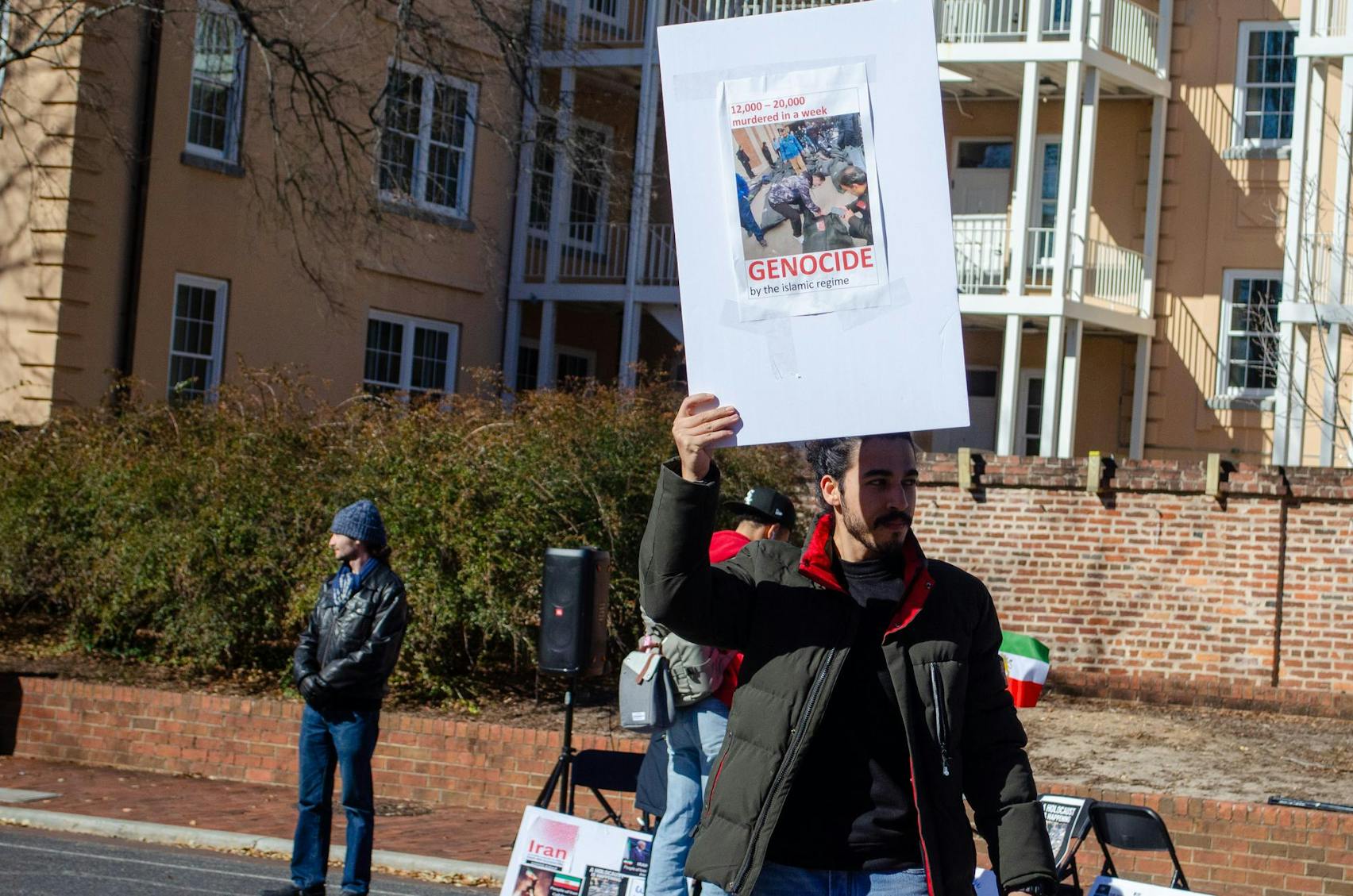
A single protester, in support of protests in Iran, holds a sign at a demonstration outside the Russell House on Greene Street in Columbia, South Carolina, on Jan. 15, 2026. The sign accuses the Islamic Republic of Genocide, and claims that 12,000-20,000 have been killed.
Advocacy
The demonstrators wanted to give a voice to the Iranian protestors who are deprived of internet access, Goli said.
Ghodsi said he wanted to deliver the same message protestors are chanting on the street: that the Iranians want Pahlavi as their leader, and they want foreign powers to help Iran.
Foreign powers helping Iran would not be an intervention, Ghodsi said. He compared Iran's situation to that of European countries which received aid from the U.S. during World War II. U.S. assistance was not considered an intervention but warranted aid, aid that Iran needs, Ghodsi said.
The second-year doctoral student said Iran is a rich country with a great culture, but the government doesn’t represent the people.
“They are smart people. They deserve a better condition,” he said.