
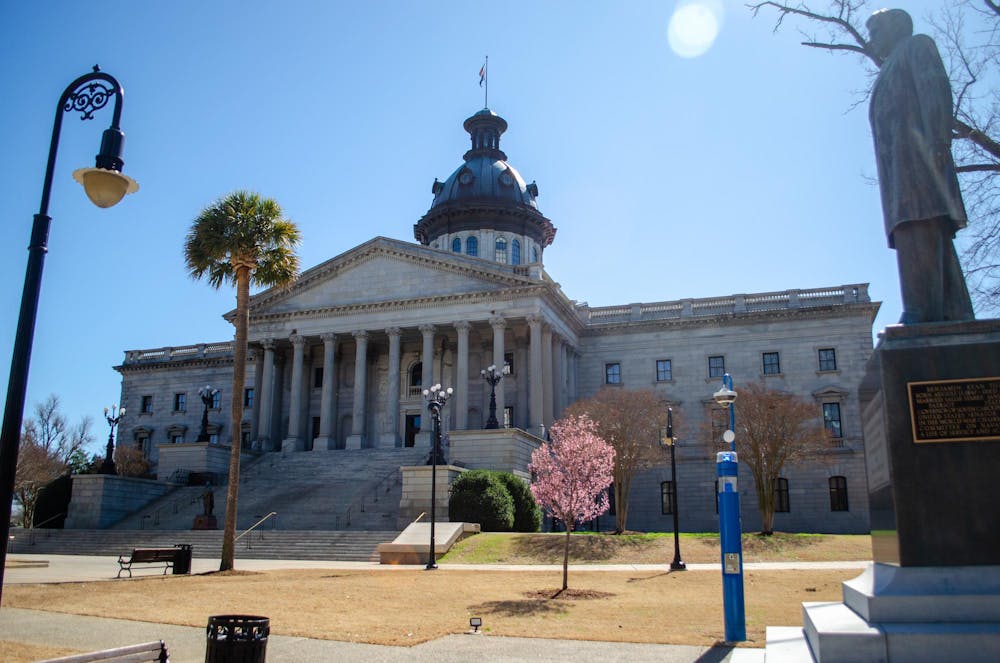
South Carolina legislators are proposing a bill that would require every law enforcement agency in the state to operate in collaboration with U.S. Immigration and Customs Enforcement.
House Bill 4764 would require each law enforcement agency operating a correctional facility to adopt ICE’s 287(g) program, which requires immigration status checks when individuals are arrested. Every county in the state has the option whether or not they want to adopt this program, and this bill would require them to do so.
“If we have people here illegally ... I do not believe it is an unreasonable step to ask our local law enforcement agencies to coordinate with the federal government to see if those people have removal warrants ... rather than bonding them back out into the streets,” said Rep. Travis Moore, primary sponsor of the bill.
In South Carolina, 37 law enforcement agencies have adopted 287(g) agreements so far. Lexington County has had the Jail Enforcement Model since 2020.
If passed, the bill would require every police officer to be trained as federal immigration agents, but it does not have specific language explaining if this includes campus police or not. However, it will force the agreements to be adopted here in Richland County.
“Because the bill is in its infancy, it’d be hard to speculate on any potential impacts," university spokesperson Collyn Taylor said. "The safety of all of our students is one of our top priorities, and we’ll always do what is in the best interest of our students, faculty and staff while complying with state and federal laws.”
Moore said that under the bill, if someone is detained and later determined to be in the country illegally, the Department of Homeland Security would have 48 hours to decide whether to keep them in custody or release them.
However, according to Moore, if they are not picked up within 48 hours, they will “bond out and be right back on the streets with us.”
The bill had a public testimony on Feb. 17 where many were opposed, arguing that this bill is not necessary and the federal government should not be stepping into local issues.
“Local law enforcement and federal immigration enforcement serve different roles,” Phillip Ford, a South Carolina resident at the hearing, said. “The federal government wants to enforce immigration law — that's their responsibility.”
Others argued the bill would create a distrust between citizens and law enforcement.
“People who are going about their lives ... they don't know the difference between these agreements," said Courtney Thomas from the American Civil Liberties Union at the hearing. “They just know that their sheriff and the deputies that they trust to help their kids cross the street or to coach their kids' Little League team, they know that they are working with ICE.”
Paul Bowers, the American Civil Liberties Union director of communications, who was present at the most recent committee meeting on Feb. 26, said these kinds of agreements make racial profiling more prevalent.
After the meeting, the American Civil Liberties Union hosted a press conference on the statehouse grounds, where its opposition to the bill was discussed.
Thomas explained there has been a recent rise in these ICE agreements since the second term of the Trump administration.
Since 2025, the number of counties in South Carolina who have collaborated with ICE has risen from three to 37.
During the press conference, Thomas expressed her worries that this mandatory collaboration with ICE could potentially be a step toward higher levels of their enforcement in the future.
The same issue was brought up in the committee hearing earlier that day, where Rep. Moore argued, in regards to ICE violence in other states, that he believes the bill will actually help to prevent the violence from getting that extreme in South Carolina. He said that those extremities have been happening in districts that refuse to have 287(g) agreements.
“It is happening in places where they refuse to cooperate at all in the removal of people here illegally who are violating the law,” Moore said.
As of the Feb. 26 meeting, the bill has advanced out of the House with a favorable vote of 3-1.