

South Carolina women's basketball concluded its season April 5 with its second consecutive blowout loss in the national championship game. The Gamecocks finished with an overall record of 36-4 and captured the Southeastern Conference regular-season title for the fifth consecutive season.
Despite the team's most recent loss to UCLA, South Carolina's season was highlighted by constant resilience throughout its run to a third straight title game.
Adversity strikes early
The date was Oct. 13 when Gamecock senior forward Chloe Kitts announced she had suffered a torn ACL in her right leg and would miss the entirety of the 2025-26 season. It was one thing for South Carolina to lose its leading rebound collector from the 2024-25 campaign, but it was another for the Gamecocks to now be without their leader in rebounds, assists, steals and blocks from that run to the national championship.
Shortly after South Carolina fell to UConn in the 2025 national championship, then-sophomore guard MiLaysia Fulwiley announced she was entering the transfer portal. Fulwiley became the first freshman in program history to win SEC Tournament MVP and was named the SEC Sixth Woman of the Year in her second season. She was the team's second-leading scorer with 11.7 points per game and leader in steals per game at 1.5.
Guard Te-Hina PaoPao, the Gamecocks' leader in assists, and forward Sania Feagin, the Gamecocks' leader in blocks, were selected in the 2025 WNBA draft. Also selected in the draft was four-year Gamecock guard Bree Hall.
Six of South Carolina's top eight scorers from the 2024-25 season did not log a minute for the team in 2025-26. Sophomore forward Joyce Edwards and junior guard Tessa Johnson were the two lone players to return. Senior guard Raven Johnson was the Gamecocks' only returning starter.
Retool, rebuild
Departures and injuries across South Carolina's lineup were counteracted by an influx of additions. The Gamecocks added three freshmen this season: a pair of guards in Ayla McDowell and Agot Makeer, and a forward from France, Alicia Tournebize, who joined the team as conference play began in January.
Head coach Dawn Staley went to work in the transfer portal as well, bringing in senior guard Ta'Niya Latson from Florida State and senior center Madina Okot from Mississippi State.
Latson was the nation's leading scorer at 25.2 points per game in the 2024-25 season. Rather than remain in her role as a scorer, Latson elected to join her former high school teammate, Raven Johnson, at South Carolina.
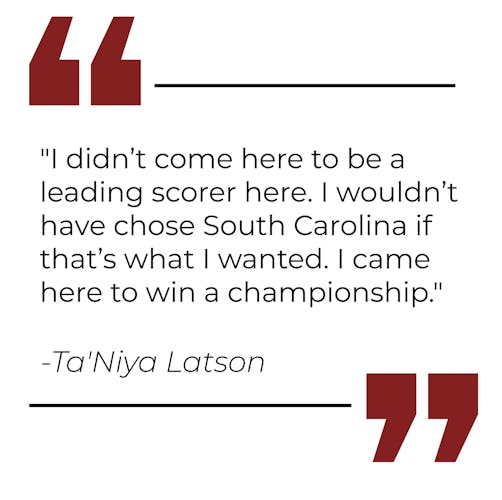
"I didn’t come here to be a leading scorer here," Latson said. "I wouldn’t have chose South Carolina if that’s what I wanted. I came here to win a championship."
In the 2024-25 campaign, Edwards was the Gamecocks' leading scorer at 12.7 points per game off the bench as a freshman. She was promoted to the starting lineup as a sophomore, but it remained unclear what the dynamic between the nation's leading scorer and a first-time starter would look like from a perspective of who would see the larger volume of attempts, but it wasn't long before the Gamecocks had their answer.
Road to tournament
By December, it had become clear South Carolina's offense would once again run through Edwards. Through the team's first eight games, she had led the team in scoring in five of them and the Gamecocks started 7-1.
That lone loss came to No. 4 Texas in the final game of the Players Era Championship tournament in Las Vegas, Nevada. The 66-64 defeat came at the hands of a game-winning shot in the game's final seconds. The defeat seemed to worked as motivation when the Gamecocks responded with a 12-game win streak lasting until late January.
Earning revenge at Colonial Life Arena on Jan. 15, South Carolina bested No. 4 Texas, 68-65. Just one week later, the Gamecocks fell on the road to No. 16 Oklahoma, 94-82, in overtime.
“They ran into a team that actually wanted to win more, and they made winning plays, and we didn’t," Staley said. "It’s not really rocket science."
Similar to the first loss, the second lit a fire under the Gamecocks as they put out another 12-game win streak after that Jan. 22 loss to the Sooners. The streak included wins over previously undefeated No. 5 Vanderbilt, No. 19 Tennessee, and on the road against No. 6 LSU, No. 25 Alabama, No. 17 Ole Miss and No. 16 Kentucky.
The Gamecocks didn't lose again until their third matchup of the season with Texas, this time in the SEC Tournament championship. The Longhorns comfortably handled South Carolina by a score of 78-61 to head into March Madness as SEC Champions for the first time in program history.
Vengeful return to national championship
South Carolina's NCAA Tournament bracket was littered with opponents the team had faced earlier in the season. In the second round, the Gamecocks hosted No. 9 USC, improving upon a 17-point margin of victory on Nov. 15 to a 40-point win on March 23.
South Carolina then got a shot at revenge against Oklahoma, earning a dominant 26-point win to advance to the Elite Eight, where the team took down TCU in a 26-point rout.
By the time UConn was set to square off against South Carolina in the Final Four, the Huskies were on a 54-game win streak dating back to February 2025.
Edwards was the Gamecocks' leading scorer, with 10 points off the bench in the 2025 national championship game. By this year's Final Four matchup, Edwards had emerged as one of the best players in the nation, averaging just short of 20 points per game.
The Huskies returned four of the five starters from the two teams' previous meeting, but the lone starter that returned for South Carolina hardly felt like the same player. Raven Johnson more than doubled her scoring average, jumping from 4.9 to 9.9 points per game this past season. She shot career highs of 48.6% from the field and 39.3% from the 3-point line.
"Her leadership has grown from doing it by example to now verbalizing and still doing it by example," Staley said. "There's winning behaviors, and Raven, during this time, only wants to hear and see things that are only going to help us."
South Carolina pulled out the win in a low scoring 62-48 affair to advance to its third straight national championship appearance. The Gamecocks fell to UCLA, who earned a 28-point win powered by its senior class; all six players to score a point for UCLA in the win were drafted in the 2026 WNBA draft.
"Obviously, we failed last year, failed this year, so hopefully next year is a different story," Edwards said.
Bright future
Edwards, a sophomore, earned recognition on every All-American list released this season. She became just the third Gamecock ever to earn that status in each of her first two seasons, joining Aliyah Boston and A'ja Wilson. Edwards broke the program's single-season scoring record, with 768 points across a program-high 40 starts.
Nobody contributed more consistently in March Madness than Makeer. Just 18 years old, Makeer entered the tournament averaging 5.8 points per game. She nearly tripled that average across the Gamecocks' six games, including setting a new career high in points twice.
Makeer saw 27 minutes per game during March Madness, netting positive results in the process — she averaged 14 points, 2.8 rebounds, 2.3 assists and 2.2 steals in a sixth-woman role throughout the tournament. She shot 55% from the field and 46.2% from the 3-point line.
Tessa Johnson also saw the most playing time in her career this season, elevated into a starting role for the first time. She averaged 12.8 points per game, thanks to an impressive 3-point percentage of 44.8%, the best mark in the SEC.
South Carolina will add the nation's top-ranked shooting guard recruit, Jerzy Robinson, to its backcourt as well this fall. The emergence of Edwards and Makeer this past season, coupled with the return of Kitts, will help bolster a Gamecock squad hoping to finish next season playing in the same final game, just finishing with a different result.
"The standard here is to get to the (national championship)," Tessa Johnson said. "I do expect our team to get here next year. The younger girls in the locker room, they don't like that feeling either."