
Ian Funk, a fourth-year marine science student and treasurer of Gamecock SCUBA, said he has told members that Student Government may not fully reimburse them for travel costs and equipment rental fees. As an organization where moving and breathing costs money, this proves to be a challenge.
Funk said Gamecock SCUBA typically spends its Student Government money on portions of its dive charters and the Airbnbs it stays at during trips. Scuba is a hobby that requires a lot of funding, and because of that, the club is heavily reliant on reimbursements for its activities, according to Funk.
His goal is to attempt to reimburse at least some money to his members who pay these trip costs. For the organization’s 2025 spring break trip, it got about 20-30% of its funds reimbursed, Funk said.
"It's a lot harder, in my opinion, to go about getting the money you need," Funk said.
There are two kinds of reimbursement with Student Government funding. Organizations request funding to help mediate the costs they spend on their own business. Student Government gets reimbursements from organizations for any money allocated that the organizations don't use.
At the beginning of the 2026 spring semester, it was announced that the new Student Organization Funding Assistance Board ran out of money. Student Government funds for student organizations lasted until the end of February.
SOFAB, run by Director of Administration for Student Life Matt Hinds, is an administrative board also responsible for funding student organizations, but it is available to all organizations, where Student Government is only open to undergraduate ones.
Due to these shortages, some student organizations on campus have been forced to find other methods of funding. Student Government remains hopeful that it can extend these funds by making more changes to the funding model for the upcoming academic year.
Student Government recent funding history
Student Government had a budget of $185,000 for the 2025-26 academic year, which former Student Body Treasurer Ashley Reynolds chose to split across the fall and spring semesters. SOFAB was allocated $120,000, which it did not split across semesters, which contributed to its lack of funds for the spring semester, Reynolds said.
According to Reynolds, once SOFAB ran out of money, the majority of student organizations went directly to Student Government to request funds.
“Even people who can’t get money from us, like sports clubs and grad students, they all came to us,” Reynolds said.
Thomas Spurgeon, former chairman of the student senate finance committee, said as long as an organization meets the metrics for funding, it will receive all the funds it requests.
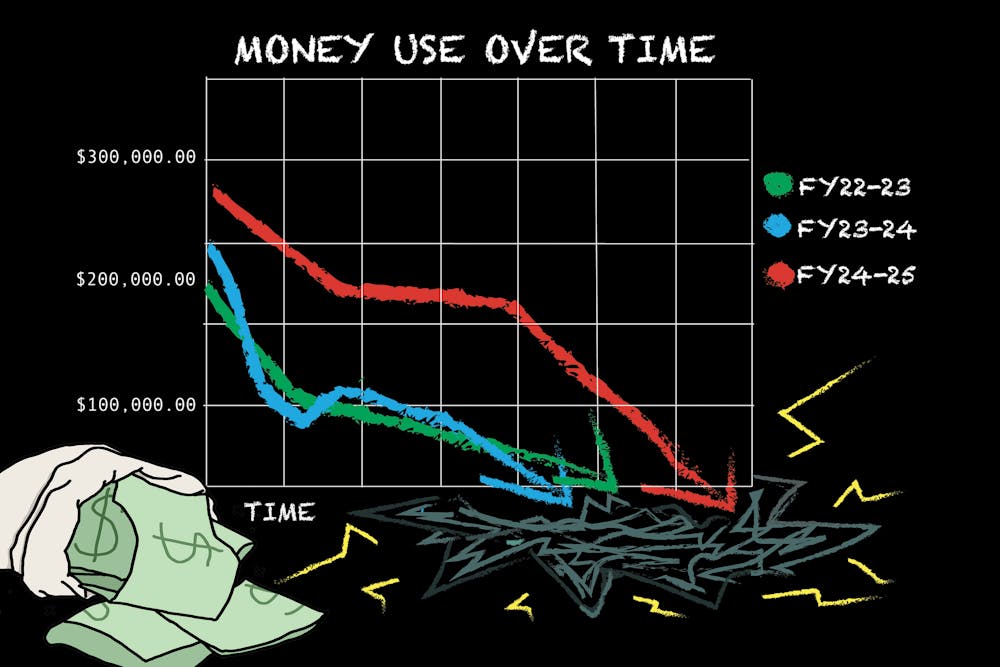
According to data provided by the finance committee, the 2024-25 academic year saw the allocation of $300,000 in funds to student organizations because of a one-time donation from President Amiridis, with funds split evenly across both semesters. In other years, the totals are similar to the current academic year and are set around $180,000.
Around 80% of the approved funds for organizations were used in the 2024-25 fall semester, with the rest of the allocated amount rolling over into the spring semester. Because the academic year gave Student Government more funds to use, and the remaining money rolled over into the spring, the funds lasted until around April.
Out of the past four academic years, two have seen funds run out at the start of the spring semester in January. Along with the current academic year, this has been a recent trend, according to the data.
Reynolds believes part of the reason the budget was able to last until February in the 2025-26 academic year was due to the partial funding system she helped to create when she became treasurer in 2025. She said the partial funding system has helped ensure student organizations request money for the right reasons.
“I think what mainly helped is that it deterred a lot of people from having events just to spend money,” Reynolds said. “I think last year I was even approached by a student organization who looked at me and told me that the whole point of the organization was to spend university funds on 'dumb stuff.' I think (partial funding) deters that idea because it's harder, and they actually have to do things that benefit other people besides just themselves.”
Student Government's new partial funding system is based around a point-system rubric for funding allocation. Organizations receive points based on how well they meet four areas of criteria for their events, such as physical location and learning outcomes met. Point totals determine what percentage of funding an organization will receive.
Spurgeon said he doesn’t know to what extent the partial funding system numerically helped in preserving the budget, but he doesn’t believe it had a significant impact. He attributes using measures such as reducing large spending this year to prolonging the budget until the end of February.
“Little bits here and there added up, but there were no enormous partial funding cuts,” Spurgeon said.
Reynolds said more organizations were able to be funded in the 2025-26 academic year under the $185,000 budget than in previous years. Student Government went from funding 20 organizations in one year to 50 in another and reached 72 this year, she said. More organizations this year got funding from the top 50% of the Student Government budget, which makes Reynolds more optimistic for the future.
“We're not just giving huge chunks of money to the same people over and over and over again,” Reynolds said.
Some of the funding has been unevenly allocated in previous academic years, according to the data. Around 11% of allocated funds for the 2022-23 academic year went to Mock Trial.
Spurgeon said there is a $10,000 hard cap on individual funding allocation written in the Student Government codes in order to prevent any one organization from receiving too much money.
According to Spurgeon, only Model UN received an override this year for that hard cap. Since Student Government had more money in the previous academic year, there were six overrides, according to the data.
Student organizations' funding experience
Some student organizations said they have had problems with both getting their money from Student Government reimbursed and general communications.
Leyah Murphy, a third-year exercise science student and the treasurer of Gamecock Robotics, said her organization, like Gamecock SCUBA, also ran into problems with reimbursements from Student Government.
Murphy said the organization does not require funds in the fall semester and only requests them in the spring to attend a competition. For its last competition, some of the accommodations, such as a hotel booking, were already paid for, when members got a notification from Student Government that it had run out of money, according to Murphy.
“We were going that weekend, so it was hard to figure out where to get the money,” Murphy said. “We actually had to go into our education fund that we had to try and pay for it, but we had to drop some people from the competition too because of that so we can make ends meet.”
Gamecock Robotics went to a competition at Auburn University last year, and Murphy had to pay for some of the travel and hotel expenses with her own money. She is still in the process of trying to get that money back through reimbursement, which is frustrating since robotics can be expensive, she said.
Murphy said the interconnectedness of the robotics field in South Carolina allows the organization to have contacts it can go to for help with funding such as high school teams, S.C. college teams and USC itself.
Anna Kate Jones, a second-year business management and Spanish student and president of USC's Collegiate DECA, said the club hasn’t used Student Government funds this year. This was due to communication issues between them and Jack Holland, a third-year finance and real estate student and Collegiate DECA's vice president of finance.
According to Jones, Holland was forced to learn the new finance system on his own after a treasurer's workshop was cancelled with no notice and a one-on-one meeting with the treasury office ended early due to the person's computer dying halfway through.
“The main issue was the lack of communication and then (the meeting) being just a little bit unprofessional,” Jones said.
DECA holds fundraising events, such as bake sales, to obtain funds. Jones said if the organization can’t get funds, it lets members know that if they’d like to attend a competition, they have to pay with their own money.
The future
Reynolds said one of the problems to address next year is organizations not submitting their reimbursements for Student Government. She said for this year, it allocated the $185,000 it was given by the university but is still waiting on $90,000 in reimbursement requests for money that needs to be returned to Student Government.
Jones said if the current funding system and the communication improve, DECA would feel more confident in asking Student Government for funds. She said she also felt it would be helpful if multiple treasurer’s workshops were held on different topics about finance.
Funk thinks having a smaller pool of money for organizations who don’t need to request as much from Student Government may help in the future. Another minor adjustment he believes could help conserve funds is reimbursing a percentage of what the organization asked for, as opposed to the full amount.
“Some things just cost less, and that is kind of the big thing for me," Funk said.
Reynolds has also mentioned having the student activity fee raised so Student Government and SOFAB can get more money to give to organizations. Spurgeon said he wants to see more money allocated to Student Government in whatever form that takes.
“I don't know if there's money to be cut from somewhere else that could go to us,” Spurgeon said. “I don't know if the activity fee is the right answer, but I do know that we need more money, and so whatever those administrators would like to do, I like.”
Editor's note: Ashley Reynolds was interviewed for this article before she resigned as student body treasurer. Thomas Spurgeon was also interviewed before he was nominated and confirmed as the new student body treasurer.