
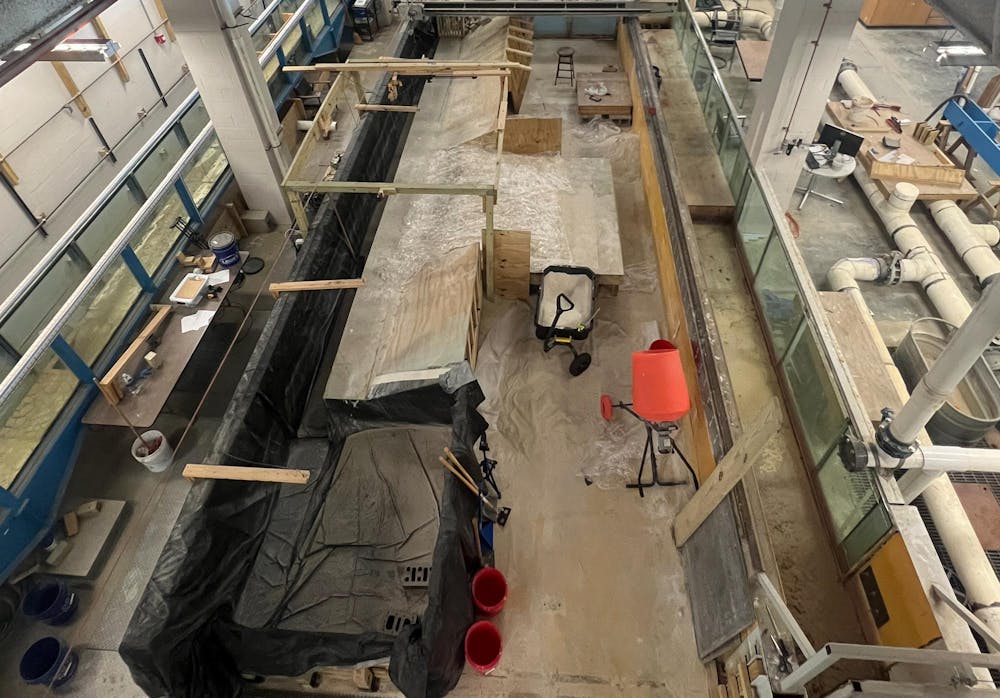
In order to accommodate a changing environment, scientists at USC have begun turning to innovative solutions for environmental challenges.
According to recent research led by USC, there is an effective fix to the increasing damage from flooding due to poor erosion resistance. It may be the same thing you're eating in your bowl of cereal, the dressing on top of your salad or the thickener in your soup: the food additive xanthan gum.
Associate Dean for International Programs and civil engineering professor Hanif Chaudhry led a research team in experiments to find an effective and economical way to prevent erosion. Over four years and $4 million, funded by the US Army Corps of Engineers, the researchers tested biopolymers to see if they could prevent erosion.
"[Biopolymers] help the basic particles in the soil to stick together,” Chaudhry said. “It's just like clay. If you have sand and then you mix it with clay, then it has a little more binding power there. So, that is where it helps in increasing the strength against erosion.”
Engineering professor Jasim Imran worked as one of the senior investigators during the research. While this project began more recently, Imran said the This work resembles the study of floods following Hurricane Katrina in 2007. Both research initiatives focus on preventing damage resulting from the elements, which Imran described as interconnected research.
“You build a model dam and send flow water over that," Imran said. "And if you mix in biopolymer, when you build this dam, it takes much longer to break the dam."
Engineering professor Enrica Viparelli served as one of the co-principal investigators during the research. Viparelli said finding effective solutions for erosion prevention would have a tangible positive impact.
"[Flooding] is dangerous for human lives, economy, infrastructure, zones, everything,” Viparelli said. "This is why finding cost effective and environmentally sustainable ways of maintaining and protecting dams and levees is a traditional problem in engineering .”
The effects of erosion can be felt locally. In 2015 South Carolina was hit with flooding that overwhelmed 50 dams and resulted in 19 fatalities. Imran reflected on the devastating damage that South Carolina faced while also comparing today's impacts.
“What is happening nowadays is that we are having more intense storms,” Imran said. “A lot of rainfall in a very short period of time. When that type of rainfall happens, they just simply overwhelm the drainage structure. You have the ditches, creeks, rivers and also underground drainage. They just cannot handle that much water coming all of a sudden. So, you're seeing more and more fresh flood with lots of damage."
Chaudhry noted that intense storms are an issue community members are hearing about with increasing frequency
"Almost every day, there is lots of rain and that levees got breached and so much area was flooded, so many properties were affected,” Chaudhry said. “Another issue, how many lives were lost and then financial damage can be considerable. From an economic point of view, it's a very attractive acquisition. Another is, if you don't do it, then what are the negatives? That becomes quite clear.”
The biopolymer also acts as a fertilizer, which will promote the growth of vegetation and strong root networks. Vegetation is a key component in preventing erosion, supporting when long durations of flow hit the environment and protecting the structure itself from being uprooted.
Xanthan gum was tested on campus, but partners in the project studied several biopolymers to create more erosion prevention tactics. A consortium of researchers at Virginia Tech, SUNY Stony Brook and the US Army Corps of Engineers came together to compare their most effective biopolymers.
“Try different materials, different biopolymers and see which one is more effective,” Chaudhry said. “I mean, there might be some which will be very effective, but if they are very costly then that is not a practical thing.”
The research team is working to spread the word about their discoveries through publishing papers. Chaudhry said they’ve already presented at national and international conferences, but more opportunities to share findings are in progress. Still Chaudhry said he believes future research is needed to go beyond the immediate effects of the biopolymers.

“I would like to see it applied in the field, as well as look into more of what are the long-term ramifications,” Chaudhry said. “It is effective now when you apply it, but would that effect be there 10 years from now?"
Chaudhry said his role as an engineer tackling critical environmental strains on communities is a never-ending research cycle to ensure a realistic solution.
Through working on the research over the years, Imran said he’s noticed the studies branching into the community so one day the solution might be the difference in safety over disaster.
“When I started the research, my thought process was that we wanted to ask scientific questions and get a solution to those,” Imran said. “There may or may not have a social impact on that, but now as time has passed, we see more and more emphasis on application of our research.
We basically work with communities, we work with agencies, work with cities and we see that our research is being translated into solutions.