
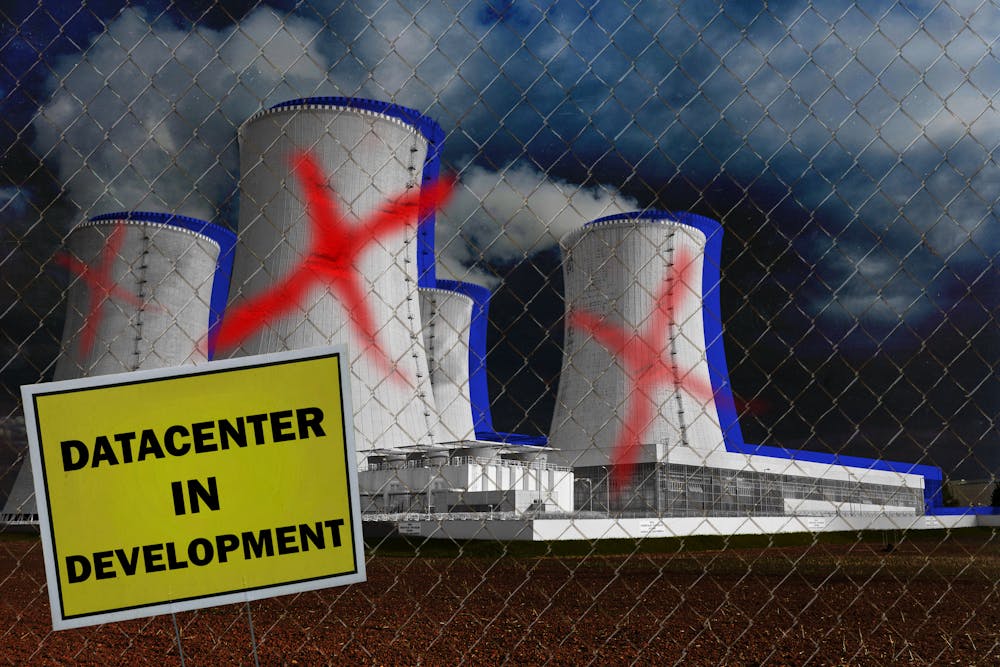
South Carolina’s largest power provider Santee Cooper approved a Memorandum of Understanding with Brookfield Asset Management, taking the next steps in growing nuclear power interest.
Less than 30 miles from Columbia, two unfinished nuclear units in Jenkinsville were set for bidding on Jan. 25, 2025. The search for private investors concluded when the memorandum was announced Dec. 8, 2025. The units are now set to potentially take on a new life as an AI datacenter, according to U.S. News.
“Santee Cooper and South Carolina are at the forefront of a reimagined nuclear landscape in the U.S. that involves more private equity and less risk to ratepayers,” Emily Tyner, a Santee Cooper Representative, said in a Feb. 2 statement.
According to South Carolina Public Radio, the state has the fastest-growing population in the country. With this growth comes a demand for energy. According to the U.S. Energy Information Administration, 60.5% of South Carolina’s energy is already traced back to nuclear production.
“In addition to enabling completion of units that will generate over 2,000 megawatts in reliable, carbon-free electricity here, this deal also puts South Carolina at the front of the nation’s nuclear resurgence,” said Santee Cooper President and CEO Jimmy Staton in a statement Dec. 8.
Nuclear trends
Mechanical engineering director Travis Knight has been with the USC nuclear program since its start in 2004. With a research focus in advanced nuclear fuels, Knight said he views the repurposing of the nuclear units as a positive development to South Carolina’s direction in energy.

“I would say it's good for South Carolina. It's good for our economy,” Knight said.“It's being bought and sold not with the rate-payers, but with other business interests that are willing to come in and finance that, and that's a good thing.”
Knight said about 20% of the country’s electricity generation is produced from nuclear energy. Holding steady over the years, he’s noticed a trend toward incentivizing nuclear power because of its reliability, sustainability and baseload power. The repurposing of the two units is an example of this trend's continuation, Knight said.
“To the extent that folks care about carbon emissions, nuclear power is very attractive because it is the lowest carbon source that's out there, and for sure the lowest carbon in the dispatchable power, that is power that you can put onto the grid,” Knight said.
Tamara Sheldon, an associate professor in the economics department, has a contrasting view of how nuclear energy has been trending. She explained that while nuclear sites are still in practice, an increase in dependence on nuclear energy has not occurred with a lack of new construction.
"To the extent that a utility owns a nuclear plant, it usually makes financial sense to keep generating with it,” Sheldon said. “There hasn't been a lot of action to build new plants.”
Sheldon said a reason for this decline in dependence is due to a combination of factors that have developed over the years.
"Part of why it's become so expensive to build new nuclear plants is because we lack experience,” Sheldon said. “We, as a country, have not been building new nuclear for so many decades now that we've lost expertise, the cutting-edge skills and human capital required to do that.”
While an expensive project to repurpose the two units, Knight said a return is likely to be seen and that the use of private investors, such as Brookfield Asset Management, is a way to avoid risk to ratepayers.
“As you start to build more of them, the time will come down, the cost will come down,” Knight said. “Now you've got all this extra capital flowing in from datacenters to make that possible.”
Fueling the future
Recently datacenters have been a more revolutionized power demand in comparison to the better predicted energy need of supporting a growing population, Knight said. With a rise in AI datacenters in South Carolina as well as nationally, Knight views the repurposing of the nearby two units for this use as a clear choice.
"You don't build just enough power for just those datacenters,” Knight said. “They contribute to the grid. You're providing reliable, safe, clean, affordable, abundant, sustainable power for everybody. I would say, in that sense, everybody wins.”
While USC primarily uses the global energy company Siemens, Santee Cooper supplies electricity for 2 million people across the state.
Santee Cooper claims the two units could bring economic benefits, including the generation of thousands of temporary construction jobs and hundreds of permanent operational jobs. Knight also pointed out the community it takes to support these repurposed plants.
"If you want clean power for datacenters, nuclear is the only place to go,” Knight said. “A large nuclear plant provides 500 to 600 jobs per reactor. Those are good paying jobs. There are a wide range of skill jobs.”
Sheldon said that while the construction may mean an economic benefit for the community, the use of the plants as AI datacenters will not lead to an increase in permanent job opportunities.
"Finishing this nuclear project or building new nuclear, it could temporarily lead to more employment in construction, but once these plants are built, they don't employ a lot of people, nor does a datacenter,” Sheldon said. “If we go in the direction of, 'Let's build nuclear, so we can service datacenters,’ that can help boost the economy, but it won't lead to a big increase in jobs for the state.”
For nuclear energy to be part of South Carolina’s future, Knight said education is a key component to its success.
"I would say we have a lot of homegrown talent,” Knight said. “In absolute numbers, we have the most nuclear operators, we have the most nuclear technicians, we're number four in nuclear engineers. A lot of talent is right here in our state. As you grow, you've got to bring more in. We can grow some of that naturally through institutions like USC, technical colleges and so on.”