
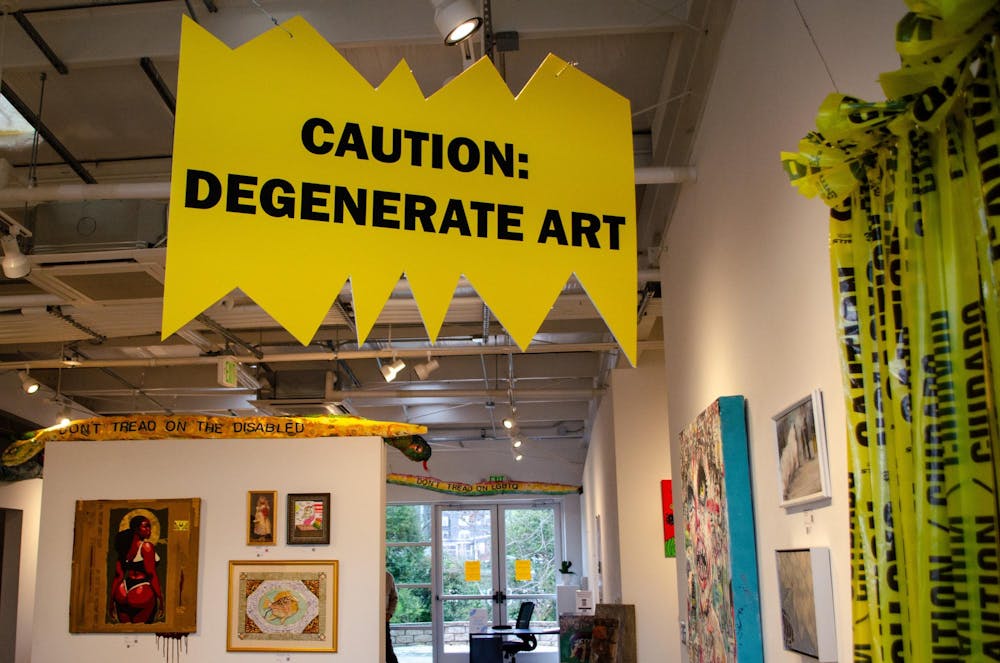
In 1937, the Nazi regime opened the infamous Degenerate Art exhibition in Munich, showcasing modern works they deemed dangerous alongside graffiti and mocking text labels. Its goal was to ridicule the art and artists that did not align with its beliefs.
Nearly 90 years later, artists in Columbia are making connections to this history. Executive director of a nonprofit art facilitator called the Jasper Project, Bekah Rice, said that the original Degenerate Art Project inspired the Jasper Project to put on a similar exhibit.
“Right now, there is a lot of censorship going on,” Rice said.
Many of the artists in this exhibit did not have a place that would show work about the subject depicted in their art, Rice said.
The Jasper Project of Columbia is hosting this art exhibition inspired by the 1937 Degenerate Art Exhibition in Munich for the second time. It takes place from Feb. 11-28 at Stormwater Studios, offering local artists a platform to express their views on controversial topics relevant to current times.
“With everything that's going on in the world, it'd be really great to create an opportunity for artists to speak out, to get to express themselves,” Rice said.
Not every piece in “Degenerate II” is overtly political, Rice said. They also cover topics like paying homage to culture.
“We wanted to create a space where they wouldn't be censored, they could fully express their vision,” she said.
The Jasper Project team built the exhibit to truly reflect the Midlands community itself. Rice said the previous Degenerate Art Project of Columbia in 2025 was an invitation-only exhibit for artists that the Jasper Project already knew. She said they felt the exhibition went well, so they decided to put together this 2026 version.
To select the pieces it would use in the exhibit, the Jasper Project put out an open call for artists in the Midlands. A committee of board members selected the artists it would feature.
“Our goal with that was to include as many voices as possible so that it was a true reflection of our community here in the Midlands, that it was very diverse," Rice said. "I feel like we did that.”
Alongside the artwork, Stormwater Studios hosted an activism resource fair on February 21st, connecting attendees with local organizations. Among them was Palmetto Luna Arts, a Latino arts nonprofit led by artist and director Ivan Segura.
Segura both participated as an artist and represented his organization at a booth. His piece, “Untitled,” was multifaceted.
“In the end, I was trying to create a piece that would show the power of my community and pay homage to my background and my culture, but at the same time facing face-forward the issue that we have right now,” Segura said.
For Segura, the exhibition represents an opportunity to work with people who feel the same way to bring those issues to the bigger community.
“You don't have to be an elected official to have a voice in the decision-making process,” he said. “You don't have to be a good speaker to let your voice be heard, but you have to speak up. You have to speak up.”
These events give people an opportunity to feel like they're contributing and a part of something bigger, Segura said.
That sense of community resonated with visitors as well. Bronwyn Hartman, a Columbia resident who discovered the exhibit through social media, described the atmosphere as inspiring.
“It's pretty cool to see a bunch of people come together like this, especially in these times,” Hartman said.
Emma Connell, representing the Modjeska Simkins School at the resource fair, spoke about the challenges queer residents face with finding community and places to gather locally.
“I am a queer person who lives in Columbia, South Carolina,” she said. “And I personally often find myself scared, not always for physical safety, but sometimes, yes, it's very difficult to actually organize and find even third spaces for queer people in Columbia, just to find each other and hang out and try to network,” Connell said.
Being present in spaces that allow groups to congregate is the building of community, and it was very meaningful to see people having these conversations, Connell said.
“It is a good opportunity to push back against those feelings of erasure,” Connell said.