
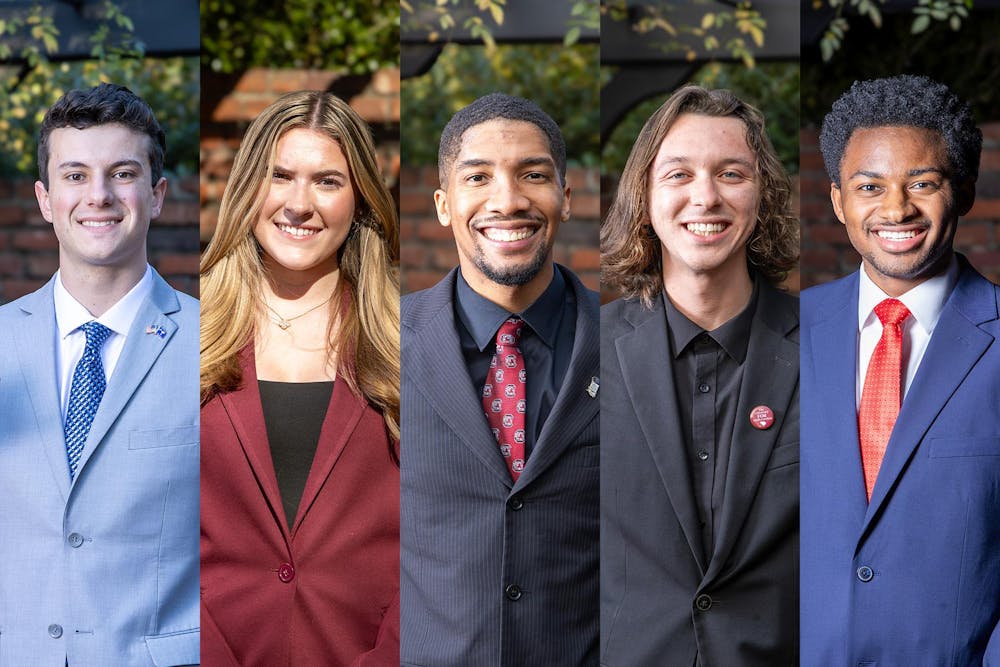
There are five presidential candidates in the 2026 Student Government election, and all of them have had prior experience working in Student Government. Voting will open online on Feb. 24 at 9 a.m. and close on Feb. 25 at 5 p.m.
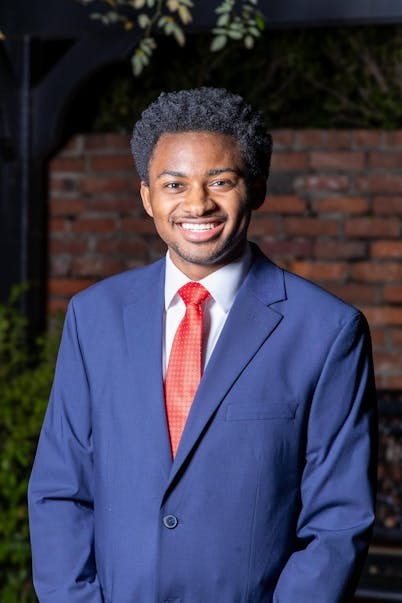
Jordan Cooper, third-year political science student
Jordan Cooper has served in Student Government as a member of the philanthropy committee and is currently the secretary of student services in the president’s cabinet.
Cooper’s campaign is focused on addressing issues with parking, the Cockpit app for sporting events and Greek life on campus.
“It’s not simple points or simple phrases according to each issue (students) have,” Cooper said. “These are things that will actually get their attention.”
Cooper said he feels the Cockpit app is a big issue for all students and wants to increase the percentage of points that roll over each year from 10% to 25%. He also said to get students more involved in Student Government elections, he wants to offer Cockpit points for students who vote.
According to Cooper, Greek life is underrepresented even though recruitment is significantly increasing each year, and he wants to make sure it is highlighted.
Cooper said he believes what makes a good president is focusing on issues that others can continue to fix after he has left.
The goals that Cooper’s campaign are focused on are issues that can always be addressed and can always be improved to help students, according to Cooper.
“I’m a student too,” Cooper said. “I have things at the university that I want to increase or make better.”
Cooper is running for president alongside vice presidential candidate Grant Hunter.
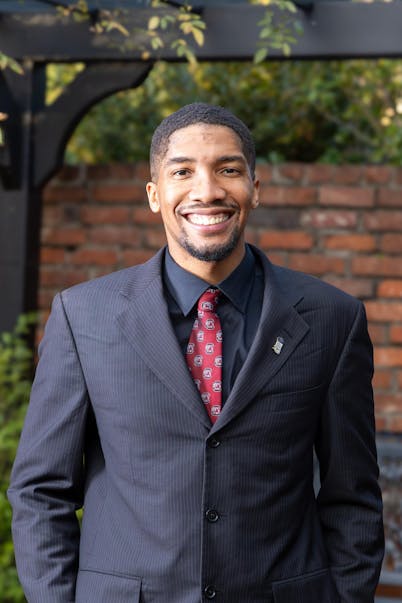
Bradley Gittens, fourth-year theatre student
Bradley Gittens got involved with Student Government for the first time in 2025. He campaigned for student body president in the last election alongside Courtney Tkacs and David Henao.
Gittens said his main campaign goal is uplifting student voices, specifically by bringing more diversity to Student Government.
“I really want to make sure the power comes from the people 'beneath’ me,” Gittens said.
According to Gittens, he feels a lot of students aren’t really invested in Student Government, but he wants students to get engaged, as it passes legislation that directly affects them.
Gittens said he wants to get new people who haven’t been previously involved with Student Government to join, along with those who might start off in Freshman Council.
According to Gittens, he doesn’t realistically see himself as winning the
presidential election but wants others to look to his campaign in the future when they consider running.
“I want to at least be an inspiration for people that maybe don’t believe that they have it in them,” Gittens said. “I want to kind of be a ‘martyr.’”
According to Gittens, he wants the student body to choose who it wants the president to be, and he wouldn’t want to be voted in based on popularity.
“I just want to know people on a personal level. I want to know each and all of their experiences,” Gittens said. “To me, student voices aren’t just a number.”
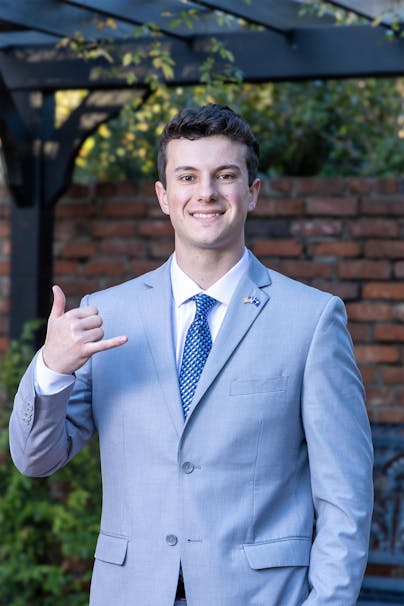
Cole Rotondo, third-year risk management and insurance student
Cole Rotondo has been involved with Student Government as historian and now chief of staff to the student body president. Rotondo wrote the President’s Transition Manual, which will be used by Student Body President Courtney Tkacs.
Rotondo has focused his campaign on the three pillars of safety, infrastructure and student experience.
“We think that those key areas are things that the university can get done now so that more tenable change can happen in the future,” Rotondo said.
Some initiatives Rotondo is looking to establish under these pillars include establishing an automated external defibrillator policy on campus, adding lights around campus, addressing parking concerns, and creating a syllabi database.
According to Rotondo, these initiatives come from looking at already-established research and collaborating with organizations such as the Residence Hall Association.
“I might not have all the answers to everything,” Rotondo said. “Student Government might not have all the answers, but partnering with the people who
do gets us the best result possible.”
Rotondo said his leadership philosophy is understanding the fact that it’s not about the president or the vice president, but all the people behind the scenes who contribute.
According to Rotondo, he wants to be a president who shows up for students and their needs.
“Meeting students where they’re at is so important because, when you do, it’s like, ‘Oh, here’s Student Government. Let me express my concerns,’ instead of them having to fit their schedule around us,” Rotondo said.
A president can’t get everything done in a single year, according to Rotondo, and he wants to keep the momentum going for the next president to build from.
Rotondo is running for president alongside vice presidential candidate Myron Harris.
Emma Strickland, third-year neuroscience student
Emma Strickland has served in Student Government within Freshman Council as assistant director of programming and deputy chief of staff to the vice president. She currently serves as chief of staff to the vice president.
Strickland is focusing her campaign on the three pillars of infrastructure, support and innovation.
According to Strickland, she wants to use these pillars to enact initiatives such as continuing the Russell House expansion plan, updating the transit system, establishing alumni connections and creating a multi-purpose USC app.
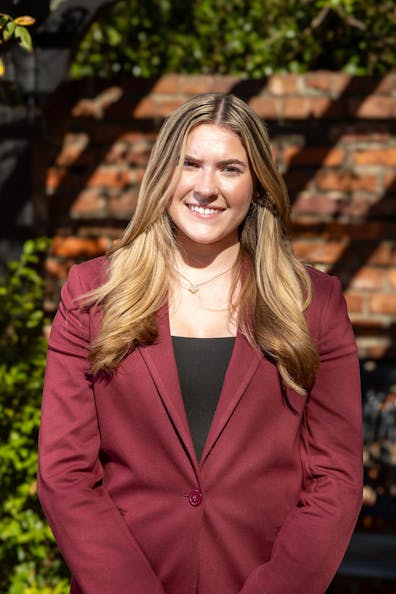
“A lot of what we’re looking at are things that are kind of in the works,” Strickland said. “We have some new ideas too, but these are things that are being talked about on the administration level, on the board of trustees level, so they just need that extra push, and it needs to be continued.”
Strickland said she is involved in more than just Student Government and wants to use her wide range of involvement to connect with as many students as possible.
“We are able to represent every type of student across campus,” Strickland said. “If I can’t relate to you maybe directly, I probably have some connection to what you’re involved in.”
Strickland said she believes it’s the little things that make someone a successful president and feels that smaller achievements are important as well as larger ones.
“Just knowing that I could even make one student’s experience better here at Carolina would be a success for me,” Strickland said.
According to Strickland, the most important thing students should know is how passionate she is about this election and becoming president.
“This is truly one of the biggest things I have cared about, and I see so much potential for the future of this university,” Strickland said.
Strickland is running for president alongside treasurer candidate Ashley Reynolds.
Jacob Whisenant, doctoral mechanical engineering student
Jacob Whisenant was involved in Student Government as a member of the student senate before he was removed from the senate in September on the article of "hindering efficient progress."
Whisenant said his main campaign goals are to stop Student Government from increasing fees, reinstate support for student organizations, and dismantle the partial funding system for student organizations.
According to Whisenant, he is running as a non-Student Government platform, and he is prioritizing ideas from the students.
Whisenant said that students have concerns about events they want to hold on campus and college becoming more expensive, which are issues he would focus on.
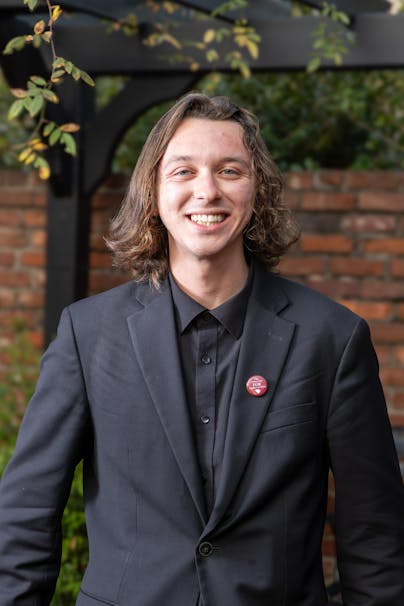
“We need to show students that (Student Government is) willing to work for them,” Whisenant said.
According to Whisenant, if he were elected as president, he would not be accepting the presidential stipend and instead would give those funds to students in need and food pantries.
Whisenant said he wants Student Government to be more transparent and more open with the student body about how it operates and would work to facilitate that as president.
According to Whisenant, he believes the current Student Government is dysfunctional and unorganized and isn't accurately utilizing the student activity fee meant for student organizations.
"I don't think it is a funding problem," Whisenant said. "I think it is an accountability and an allocation problem."
Whisenant said he believes Student Government is creating more problems for students than it's solving and wants to address that as president.
“As the president, I will be a problem-solver,” Whisenant said.
Editor's note: Jack Bradshaw, John Davis and Katherine Naronis contributed to the reporting in this article.