
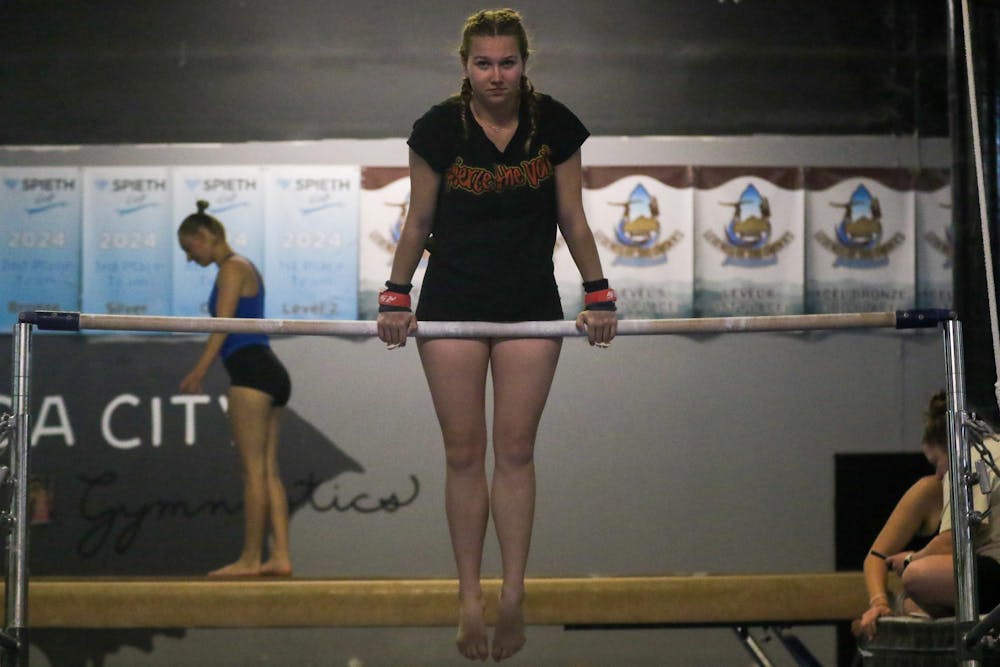
Club sports often give students a chance to stay active while building friendships, and for many University of South Carolina students, club gymnastics offers exactly that: a place where competition exists alongside community, personal growth and fun.
Club gymnastics allows students to practice and compete without the intensity of NCAA athletics. Members train together throughout the year and travel to meets during the spring competition season, including a national championship event.
For many students, like first-year elementary education and history student Luke Beauchamp, the club is a way to continue a sport they grew up loving, while adjusting to college life.
“I knew that I wanted to do gymnastics in college, but then I tore my ACL, so that kind of went out the door,” Beauchamp said. “Whenever I saw that we had a club gymnastics team, I thought it was the perfect opportunity for me to go back to gymnastics.”
Like Beauchamp, first-year pre-nursing student Breanna Hawkins had spent most of her life involved in the sport and was searching for a way to continue it when she arrived on campus.
“I’ve done gymnastics basically my whole life,” Hawkins said. “My teammates have become family to me, and my coaches have been like my mom and dad. They've been always there for me. When I came to college from Long Island, I wanted that same sense of community.”
Hawkins discovered the club through its Instagram page after searching for gymnastics opportunities on campus. Although both students had years of experience in the sport, they found that the environment within club gymnastics differs from the more competitive programs they grew up with.
Club gymnastics offers a more relaxed and laid-back atmosphere focused on having fun. The supportive environment is one of the club's defining features, and Beauchamp experiences that sense of encouragement every day.
“Our team is very upbringing” Beauchamp said. “Everyone wants everyone to do good. It’s not even like a competition at this point. Everyone just wants everyone to succeed and have fun.”
Much of that community develops through the club’s travel competitions, where teammates spend long weekends together on the road. Sofia Bacha, third-year computer science student and the club’s travel meet chair, coordinates the logistics of those trips. She said careful planning is necessary to ensure competitions are worthwhile for members.
“A lot of our meets are heavily budget-based,” Bacha said. “We want to make sure that if we’re going to a meet, it’s within the budget and worth going to.”
Club funding and membership dues help cover registration fees, transportation and hotels. Because of these limitations, Bacha said the team prioritizes competitions that provide both a strong experience and reasonable costs.
While the team competes during the spring season, preparing for the club’s biggest event, nationals, requires the most planning.
“It’s a three-or four-day competition, so we really have to make sure it's planned around class schedules ... and make sure everyone who signed up is made aware we’re missing school for that,” Bacha said. “We start planning for it when December starts.”

The club’s growth in recent years has also brought new challenges and opportunities for its leadership. Club president and fourth-year accounting student Sonali Desai has been involved with the organization since her freshman year and previously served as treasurer before stepping into her current role.
Desai said the club has expanded significantly during her time on the team. She noted that what started as a a small group has grown into a more active and visible organization on campus.
“When I started on the team, it was like three of us going to meets,” Desai said. “Now we’re bringing like 30 girls.”
As the club has grown, Desai has had to adapt quickly and increasingly rely on her chair members, learning to emphasize teamwork and delegation.
With more members to manage, leadership now divides responsibilities to keep the club running smoothly while also prioritizing a welcoming environment for athletes of all skill levels. Unlike highly competitive programs, the club encourages members to try new events and participate at their own pace.
“We always say, 'If you don’t have experience, that’s fine,'” Desai said. “And I feel like because we make that a forefront of our program... it makes it very easy to encourage others.”
For Desai, the friendships formed through the club stand out as her most meaningful takeaway. Beyond practices and competitions, the team has created a strong sense of community that extends into everyday life, helping members feel connected both inside and outside the gym.
“I’m an out-of-state student, so I knew making friends was going to be a little bit difficult,” Desai said. “Club gymnastics has helped me so much with making new friends ... and having a support system of people I hope to stay friends with for years after graduation.”
Members say that supportive environment keeps them coming back to the gym each week. Rather than feeling pressured by intense competition, athletes describe practices as a space where they can relax, connect with teammates and enjoy the sport. Hawkins said that sense of positivity is evident from the moment they walk into the gym.
“You go to practice every day, and everyone's always smiling, and you're talking to everyone,” Hawkins said. “And it's a good environment.”