
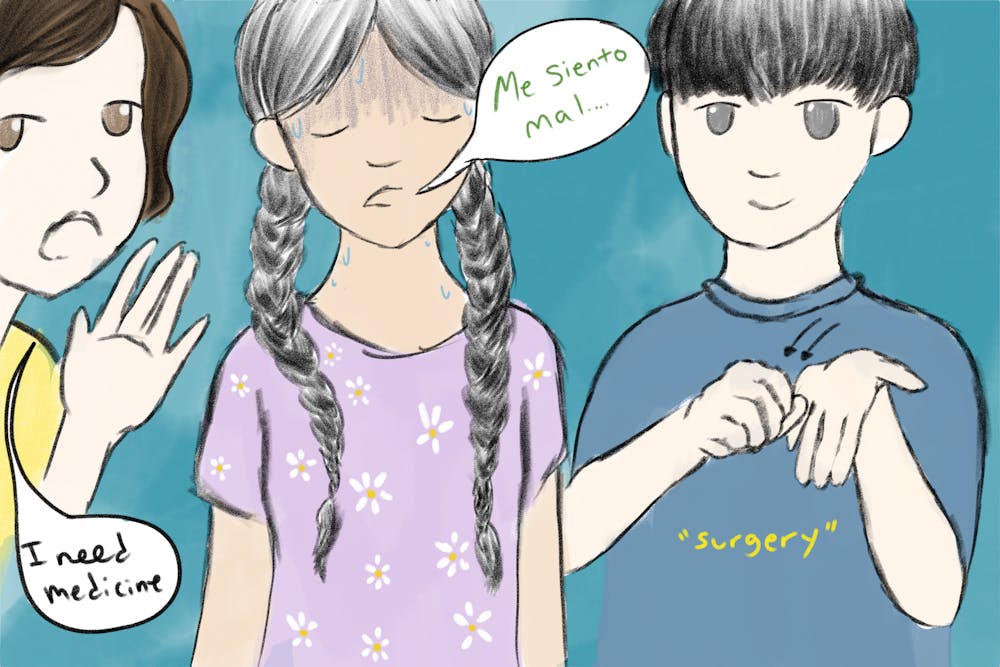
When fourth-year nursing student Reagan Warnecke started her clinical hours, she quickly recognized a problem: non-English speaking patients didn’t receive the same care as English speakers.
The majority of health-care providers could not communicate with this demographic of patients, and hospital translators were few and far between.
“Worldwide, they’re waiting for interpreters,” Warnecke said. “They have to wait hours for interpreters.”
The discrepancy spurred Warnecke, alongside third-year nursing student Ava Jacob, to create the Nursing Language & Communication Society, or NLCS, in fall 2025.
NLCS teaches students medical phrases in common non-English languages to promote health care equity and enable students to care for diverse populations. It focuses on Spanish and American Sign Language, though Jacob says the core languages are always subject to change.
At the monthly meetings, members participate in interactive meetings and games. At their March 24 meeting, students competed in team "Jeopardy!" The categories were Spanish to English, Spanish communication, ASL communication skills, cultural competency and ASL basics.
The game posed questions such as “How do you say: ‘I’m going to check your blood pressure' in Spanish?" and “How many deaf people are born to hearing parents?”
On Feb. 24, NLCS hosted a medical sign language interpreter who showed members common terms in ASL, such as "help" and "doctor." NLCS member and first-year nursing student Jacob Schwartz said the health care-specific terms were useful.
“When you first start learning a foreign language, it tends to be a lot of conversational stuff,” Schwartz said. “Having someone talk about the stuff that I would use on a daily basis, especially in the health care field, was very interesting.”
Master's Entry to Practice Nursing student Andi Chaver joined NLCS because she saw the impact of poor communication firsthand. Chaver is a native Spanish speaker and grew up in a predominantly Hispanic community.
“Growing up, I saw my family — some of them struggled communicating with their doctors or trusting their health care providers and establishing that connection and rapport," Chaver said.
Chaver said she has seen the delay in care that results from waiting for a translator. At her workplace, one deaf patient who used ASL faced barriers when communicating with health care providers.
“Seeing that firsthand is really eye-opening, because I can’t imagine how scary it can be for someone to not understand,” Chaver said.
The same patient’s eyes lit up when her nurses learned a few ASL words and phrases for her. Chaver said it's important for patients to see their health care professionals making an effort to communicate.
Legal regulations prevent the use of online translation tools or family members — providers must pass a test through their hospital to be certified. Speaking multiple languages can lead to higher pay and make securing a job easier, Jacob and Warnecke said.
USC’s nursing program divides students into upper and lower divisions. In their third semester, lower division students apply for admission into upper division; over the past three years, the program admitted between 270 and 300 applicants per admission cycle.
Jacob said a benefit of NLCS is that students in upper division, lower division and master’s students can connect with each other. Lower-division students can ask for advice on professors and classes from more experienced students.
“I want them to feel comfortable to text me at 11 p.m., and just be like, ‘Hey Ava, I really need help,’” Jacob said.
NLCS is collecting teddy bears and toy donations for Prisma Health Children’s Hospital this semester. The club is planning to host a teddy bear clinic at a local, predominantly Hispanic elementary school in the next academic year.
Elementary students will bring in stuffed toys, and NLCS members will perform "check-ups" on the toys in Spanish. The event will allow club members to implement the terms they have learned and increase the children’s comfort level with medical supplies.
NLCS is the first club of its kind at USC, and there is no similar national college organization, Warnecke said. Both founders hope NLCS will eventually spread to other universities to continue fulfilling its mission.
“Our biggest goal one day, a couple years down the road, is to come back here and see this club still going,” Jacob said.