
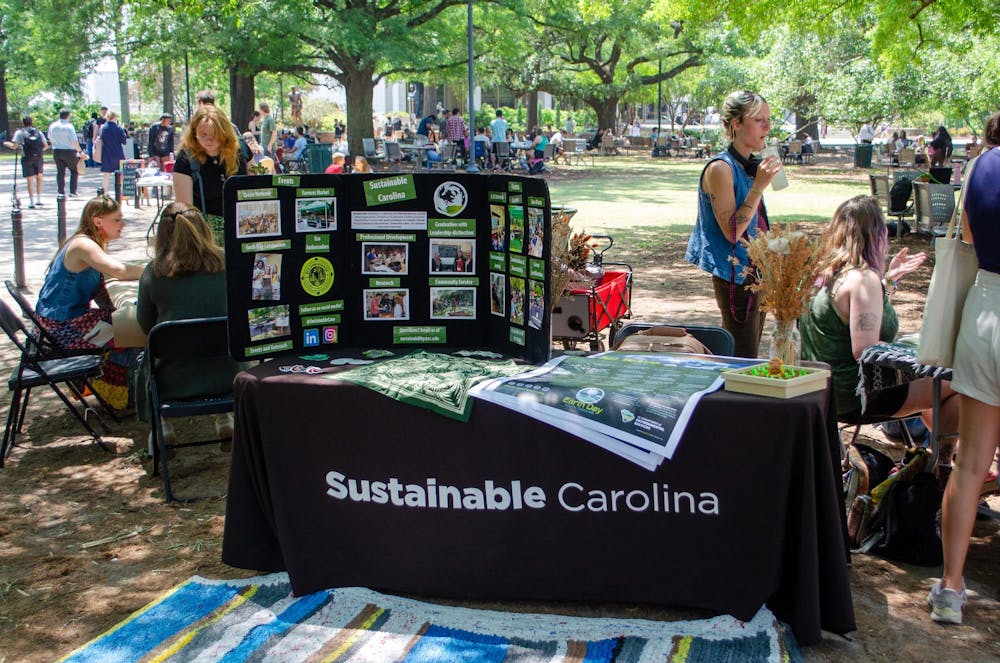
What may appear like a normal Wednesday afternoon for some was a celebration for others as Sustainable Carolina hosted its annual Earth Day event on April 22.
Students gathered around tables on Davis Field to learn about environmental mindsets and advocacy in this year's continuing Earth Day tradition. Kate Briggs, a third-year geography student and project coordinator for the Sustainable Carolina’s Food Recovery Network, said she hopes the event was able to spark appreciation for the natural world.
"We're all aligned towards the same mission, but we're doing different things,” Briggs said. “Every year, we grow a little bit more. I’ve been a part of (Sustainable Carolina) for three years, so seeing us having this many tables this year is very cool.”
Emilia Keesey, a fourth-year global studies student and project coordinator for Sustainable Carolina’s conservation and stewardship team, said to really embrace the meaning of the celebration students should keep Earth Day's core themes in mind every day.
"This is really just a way to celebrate what it means to give back to the Earth and recognize what it does for us," Keesey said. "We're trying to inspire that appreciation for not just April 22, but year-round.”
Impact beyond campus
Xuefeng "Nick" Peng, has taken USC’s sustainability initiatives beyond campus during his fourth year of partnership with Riverbanks Zoo and Garden's ZooTeen program. It’s through this initiative that Peng engages future potential scientists in the research field, as well as the rest of the community.
“USC is in a very special position because we are the flagship university of the state,” Peng said. “We have a mission to educate the people of South Carolina. This is who we are.”
Recently, Peng took ZooTeens to the Belle W. Baruch Institute for Marine and Coastal Sciences, a national estuarine research reserve that is home to several universities including USC. Within the timeframe of the program, Peng said he’s seen firsthand the impact it’s created on the community.
"I think many of (the students) realize that (sustainability) is something that is actually tangible,” Peng said. “We had, in most years, let them play with the crabs on the marsh, and they had a lot of fun. They can see marine science in their hands.”
Peng said dispersing research findings to the public is essential for the future of sustainability. Through the ZooTeens program, Peng and students table twice a year to showcase newest research findings, including one near Earth Day. These events help connect the public to better understand the work behind sustainability, Peng said.
“There are, at this time of the year, over 10,000 visitors per day at the zoo,” Peng said. “We typically can reach at least 5% of them, so over 500. We distribute these pamphlets that we have prepared ahead of time ...These are important concepts to introduce to the public so they will be more environmentally conscious.”
Continuing USC’s branch into the community, doctoral marine science student Archana Venkatachari works with WaterWatch, a program that partnered with USC and began in 2008 to monitor the water quality in Lake Wateree. The location was originally targeted for its historic blooms in cyanobacteria, an algae that can become harmful and toxic to the environment due to fertilizer runoff.
“We all go to the doctor regularly,” Venkatachari said. “We visit the dentist once every six months. As you get older, you have to start having more routine checkups or if you're sick. Unfortunately, Lake Wateree is both old and sick. This monitoring really helps keep tabs of how things are changing."
Through this initiative, Venkatachari has worked closely with Lake Wateree’s surrounding community, often using their docks as entryways to collect data. Venkatachari said she’s received support from community members, some opening their perspectives in the process of wanting to learn from her about their own backyards.
“Awareness is usually the first step to any change,” Venkatachari said. ”Maybe somebody isn't fertilizing their lawns now because they know that's causing the lake to have more of the cyanobacteria. I can't say that it was a directly sustainability-oriented initiative, but awareness, education and exposure is usually fundamental in everything for change overall.”
Celebrating sustainability
Earth Day began 56 years ago in 1970 as a response to the public wanting to have a voice against environmental issues of the time. This same desire to come together to be stewards of the environment is a motive Keesey said is at the core of Earth Day’s purpose.
“Those small things really do add up,” Keesey said. “I think people get discouraged when they think of themselves as one individual, that they don't have a lot of power over what happens in terms of resource use. Just staying more aware of how the long-term effects of individual actions can really start to make some small but really meaningful changes in people's lives."
Along with the seven teams that are part of Sustainable Carolina, other organizations such as Cocky’s Cleanup Crew showcased how they too have embraced sustainability. While representing the organization at the event, first-year advertising student Piper Koury said a powerful message is created when a variety of people come together to celebrate on Earth Day.
"Earth Day isn't just for people who celebrate sustainable advocacy,” Koury said. “It's for everyone to come in and participate. Whether it's helping do something like plant a tree or just learning about how you can help protect the Earth. Knowledge is power, so coming together really helps protect the Earth.”
While the fate of the environment may seem daunting at times, Peng said it’s important to understand every action has the potential to create a huge impact.
“Everybody's different,” Peng said. “Everybody has their own strength. We can all contribute in different ways based on our own strengths.”
Keesey said Earth Day is about everyday people caring about everyday actions. Without this stewardship from the community, the environment and the scientists hard at work behind the research will be in vain, Keesey said.
"(Earth Day) is about coming together for a greater purpose,” Keesey said. “Earth Day symbolizes collective action, showing up and really making a moment out of what it means to stand up for the planet.”