
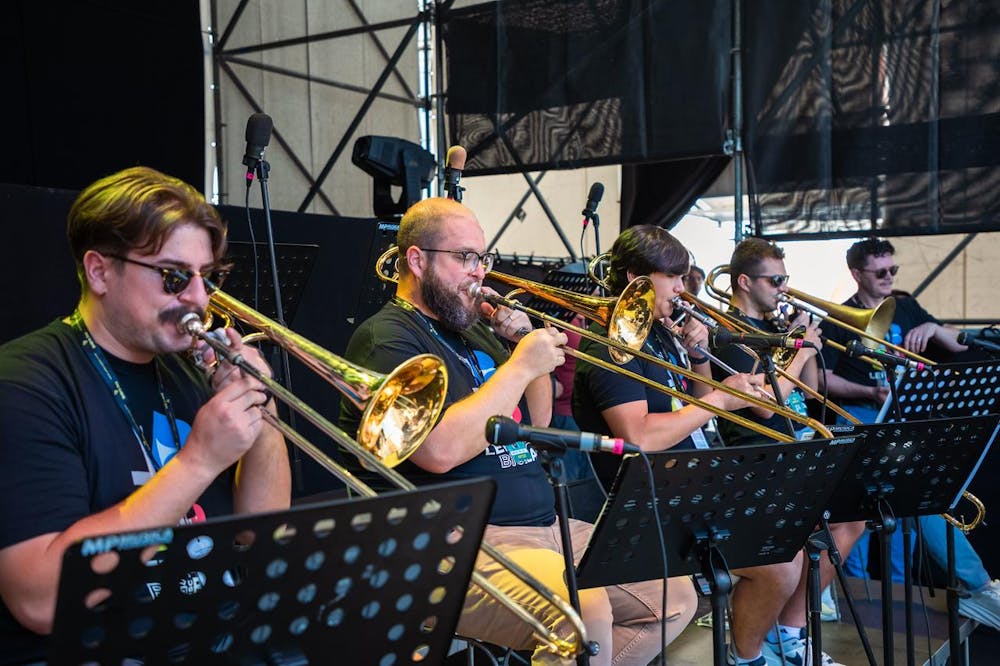
From academics to friendships, music is an essential part of Josh Anderson’s life. His deep involvement in USC’s jazz community has been a defining part of his college experience.
“It gave me my guiding post of what exactly I need to do in order to make music my career,” Anderson said. “It gave me my purpose.”
Along with running Jazz Jaam, a weekly gathering of student musicians, the third-year jazz studies student plays drums for the Left Bank Big Band, a jazz ensemble made up of USC students that earn spots through an audition. This weekend, Anderson and his bandmates will travel to New York City and represent USC at the 2026 National Collegiate Jazz Championship, hosted by Jazz at Lincoln Center Orchestra in from Jan. 17-18.
The event, which is in its fifth year, invites 10 schools from around the country, with a top prize of $10,000 in scholarship funding. USC will be making its first appearance.
USC professor Matthew White, who serves as director of jazz studies and the university’s Center for Southern African-American music, directs the Left Bank Big Band. The ensemble toured Europe this past summer, followed by its second annual appearance at the Savannah Jazz festival in September.
Among the most skilled jazz performers at USC, White said his students’ passion for the music and for one another is what makes them truly stand out.
“That sense of community, that sense that they want to support each other and really do great and lift each other up,” White said. “That’s really been the thing that’s been amazing about leading this band.”
At the championship, the competing big bands will perform three compositions, with one coming from the Lincoln Center’s extensive Duke Ellington collection and the second from the general library. The band’s third composition will be an original work written by USC graduate assistant and band member Nick Kervin, who plays the trumpet.
Anderson said he was excited to play Kervin’s piece, praising its propulsive nature.
“It’s a very intense piece, but it’s a lot of fun,” Anderson said. “I love it.”
USC jazz studies associate professor Colleen Clark will also be making the trip to New York with her students. Clark oversees both the Swing Shift Big Band, a second ensemble that often feeds into the Left Bank Big Band, and the department’s jazz combo program. She also founded Jazz Girl’s Day, a free yearly event where middle and high school girls are invited to learn about jazz.
Jazz combos bring together smaller groups of students than the full ensembles, with the Clark Combo set to compete at the championship. Clark’s small group created a unique medley of John Coltrane compositions for its performance.
Clark said her passion for sharing and teaching jazz stems from what’s it’s given back to her.
“I was always pretty infatuated with the sound of jazz and the force and power that the drum set had in the jazz ensemble, and so I was always really affected by that,” Clark said. “Living those experiences and playing in all the major clubs and stages and whatnot, I always knew that I wanted to continue to be able to share the knowledge that was provided to me by my mentor.”
White said there’s no objective set of metrics provided to find success in the competition. He said becoming too focused on hitting benchmarks would miss the point of the individuality and creativity that makes jazz special.
“One of the things you can fall into is kind of chasing what you think the judges want to hear rather than just, you know, trying to make music,” White said. “I’ll just tell them to play pretty and have a great time.”
Clark said the key to having an effect on a judge is making them feel the same level of inspiration as a performer.
“At the end of the day, it’s like, 'Is it swinging?'” Clark said. “'Is this really grooving in such a way that anybody in the audience can feel that?' And that’s the whole point of jazz music.”
Anderson identified another key factor that can help set a band apart from the pack.
“Confidence,” Anderson said. “How we perform and how we present ourselves will be pretty big.”
Clark said she hopes the opportunities and discoveries the trip will offer have a lasting impact on her students.
“Maybe it’s when they just have that moment of walking onto the stage and looking out at the judges, maybe it’s the new friends they’re going to make when they meet other cats from other programs, maybe it’s a type of food they’ve never had,” Clark said. “Being somewhere new in an environment where everyone loves the same thing, which is jazz.”
Anderson said he believes going to New York is only the latest accomplishment for the USC jazz department, and that he’s proud to be a part of its rise.
“We are kind of the spearhead of the growth of the program,” Anderson said. “When I first got here it was not what it was today, and I think it’ll be even better tomorrow.”
More information on USC jazz and the National Collegiate Jazz Championship can be found on their respective websites.