
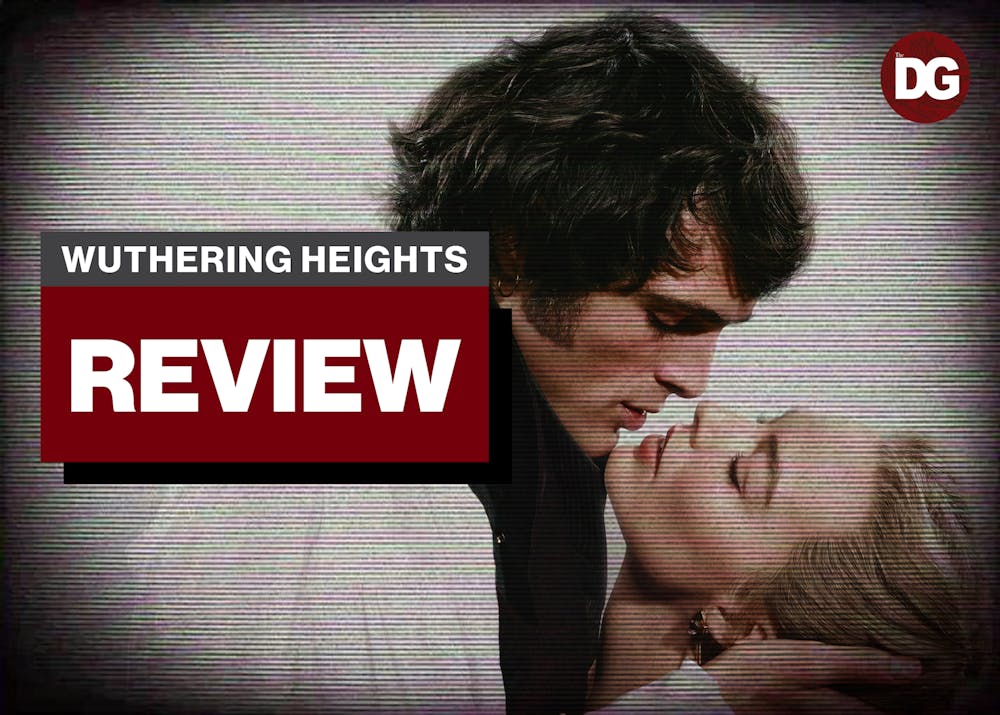
Movie: “Wuthering Heights”
Release Date: Feb. 13, 2026
Director: Emerald Fennell
Runtime: 2 hours, 16 minutes
Genre: Romance, tragedy
Rating: B

When watching "Wuthering Heights," the first word that comes to mind is "excess."
Based on the Emily Brontë novel of the same name, the film follows the all-consuming (and sometimes terrifying) love between the two protagonists: Catherine Earnshaw (Margot Robbie) and Heathcliff (Jacob Elordi).
The pair grew up together under the tumultuous influence of Catherine's father, Mr. Earnshaw (Martin Clunes). Eventually they fall in love with each other, but Catherine's decision to marry her rich neighbor Edgar Linton (Shazad Latif) spikes tension between them.
The decision drives Heathcliff away from her. When they are reunited years later, their feelings for each other become a destructive force that snowballs into disaster.
The overall theme seems to be quite simple: Humanity is monstrous. And nothing is more monstrous than the love depicted between Catherine and Heathcliff. Love is pain. Love is violence. Love can be deadly.
The violent nature of love manifests physically in the scars on Heathcliff’s back from all the beatings he’s taken to keep Catherine from harm and the gruesome sickness that overcomes her towards the end of the film.
Elordi and Robbie are excellent in their roles. The characters are raw and compelling, even if the parts they play are two-dimensional. Understandingly unable to capture the nuance of the book, Fennell seems to rely on shock value to create an impact.
From the first scene, you can tell what this movie is going to be: dramatic. An enthusiastic crowd is depicted in full-on hedonistic revelry as they watch a man hang. The celebration is shot in slow motion against the backdrop of foreboding music off-putting each joyful expression.
The music is intense, the lighting is severe, and most of the characters are insane. As an example, Catherine’s sister-in-law, Isabella Linton (Alison Oliver), steals Catherine’s hair over a long period of time to make her a doll, which she later gruesomely butchers in a rage.
Mr. Earnshaw is especially monstrous. Viewers watch this erratic, well-meaning but foul-tempered man devolve into a pitiful, disgusting creature as he gambles his money away and physically rots within his dilapidated home.
The set design is as dramatic as the characters: Mr. Earnshaw's drunkenness and lack of control manifest in the form of floor-to-ceiling bottles lining the interior of his parlor. The Lintons’ lavish and gross wealth are portrayed through enormous jewels, an entire room of ribbons and Catherine’s own room — designed to match a freckle on her cheek.
This kind of hyperbole seems intended to make watchers gasp or giggle in disbelief, but sometimes goes so far leaving viewers cringing.
While well-played by the cast, each character feels lacking. Mr. Earnshaw's monstrosity is baseless, Heathcliff’s devotion to Catherine’s petulance is exasperating and Isabella’s creepiness is just creepy.
The villain, in some senses of the story is Catherine’s servant Nelly Dean (Hong Chau). In the book, Dean is a narrator, but in the film, she plays a small but important role with a few pivotal moments, in which she hides Catherine’s and Heathcliff’s devotion from each other, seemingly out of jealousy.
By the end of the movie, Nelly is pretty irredeemable. Her involvement in the tragedy of Catherine's life is undeniable, but she does not deserve to be constantly blamed for the estrangement between the two lovers.
Like the rest of the cast, her role is not poorly played. It is just not developed.
The film’s pure shock value lies in its horrific depictions of love, violence and indulgence, which seems to be the main point. The costumes, the gore, the setting and the score seem specifically tailored to heighten your pulse, failing to add substance to the narrative.
It is impossible for a film to perfectly match the novel it was based off of and please everyone. While some viewers may have gotten exactly what they wanted from the film’s dramatic, romanticized depiction of the book, other viewers may wish Fennell had spent more time analyzing its characters.